mirror of
https://github.com/codestable/CodeStable.git
synced 2026-09-19 09:03:09 +08:00
 liuzhengdong
a93053864e
liuzhengdong
a93053864e
- Added Vision Spec to capture the overarching application vision, allowing users to articulate their desired outcomes and candidate directions.
- Updated Talk mode to facilitate discussions around the Vision, enabling users to clarify and refine their product ideas without immediate pressure to implement.
- Enhanced templates for issues and epics to reference Vision, ensuring alignment between current development and long-term goals.
- Implemented a new directory structure for Vision-related documents, including vision-index and vision-section-index templates.
- Revised existing documentation to reflect the separation of Vision from Project Spec, emphasizing the importance of maintaining distinct boundaries between desired outcomes and current realities.
- Introduced guidelines for using Vision to support user journeys and product capabilities, allowing for a more structured approach to product development.
322 lines
21 KiB
Markdown
322 lines
21 KiB
Markdown
<div align="center">
|
|
|
|
# CodeStable
|
|
|
|

|
|
|
|
**English** · [中文](./README.md)
|
|
|
|
**An AI coding workflow for serious software engineering**
|
|
|
|
Tired of OpenSpec's flimsiness, Oh-My-OpenAgent's over-engineering, and Superpowers' fragmentation — I built a lightweight, **human-in-the-loop** AI harness from scratch.
|
|
|
|
<p>
|
|
<img src="https://img.shields.io/badge/status-beta-F59E0B?style=flat-square" alt="Status"/>
|
|
<img src="https://img.shields.io/badge/skills-1-6366F1?style=flat-square" alt="Skills"/>
|
|
<img src="https://img.shields.io/badge/license-MIT-10B981?style=flat-square" alt="License"/>
|
|
</p>
|
|
|
|
</div>
|
|
|
|
---
|
|
|
|
## Install
|
|
|
|
Install with the Skills CLI:
|
|
|
|
```bash
|
|
npx skills add liuzhengdongfortest/CodeStable
|
|
```
|
|
|
|
Installation is project-local by default. Add `-g` to make it available across projects:
|
|
|
|
```bash
|
|
npx skills add liuzhengdongfortest/CodeStable -g
|
|
```
|
|
|
|
For local development, verify discovery from the repository root:
|
|
|
|
```bash
|
|
npx skills add . --list
|
|
```
|
|
|
|
Use the single entry to onboard a project:
|
|
|
|
```bash
|
|
/cs onboard CodeStable in this project
|
|
```
|
|
|
|
Use that same entry for vision shaping, requirements, specs, direct changes, managed issues, closing, and knowledge capture:
|
|
|
|
```bash
|
|
/cs
|
|
```
|
|
|
|
`cs` first determines whether the user is asking, imagining, discussing, or authorizing action, then uses a vision spec, project spec, epic spec, or issue only when it adds value. CodeStable changes the agent's judgment; it does not force the user through a fixed workflow.
|
|
|
|
The repository distributes one Skill at `skills/cs/`; action rules, design principles, templates, and scripts load progressively inside it. The released version lives in `VERSION`, with release notes in `CHANGELOG.md`.
|
|
|
|
## Upgrade
|
|
|
|
After a new release, check `CHANGELOG.md`, then update the installed `cs` Skill:
|
|
|
|
```bash
|
|
npx skills update cs
|
|
```
|
|
|
|
---
|
|
|
|
## Why
|
|
|
|
I was building a new harness agent ([MA](https://github.com/liuzhengdongfortest/MA)) — vibe-coding at first, just writing designs and requirements while AI wrote the code. It carried most features, until Codex repeatedly failed on a problem I thought was simple, making the same mistake in the same place. That's when I knew the project needed a workflow to keep moving.
|
|
|
|
I surveyed OpenSpec, SuperPowers, Oh-My-OpenAgent — none felt right:
|
|
|
|
- **OpenSpec** — too thin, no compounding, specs too abstract for humans to read
|
|
- **SuperPowers** — no process discipline, you never know which one to use
|
|
- **Oh-My-OpenAgent** — too heavy, philosophically treats "human intervention = failure"
|
|
|
|
CodeStable's goal is **to solve real software implementation and coding problems for serious engineering** — not to coin a new term or chase trends.
|
|
|
|
---
|
|
|
|
## The core difference: what gets orchestrated
|
|
|
|
Mainstream AI coding frameworks — Superpowers, CCW, Oh-My-OpenAgent — are all doing **the same thing**:
|
|
|
|
> **Orchestrating agents better.** Get them to team up, collaborate, brainstorm, run pipelines, hand off automatically. The entity at the center is always the **Agent**.
|
|
|
|
CodeStable goes the **other way**:
|
|
|
|
> **What gets orchestrated isn't agents — it's the lifecycle of the software itself.** The entities at the center are **the elements that make up software**: every change, every trade-off, every rejected alternative, every constraint left in history.
|
|
|
|
<table>
|
|
<tr><th></th><th>Agent-orchestration camp</th><th>CodeStable</th></tr>
|
|
<tr><td><b>Core entity</b></td><td>Agent / Role / Team</td><td>Vision spec · project spec · epic spec · issues</td></tr>
|
|
<tr><td><b>Main question</b></td><td>How do agents divide work, hand off, coordinate?</td><td>How do the software's target world, current truth, change lines, and closeable work get organized and evolved?</td></tr>
|
|
<tr><td><b>Where state lives</b></td><td>Agent sessions / message buses / queues</td><td>The <code>.cs/</code> file tree (readable by both humans and AI)</td></tr>
|
|
<tr><td><b>Pain it solves</b></td><td>One agent isn't enough; need coordination to scale</td><td>Software complexity overflows context; tacit knowledge gets lost; requirements drift</td></tr>
|
|
<tr><td><b>Role of humans</b></td><td>The less the better — full automation is the ideal</td><td>Human-in-the-loop — the programmer owns the whole; AI is an efficient executor</td></tr>
|
|
</table>
|
|
|
|

|
|
|
|
**Neither direction is wrong.**
|
|
|
|
If your task is "run an end-to-end automated pipeline with AI" or "have multiple agents debate a plan," the agent-orchestration camp fits better.
|
|
|
|
If your task is "maintain serious software that iterates over years" or "make sure a requirement written today can still be accurately recalled three months later" — then CodeStable's software-element-centric model fits better.
|
|
|
|
I built CodeStable because I believe **the chaos of software engineering isn't really about agents not being strong enough — it's about elements not being organized**. No matter how strong the agent, it can't save a project that's lost its requirements, trade-offs, and history.
|
|
|
|
---
|
|
|
|
## Design: vision spec + project spec + epic spec + issues when useful
|
|
|
|
CodeStable separates four responsibilities: the target application world, current project truth, bounded evolving changes, and closeable work that is worth managing over time. They are not stages every request must pass through.
|
|
|
|
### vision spec — the target application world
|
|
|
|
The vision spec lives in `.cs/vision/`. It lets an individual developer externalize the product in their head: how users eventually get results, which capability areas make up the application, which imaginative ideas and mutually exclusive directions remain open, and which areas are planned, under construction, or real.
|
|
|
|
Vision is a recursively expandable product map. Each `index.md` leads with user journeys and uses the capability landscape as a secondary view. The agent does more than transcribe: it helps place, divide, connect, and challenge ideas. Vision is not a roadmap or task board; detailed delivery state remains in epics and issues.
|
|
|
|
### project spec — the mainline truth
|
|
|
|
The project spec lives in `.cs/spec/`. It tells a new developer what the project currently is, which capabilities and boundaries already hold, how the architecture expands, and where shared language lives. The target future belongs in Vision; Project Spec keeps stable current truth.
|
|
|
|
Shared language belongs in the nearest `index.md` where it applies, not in a separate domain hierarchy. A spec does not record change logs; it explains why the current design, boundaries, and trade-offs stand.
|
|
|
|
### epic spec — a large-change line
|
|
|
|
Large changes live in `.cs/epics/YYYY/MM/DD/{短语}/spec.md`. An epic may extract a slice from Vision or begin from a current problem. Its `spec.md` is the single authority for status, current requirements, architecture considerations, direct slices and issue links, blockers, close conditions, and graduation candidates.
|
|
|
|
Issues under an epic close back into the epic spec first. Only when a human confirms the whole epic is done does AI merge the graduated conclusions back into the project spec.
|
|
|
|
### issues — closeable work when ongoing management helps
|
|
|
|
Use an issue when a change has scope trade-offs, needs multiple rounds or sessions, needs handoff and history, or the user explicitly wants tracking. A small, clear, one-session bug, feature, or chore can be changed and verified directly. Even an epic creates issues only when the continuing record pays for itself.
|
|
|
|
The close rule is simple: independent issue → Project Spec; exploratory issue → confirmed stable understanding in Project Spec; epic issue → Epic Spec; user-confirmed epic close → Project Spec plus realization state and links in the source Vision.
|
|
|
|
## How quality follows a change
|
|
|
|
CodeStable uses the nine product-quality characteristics from [ISO/IEC 25010:2023](https://www.iso.org/standard/78176.html) as a shared vocabulary: functional suitability, performance efficiency, compatibility, interaction capability, reliability, security, maintainability, flexibility, and safety. This is an engineering decision model, not a claim of ISO compliance or certification.
|
|
|
|
```text
|
|
Target quality directions in Vision
|
|
↓ extract and confirm
|
|
Stable quality constraints in Project / Epic Spec
|
|
↓ inherit
|
|
Risk discovery in Talk / Explore / Complain
|
|
↓ select
|
|
Issue objectives / necessary boundaries for a direct change
|
|
↓ realize
|
|
Design decisions → Do evidence → Close check and write-back
|
|
```
|
|
|
|
- The nine characteristics are a risk lens, not a nine-row “met / not applicable” checklist.
|
|
- Vision may preserve target quality directions, but a development slice confirms them again. An issue selects only objectives that change its design or acceptance.
|
|
- Relevant spec constraints are inherited automatically. The agent identifies ordinary engineering risks; users decide thresholds, material cost, compatibility policy, and conflicts between objectives.
|
|
- Selection creates a commitment: Design responds to every objective, Do produces evidence, and Close passes only when that evidence is sufficient.
|
|
- A direct change does not create a formal quality checklist, but it still obeys relevant specs, explicit user requirements, security, data protection, accessibility, and necessary verification.
|
|
- Testability remains a maintainability subcharacteristic. Observability remains an engineering means that supports reliability, analysability, and evidence instead of becoming a competing quality model.
|
|
|
|
## How implementation stays economical
|
|
|
|
CodeStable tightens “write less code” into a **minimum sufficient change**: understand the real trigger-to-result path first, then try no new behavior, deletion or narrower scope, reuse in the correct owner, the standard library, native platform features, and installed dependencies before writing new code. A small diff beside the symptom is not small if the responsibility belongs elsewhere.
|
|
|
|
- Do not prepay for imagined futures with single-implementation interfaces, unset configuration, forwarding wrappers, or unnecessary dependencies.
|
|
- When a deliberately simple solution has a capacity, environment, or algorithmic ceiling, record that ceiling, the observable upgrade trigger, and the layer to replace. Do not build the future before the trigger, and do not hide an already-triggered limit as “later.”
|
|
- Leave at least one smallest useful runnable check for non-trivial logic, preferably through an existing test entry point instead of a new framework.
|
|
- Trust-boundary validation, data-loss prevention, security, accessibility, dangerous-action safeguards, explicit user requirements, and selected quality objectives are not optimization targets.
|
|
- Without a real comparison baseline, report what was removed or avoided; do not invent LOC, cost, or time savings.
|
|
|
|
## How UI specs use visuals
|
|
|
|
When spatial relationships, information hierarchy, or multi-state interaction affect the meaning of a UI requirement, CodeStable keeps a versionable visual specification in Vision or the relevant spec. Projects without relevant UI, and simple copy or styling changes, do not keep empty visual sections.
|
|
|
|
- ASCII wireframes express layout, regions, hierarchy, and major controls; Mermaid expresses navigation flows or state transitions.
|
|
- Vision Spec shows the target application experience and candidate directions across epics. Project Spec shows the stable current interface; Epic Spec shows the bounded target change; an Issue stays local; Design maps the contract to implementation.
|
|
- Adjacent annotations identify the role and entry point, interaction and key states, stable constraints, and merely illustrative details. A diagram/text conflict must be resolved before implementation.
|
|
- Screenshots, high-fidelity designs, and prototypes may serve as visual evidence, but not as the only specification. A wireframe clarifies an interaction objective; it does not replace runnable behavior or accessibility evidence.
|
|
|
|
---
|
|
|
|
## Skill catalog
|
|
|
|
The repository distributes one `cs` Skill. Users no longer choose among a catalog of skill names; `cs` first identifies what the user wants now, then loads the relevant internal mode:
|
|
|
|
| Intent | What `cs` does internally |
|
|
|---|---|
|
|
| First-time setup | Create or complete the `.cs/` skeleton without silently migrating old requirements |
|
|
| Imagining the whole application | Help the user shape a navigable product map under `.cs/vision/` without forcing immediate delivery |
|
|
| Fuzzy local idea or planning | Inspect context, clarify the real problem, then directly change, update Vision, create an issue / epic, or continue exploring |
|
|
| Spec change | Maintain the project spec or the epic's single `spec.md` |
|
|
| Behavior breaks expectations | Diagnose, fix, and verify through a feedback loop; direct for simple bugs, managed by issue when tracking helps |
|
|
| Clear change | Implement when authorized; write back to an issue when one exists, and do not invent one otherwise |
|
|
| How the system works is unclear | Trace trigger to result with lightweight Explore; promote to a full exploratory issue when complex or reusable |
|
|
| Reusable knowledge | Write notes, agent instructions, or tools; learn unknown workflows under human guidance |
|
|
|
|
Action rules and principles for code design, debugging, documentation, and skill design live under `cs/references/` and load only when the current situation needs them.
|
|
|
|
---
|
|
|
|
## How the structure evolves
|
|
|
|
CodeStable is not a linear pipeline. Four information responsibilities collaborate only when useful:
|
|
|
|
```text
|
|
Vision Spec ──extract target slice──> Epic Spec ──issues as useful──> Issues
|
|
│ │ │
|
|
│ └──close and graduate──────────┤
|
|
│ ↓
|
|
└──target world Project Spec (current reality)
|
|
|
|
Small clear change ──implement and verify directly──> Project Spec (only if current truth changes)
|
|
```
|
|
|
|
**How to read this diagram:**
|
|
|
|
- **Vision is the target world; Project Spec is current reality** — their difference is an intentional product gap, not a precedence conflict
|
|
- **Epic Spec is a bounded change line** — it may extract from Vision, graduates into Project Spec, and updates Vision's realization links at close
|
|
- **Issues are optional ongoing records** — use them when tracking helps; implement and verify small clear changes directly
|
|
- **Support files are the flywheel**: any work item that surfaces something worth keeping triggers a sink; the next round of work reads it back — the physical implementation of CodeStable's "compounding"
|
|
|
|
---
|
|
|
|
## Runtime structure
|
|
|
|
After `/cs` onboards the project, a `.cs/` directory appears at the project root — the aggregate root for specs, work items, and knowledge artifacts.
|
|
|
|
```
|
|
your-project/
|
|
├── .cs/
|
|
│ ├── talks/ # Discussion synthesis (written only after confirmation)
|
|
│ │ └── YYYY/MM/DD/{短语}.md
|
|
│ ├── vision/ # Vision spec: target application world
|
|
│ │ ├── index.md
|
|
│ │ └── ... # Recursive product map led by user journeys
|
|
│ ├── spec/ # Project spec: mainline truth
|
|
│ │ ├── index.md
|
|
│ │ └── ... # Recursive reading path; each layer may have its own index.md
|
|
│ │
|
|
│ ├── issues/ # Closeable work items, sharded by creation date
|
|
│ │ ├── YYYY/MM/DD/{status}-{短语}.md # ordinary issues
|
|
│ │ └── YYYY/MM/DD/{status}-{短语}/ # full Explore: index + trigger-to-result path articles
|
|
│ ├── epics/ # Large-change lines
|
|
│ │ └── YYYY/MM/DD/{短语}/
|
|
│ │ └── spec.md # Single authority: spec, direct slices, issues, blockers, close conditions
|
|
│ │
|
|
│ ├── notes/ # Knowledge notes, plain markdown, full-text search
|
|
│ │ └── YYYY/MM/DD/{短语}.md
|
|
│ │
|
|
│ └── tools/ # Shared scripts captured after a workflow is proven
|
|
│
|
|
└── (other project files)
|
|
```
|
|
|
|
**Key points:**
|
|
|
|
- Specs, work items, and knowledge artifacts aggregate under `.cs/`, so "how did we handle that change last time" is three seconds away
|
|
- `vision/` holds the target application world, candidates, and mutually exclusive directions; AI helps organize the map and writes only after user confirmation
|
|
- `spec/` is the project spec, organizing mainline requirements, architecture considerations, shared language, and reading paths for a developer entering the project
|
|
- `epics/` are large-change lines; at close they graduate into Project Spec and check realization state and links in their source Vision
|
|
- Small clear changes can be implemented and verified without an issue; use issues when complexity, risk, multiple sessions, or history make them valuable
|
|
- Before changing code, trace how a trigger produces its result; keep the lightweight model in current context or the target issue, and promote to full Explore only when it crosses unclear boundaries or deserves reuse
|
|
- A full Explore `index.md` carries the one-sentence model, boundary, and reading path; path articles progressively reveal the main flow, responsibilities, data, state, relevant branches, and evidence
|
|
- On close, stable How-it-works knowledge graduates progressively into project spec; change-specific impact stays in the target issue, while evidence and excluded interpretations remain in the Explore issue
|
|
- Talks and notes default to `YYYY/MM/DD/{短语}.md` date shards, epics use `YYYY/MM/DD/{短语}/` workspaces, ordinary issues use `YYYY/MM/DD/{status}-{短语}.md`, and exploratory issues use `YYYY/MM/DD/{status}-{短语}/` workspaces; search recursively under each area
|
|
- `notes/` is the knowledge notes area — plain markdown, no frontmatter, full-text searchable. `cs` decides whether daily "remember this" work belongs in notes or project agent instructions
|
|
- Human-guided unknown workflows become `notes/`; add a one-line reference to `AGENTS.md` or `CLAUDE.md` only when the workflow is a stable prerequisite for related work, and produce `tools/` only when automation is stable
|
|
- The agent framework injects root instruction files automatically, so `cs` neither reads them proactively nor models them under `.cs/`; prefer an existing `AGENTS.md` for cross-agent rules and `CLAUDE.md` for Claude-only rules
|
|
- Keep Markdown appropriately concise without a universal line limit; preserve the complete core structure, background, principles, and contracts in the main narrative, and progressively disclose only details that are scenario-specific or obstruct the reading flow
|
|
|
|
### Hard constraint
|
|
|
|
> CodeStable has one installed `cs` unit. Its core structure and shared boundaries live in `SKILL.md`; scenario-specific action rules and principles live in that same skill's `references/`, with templates and scripts in the same package.
|
|
>
|
|
> `SKILL.md` must say when to read each reference. It must not hide core contracts or load every scenario at once. The target application world belongs in `.cs/vision/`, stable project truth in `.cs/spec/`, reusable knowledge in `.cs/notes/`, and short startup rules directly in `AGENTS.md` or `CLAUDE.md`.
|
|
|
|
Before switching internal modes, `cs` first decides whether the user is asking, imagining, discussing, or authorizing action. It reuses a known vision, project spec, epic spec, or issue when current, and confirms the target file's latest version before writing.
|
|
|
|
To change system rules, update `cs/SKILL.md`, the relevant reference, and its templates together; project-specific stable needs and operating knowledge belong in the matching `.cs/` entities.
|
|
|
|
---
|
|
|
|
## Design philosophy
|
|
|
|
CodeStable takes the **opposite** philosophy from OMO:
|
|
|
|
- OMO says: any human intervention is a failure signal
|
|
- CodeStable says: **the programmer is in the loop of software coding** — you may not understand the black-box implementation, but you must own the whole, and dive in when needed
|
|
|
|
Software architecture must be **evolvable**, **observable**, **controllable**.
|
|
|
|
This may matter less as AI gets stronger, but **right now this makes programmers comfortable in reality** — and that's the value.
|
|
|
|
CodeStable is modeled for real-world development scenarios, aiming to handle common dev problems through a closed-loop system. **Most existing frameworks model around AI, not around humans.** I think their authors have strong AI-driving skills but aren't seriously building software — they lack the basic ability to organize requirements and design, and they lack respect for code implementation.
|
|
|
|
---
|
|
|
|
## Roadmap
|
|
|
|
CodeStable adapts to model capability. If a future model nails a module reliably, that module gets removed.
|
|
|
|
- [ ] Keep refining Vision shaping and extraction into development slices
|
|
- [ ] Keep refining adaptive choice between direct change, Issue, and Epic
|
|
- [ ] …
|
|
|
|
Issues welcome — share your real-world dev pain and refactoring experience.
|
|
|
|
---
|
|
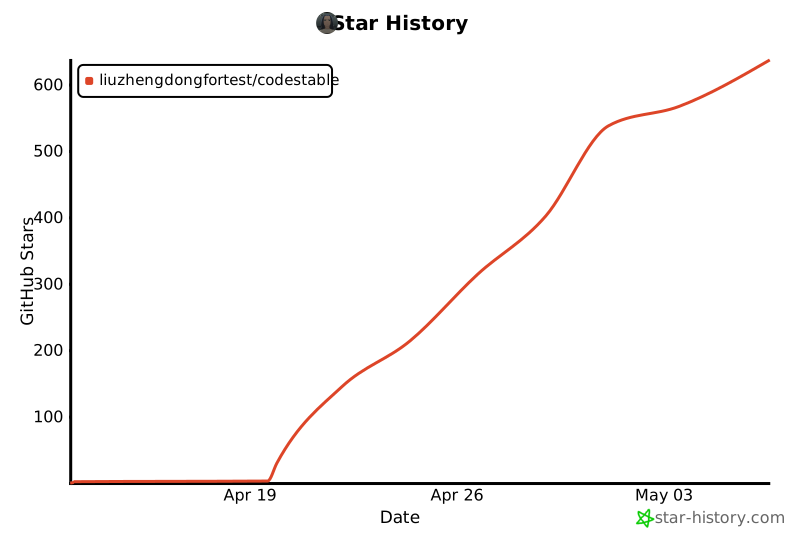
## Star History
|
|
|
|
[](https://www.star-history.com/?repos=liuzhengdongfortest%2FCodeStable&type=date&legend=top-left)
|
|
|
|
<div align="center">
|
|
|
|
MIT License · by [@liuzhengdong](https://github.com/liuzhengdongfortest)
|
|
|
|
</div>
|