`NextURL` intentionally canonicalizes loopback hosts (127.x.x.x, [::1],
localhost) to localhost so that internal URL handling is consistent
across equivalent local origins.

However, we were applying a regex replacement to the entire URL before
parsing, which unintentionally rewrote loopback strings inside query
parameter values, eg `?redirect_uri=http%3A%2F%2F127.0.0.1...`. This is
unexpected for anyone that is explicitly passing through different
loopback values.

This fixes it by first parsing the URL with `new URL()`, and then only
apply the replacement logic to `parsed.hostname` when it is a loopback
host. This leaves search unchanged.

Fixes NEXT-4864
When configuring a body with `NextRequest` in node runtime without the
`duplex: 'half'` option it can throw an error un-necessarily since it's
an extension of the node `Request` instance. This auto-configures
`duplex: 'half'` when using `NextRequest` for easier migration from edge
-> node runtime for middleware.

```sh
TypeError: RequestInit: duplex option is required when sending a body.
    at new Request (/opt/rust/undici-runtime.js:40:31096)
```

x-ref: [slack
thread](https://vercel.slack.com/archives/C07LQPFERGF/p1740490607381379)
### Overview

This PR removes the `geo` and `ip` properties from `NextRequest` for
Next.js 15. These values had to be provided by your hosting provider.
Since this feature was not generally useful for the broader Next.js
community (outside of Vercel), we feel it makes more sense to keep this
as a Vercel-specific feature and not something built into the framework.

### Alternatives

If you are using Vercel, you can alternatively use the `geolocation` and
`ipAddress` functions from
[`@vercel/functions`](https://vercel.com/docs/functions/vercel-functions-package)
instead:

```js filename="middleware.ts"
import { geolocation, ipAddress } from '@vercel/functions';
import type { NextRequest } from 'next/server'

export function middleware(request: NextRequest) {
  const { city } = geolocation(request);
  const ip = ipAddress(request)

  // ...
}
```

---------

Co-authored-by: Eng Zer Jun <engzerjun@gmail.com>
### What?

Note: This is not a breaking change, just removing some unused code.

### Why?

Since #56896 we don't need this, as Node.js 18+ has `fetch` exposed by default.

### How?

Depends on #56896, #56909

We already didn't load `fetch` if `globalThis` had it (ie. Node.js 18+ environments), and since we are dropping support for Node.js 16, these code paths should have no effect on runtime behavior.
### What?
When cloning a `Request` with `NextRequest` the second argument needs to take precedence over the `Headers` set on the original request.
### Why?
Follow-up of #53157
I checked the `Request` spec https://fetch.spec.whatwg.org/#request-class and following the order of execution, `init.headers` should indeed override the headers if the first param was `Request`.
I verified this in the browser too:
```js
const req1 = new Request("http://n", {headers: {"x-header": "foo"}})
const req2 = new Request(req1, {headers: {"x-header-2": "bar"}})
Object.fromEntries(req2.headers) // {x-header-2: "bar"}
```
So we should match `NextRequest` with this behavior.
### How?
Pass the `init` to `super` when cloning the request.
Closes NEXT-1521
Fixes#54094
### What?
This PR makes it easier to use Next.js with IPv6 hostnames such as `::1` and `::`.
### How?
It does so by removing rewrites from `localhost` to `127.0.0.1` introduced in #52492. It also fixes the issue where Next.js tries to fetch something like `http://::1:3000` when `--hostname` is `::1` as it is not a valid URL (browsers' `URL` class throws an error when constructed with such hosts). It also fixes `NextURL` so that it doesn't accept `http://::1:3000` but refuse `http://[::1]:3000`. It also changes `next/src/server/lib/setup-server-worker.ts` so that it uses the server's `address` method to retrieve the host instead of our provided `opts.hostname`, ensuring that no matter what `opts.hostname` is we will always get the correct one.
### Note
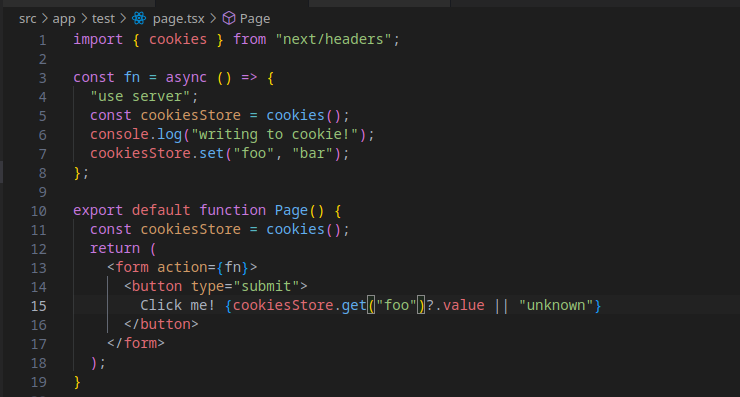
I've verified that `next dev`, `next start` and `node .next/standalone/server.js` work with IPv6 hostnames (such as `::` and `::1`), IPv4 hostnames (such as `127.0.0.1`, `0.0.0.0`) and `localhost` - and with any of these hostnames fetching to `localhost` also works. Server Actions and middleware have no problems as well.
This also removes `.next/standalone/server.js`'s logging as we now use `start-server`'s logging to avoid duplicates. `start-server`'s logging has also been updated to report the actual hostname.
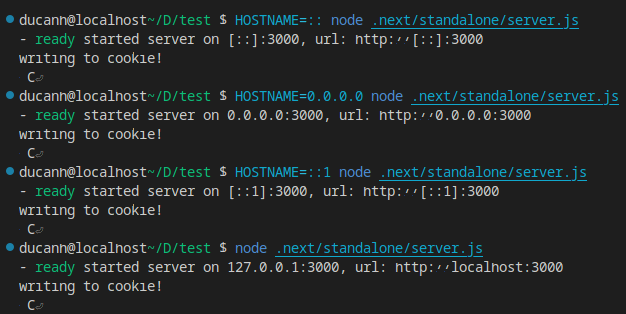

The above pictures also demonstrate using Server Actions with Next.js after this PR.
Fixes#53171Fixes#49578
Closes NEXT-1510
Co-authored-by: Tim Neutkens <6324199+timneutkens@users.noreply.github.com>
Co-authored-by: Zack Tanner <1939140+ztanner@users.noreply.github.com>
### What?
Allow the following:
```ts
new NextRequest(new Request(...))
```
### Why?
Cloning a request by passing it to the constructor of another `Request` is allowed by the spec: https://developer.mozilla.org/en-US/docs/Web/API/Request/Request#parameters
### How?
If the passed argument is an instance of `Request`, we pass it as-is to `super()`
Fixes#52967
Closes NEXT-1468
<!--
Thanks for opening a PR! Your contribution is much appreciated.
To make sure your PR is handled as smoothly as possible we request that
you follow the checklist sections below.
Choose the right checklist for the change that you're making:
-->

Consider the following middleware which redirects to
`/path/to#fragment`.

```ts
import { NextResponse } from 'next/server';

export async function middleware(request) {
  const url = new URL('/path/to#fragment', request.url);
  return NextResponse.redirect(url);
}
```

However, it actually redirects to `/path/to`, namely it discards the
fragment part in the destination URL `#fragment`. This is because
`NextURL.toString()` does not append that part. This PR fixes the bug.

## Bug

- [ ] Related issues linked using `fixes #number`
- [x] Integration tests added
- [ ] Errors have a helpful link attached, see `contributing.md`

## Feature

- [ ] Implements an existing feature request or RFC. Make sure the
feature request has been accepted for implementation before opening a
PR.
- [ ] Related issues linked using `fixes #number`
- [ ] Integration tests added
- [ ] Documentation added
- [ ] Telemetry added. In case of a feature if it's used or not.
- [ ] Errors have a helpful link attached, see `contributing.md`

## Documentation / Examples

- [ ] Make sure the linting passes by running `pnpm lint`
- [ ] The "examples guidelines" are followed from [our contributing
doc](https://github.com/vercel/next.js/blob/canary/contributing/examples/adding-examples.md)
Lately, `Response.json` was introduced as a standard static method.
That means we can remove our implementation of `NextResponse.json` piggyback on `Response.json`


Co-authored-by: JJ Kasper <22380829+ijjk@users.noreply.github.com>
This resolves#35573
I can't seem to reproduce the issue so I only created a unit test that verifies that it has the correct behavior.
@tavvy can you also check this PR out to see if it makes sense or not?
## Bug
- [x] Related issues linked using `fixes #number`
- [x] Integration tests added
- [ ] Errors have helpful link attached, see `contributing.md`
This PR fixes an issue where we have a middleware that rewrites every single request to the same origin while having `i18n` configured. It would be something like:

```typescript
import { NextResponse } from 'next/server'

export function middleware(req) {
  return NextResponse.rewrite(req.nextUrl)
}
```

In this case we are going to be adding always the `locale` at the beginning of the destination since it is a rewrite. This causes static assets to not match and the whole application to break. I believe this is a potential footgun so in this PR we are addressing the issue by removing the locale from pathname for those cases where we check against the filesystem (e.g. public folder).

To achieve this change, this PR introduces some preparation changes and then a refactor of the logic in the server router. After this refactor we are going to be relying on properties that can be defined in the `Route` to decide wether or not we should remove the `basePath`, `locale`, etc instead of checking which _type_ of route it is that we are matching.

Overall this simplifies quite a lot the server router. The way we are testing the mentioned issue is by adding a default rewrite in the rewrite tests middleware.
This PR moves the internal logic associated with `req.ua` into an explicit method the user should to call to have the same behavior.

**before**

```typescript
// middleware.ts
import { NextRequest, NextResponse } from 'next/server'
export function middleware(request: NextRequest) {
  const url = request.nextUrl
  const viewport = request.ua.device.type === 'mobile' ? 'mobile' : 'desktop'
  url.searchParams.set('viewport', viewport)
  return NextResponse.rewrites(url)
}
```

**after**

```typescript
// middleware.ts
import { NextRequest, NextResponse, userAgent } from 'next/server'
export function middleware(request: NextRequest) {
  const url = request.nextUrl
  const { device } = userAgent(request)
  const viewport = device.type === 'mobile' ? 'mobile' : 'desktop'
  url.searchParams.set('viewport', viewport)
  return NextResponse.rewrites(url)
}
```

This potentially will save the extra 17 kB related to the size of `ua-parser-js`
* Refactor data fetching to support getting headers

* Relax `getNextPathnameInfo` type

* Add test for middleware internal redirects

* Export `ParsedRelativeUrl` type

* Refactor `getMiddlewareEffects`

* Move rewrite i18n test to middleware rewrite tests

* Fix bug parsing pathname info

* Normalize data requests to page requests for middleware

* Ensure there is a header `x-nextjs-matched-path` for middleware rewrites on data requests

* Extract `getDataHref` to a function

* Stop using `getDataHref` for flight

* Always set the query in `dataHref` independently of if it is SSG

* Add test for recursive rewrites

* Refactor dynamicPath validation to `matchHrefAndAsPath`

* Add `dataHref` to `FetchDataOutput`

* Extract `matchesMiddleware` function

* Add `hasMiddleware` option to `fetchNextData`

* Move preflight test

* Remove preflight test

* Add middleware prefetch tests

* Remove preflight

* Attempt to reduce bundle size

Include `withMiddlewareEffects` and `matchHrefAndAsPath` into `router`

Bring `getDataHref` back to `page-loader`

Bring `resolveDynamicRoute` back to `router`

* Reduce arg duplication for `withMiddlewareEffects`

* Remove some async/await and spreads to reduce bundle size

* Upgrade `edge-runtime` & clone `Request` on redirects to mutate headers

* Add some rewrite tests

Co-authored-by: Kiko Beats <josefrancisco.verdu@gmail.com>
Co-authored-by: JJ Kasper <jj@jjsweb.site>
This PR introduces [Edge Runtime](https://edge-runtime.vercel.app/) for emulating [Edge Functions](https://vercel.com/features/edge-functions) locally.

Every time you run a [middleware](https://nextjs.org/docs/advanced-features/middleware) locally via `next dev`, an isolated edge runtime context will be created.

These contexts have the same constraints as production servers, plus they don't pollute the global scope; Instead, all the code run in a vm on top of a Node.js process.

Additionally, `@edge-runtime/jest-environment` has been added to make easier testing Edge Functions in a programmatic way.

It dropped the following polyfills from Next.js codebase, since they are now part of Edge Runtime:

- abort-controller
- formdata
- uuid
- web-crypto
- web-streams

Co-authored-by: Gal Schlezinger <2054772+Schniz@users.noreply.github.com>
* Do not exclude internal _next request in middleware

* Allow for `NextURL` to parse prefetch requests

* Add test for middleware data prefetch

* Refactor `hasBasePath` and `replaceBasePath`

* Refactor `removeTrailingSlash`

* Refactor parsed next url to use `getNextPathnameInfo`

* Allow to configure `NextURL`

* Ensure middleware rewrites with always with a locale

Co-authored-by: JJ Kasper <jj@jjsweb.site>
_Hello Next.js team! First PR here, I hope I've followed the right practices._

### What's in there?

It has been decided to only support the following uses cases in Next.js' middleware:
- rewrite the URL (`x-middleware-rewrite` response header)
- redirect to another URL (`Location` response header)
- pass on to the next piece in the request pipeline (`x-middleware-next` response header)

1. during development, a warning on console tells developers when they are returning a response (either with `Response` or `NextResponse`).
2. at build time, this warning becomes an error.
3. at run time, returning a response body will trigger a 500 HTTP error with a JSON payload containing the detailed error.

All returned/thrown errors contain a link to the documentation.

This is a breaking feature compared to the _beta_ middleware implementation, and also removes `NextResponse.json()` which makes no sense any more.

### How to try it?
- runtime behavior: `HEADLESS=true yarn jest test/integration/middleware/core`
- build behavior : `yarn jest test/integration/middleware/build-errors`
- development behavior: `HEADLESS=true yarn jest test/development/middleware-warnings`

### Notes to reviewers

The limitation happens in next's web adapter. ~The initial implementation was to check `response.body` existence, but it turns out [`Response.redirect()`](https://github.com/vercel/next.js/blob/canary/packages/next/server/web/spec-compliant/response.ts#L42-L53) may set the response body (https://github.com/vercel/next.js/pull/31886). Hence why the proposed implementation specifically looks at response headers.~
`Response.redirect()` and `NextResponse.redirect()` do not need to include the final location in their body: it is handled by next server https://github.com/vercel/next.js/blob/canary/packages/next/server/next-server.ts#L1142

Because this is a breaking change, I had to adjust several tests cases, previously returning JSON/stream/text bodies. When relevant, these middlewares are returning data using response headers.

About DevEx: relying on AST analysis to detect forbidden use cases is not as good as running the code.
Such cases are easy to detect:
```js
new Response('a text value')
new Response(JSON.stringify({ /* whatever */ })
```
But these are false-positive cases:
```js
function returnNull() { return null }
new Response(returnNull())

function doesNothing() {}
new Response(doesNothing())
```
However, I see no good reasons to let users ship middleware such as the one above, hence why the build will fail, even if _technically speaking_, they are not setting the response body.


## Feature

- [x] Implements an existing feature request or RFC. Make sure the feature request has been accepted for implementation before opening a PR.
- [ ] Related issues linked using `fixes #number`
- [x] Integration tests added
- [x] Documentation added
- [ ] Telemetry added. In case of a feature if it's used or not.
- [x] Errors have helpful link attached, see `contributing.md`

## Documentation / Examples

- [x] Make sure the linting passes by running `yarn lint`
Hello,

This is an iteration after first work at https://github.com/vercel/next.js/pull/36478.

What that PR missed is a way to just get a cookie value. Well, this PR adds two new things:

`cookies.get` returns the cookie value that could be `string | undefined`:

```js
const response = new NextResponse()
response.cookies.set('foo', 'bar', { path: '/test' })

const value = response.cookies.get('foo')
console.log(value) // => 'bar'
```

Additionally, if you want to know all the cookie details, you can use `cookies.getWithOptions`:

```js
const response = new NextResponse()

response.cookies.set('foo', 'bar', { path: '/test' })
const { value, options } response.cookies.getWithOptions('foo')

console.log(value) // => 'bar'
console.log(options) // => { Path: '/test' }
```
This PR introduces a more predictable API to manipulate cookies in an Edge Function context.
```js
const response = new NextResponse()
// set a cookie
response.cookies.set('foo, 'bar') // => set-cookie: 'foo=bar; Path=/'`
// set another cookie
response.cookies.set('fooz, 'barz') // => set-cookie: 'foo=bar; Path=/, fooz=barz; Path=/'`
// delete a cookie means mark it as expired
response.cookies.delete('foo') // => set-cookie: 'foo=; Path=/; Expires=Thu, 01 Jan 1970 00:00:00 GMT, fooz=barz; Path=/'`
// clear all cookies means mark all of them as expired
response.cookies.clear() // => set-cookie: 'fooz=; Path=/; Expires=Thu, 01 Jan 1970 00:00:00 GMT, foo=; Path=/; Expires=Thu, 01 Jan 1970 00:00:00 GMT'`
```
This new cookies API uses [Map](https://developer.mozilla.org/en-US/docs/Web/JavaScript/Reference/Global_Objects/Map) interface, and it's available for `NextRequest` and `NextResponse`.
Additionally, you can pass a specific cookies option as a third argument in `set` method:
```js
response.cookies.set('foo', 'bar', {
path: '/',
maxAge: 60 * 60 * 24 * 7,
httpOnly: true,
sameSite: 'strict',
domain: 'example.com'
}
```
**Note**: `maxAge` it's in seconds rather than milliseconds.
Any cookie manipulation will be reflected over the `set-cookie` header, transparently.
closes#31719
We currently have inconsistencies when working with URLs in the Edge Functions runtime, this PR addresses them introducing a warning for inconsistent usage that will break in the future. Here is the reasoning.

### The Browser

When we are in a browser environment there is a fixed location stored at `globalThis.location`. Then, if one tries to build a request with a relative URL it will work using that location global hostname as _base_ to construct its URL. For example:

```typescript
// https://nextjs.org
new Request('/test').url; // https://nextjs.org/test
Response.redirect('/test').headers.get('Location'); // https://nextjs.org/test
```

However, if we attempt to run the same code from `about:blank` it would not work because the global to use as a base `String(globalThis.location)` is not a valid URL. Therefore a call to `Response.redirect('/test')` or `new Response('/test')` would fail.

### Edge Functions Runtime

In Next.js Edge Functions runtime the situation is slightly different from a browser. Say that we have a root middleware (`pages/_middleware`) that gets invoked for every page. In the middleware file we expose the handler function and also define a global variable that we mutate on every request:

```typescript
// pages/_middleware

let count = 0;

export function middleware(req: NextRequest) {
  console.log(req.url);
  count += 1;
}
```

Currently we cache the module scope in the runtime so subsequent invocations would hold the same globals and the module would not be evaluated again. This would make the counter to increment for each request that the middleware handles. It is for this reason that we **can't have a global location** that changes across different invocations. Each invocation of the same function uses the same global which also holds primitives like `URL` or `Request` so changing an hypothetical `globalThis.location` per request would affect concurrent requests being handled.

Then, it is not possible to use relative URLs in the same way the browser does because we don't have a global to rely on to use its host to compose a URL from a relative path.

### Why it works today

We are **not** validating what is provided to, for example, `NextResponse.rewrite()` nor `NextResponse.redirect()`. We simply create a `Response` instance that adds the corresponding header for the rewrite or the redirect. Then it is **the consumer** the one that composes the final destination based on the request. Theoretically you can pass any value and it would fail on redirect but won't validate the input.

Of course this is inconsistent because it doesn't make sense that `NextResponse.rewrite('/test')` works but `fetch(new NextRequest('/test'))` does not. Also we should validate what is provided. Finally, we want to be consistent with the way a browser behaves so `new Request('/test')` _should_ not work if there is no global location which we lack.

### What this PR does

We will have to deprecate the usage of relative URLs in the previously mentioned scenarios. In preparation for it, this PR adds a validation function in those places where it will break in the future, printing a warning with a link that points to a Next.js page with an explanation of the issue and ways to fix it.

Although middleware changes are not covered by semver, we will roll this for some time to make people aware that this change is coming. Then after a reasonable period of time we can remove the warning and make the code fail when using relative URLs in the previously exposed scenarios.
**Note**: This PR is applying again changes landed #31935 that were reverted from an investigation.
This PR fixes#30398
By default Next will polyfill some fetch APIs (Request, Response, Header and fetch) only if fetch is not found in the global scope in certain entry points. If we have a custom server which is adding a global fetch (and only fetch) at the very top then the rest of APIs will not be polyfilled.
This PR adds a test on the custom server where we can add a custom polyfill for fetch with an env variable. This reproduces the issue since next-server.js will be required without having a polyfill for Response which makes it fail on requiring NextResponse. Then we remove the code that checks for subrequests to happen within the **sandbox** so that we don't need to polyfill `next-server` anymore.
The we also introduce an improvement on how we handle relative requests. Since #31858 introduced a `port` and `hostname` options for the server, we can always pass absolute URLs to the Middleware so we can always use the original `nextUrl` to pass it to fetch. This brings a lot of simplification for `NextURL` since we don't have to consider relative URLs no more.
## Bug
- [x] Related issues linked using `fixes #number`
- [x] Integration tests added
- [x] Errors have helpful link attached, see `contributing.md`
This PR fixes#30398
By default Next will polyfill some fetch APIs (Request, Response, Header and fetch) only if fetch is not found in the global scope in certain entry points. If we have a custom server which is adding a global fetch (and only fetch) at the very top then the rest of APIs will not be polyfilled.
This PR adds a test on the custom server where we can add a custom polyfill for fetch with an env variable. This reproduces the issue since next-server.js will be required without having a polyfill for Response which makes it fail on requiring NextResponse. Then we remove the code that checks for subrequests to happen within the **sandbox** so that we don't need to polyfill `next-server` anymore.
The we also introduce an improvement on how we handle relative requests. Since #31858 introduced a `port` and `hostname` options for the server, we can always pass absolute URLs to the Middleware so we can always use the original `nextUrl` to pass it to fetch. This brings a lot of simplification for `NextURL` since we don't have to consider relative URLs no more.
## Bug
- [x] Related issues linked using `fixes #number`
- [x] Integration tests added
- [x] Errors have helpful link attached, see `contributing.md`
Previously `response.cookie(name, value, options)` would mutate the passed in `options` which lead to unexpected behaviour as described in #31666.

This PR clones the `options` argument before mutating it.

## Bug

- [x] Related issues linked using `fixes #number`
- [ ] Integration tests added
- [ ] Errors have helpful link attached, see `contributing.md`

## Feature

- [ ] Implements an existing feature request or RFC. Make sure the feature request has been accepted for implementation before opening a PR.
- [x] Related issues linked using `fixes #number`
- [ ] Integration tests added
- [ ] Documentation added
- [ ] Telemetry added. In case of a feature if it's used or not.
- [ ] Errors have helpful link attached, see `contributing.md`

## Documentation / Examples

- [x] Make sure the linting passes by running `yarn lint`
Since `localhost` is actually an alias for `127.0.0.1` that points to loopback, we should take that into consideration at `NextURL` when we handle local URLs.

The implementation is based on [is-localhost-url](https://github.com/Kikobeats/is-localhost-url); I added some tests over local URLs variations present at the library to ensure other variations are working fine.

Additionally, I refactor some things over the code to avoid doing the same twice and added some legibility that is always welcome when you are working with URLs stuff.

 closes https://github.com/vercel/next.js/issues/31533
closes: https://github.com/vercel/next.js/issues/30353

According with spec, `'about:client'` is the default value is the user doesn't provide it.

It needs to add a test there, looks like there no unit tests for these classes 🤔
This PR adds support for [Middleware as per RFC ](https://github.com/vercel/next.js/discussions/29750).

## Feature

- [ ] Implements an existing feature request or RFC. Make sure the feature request has been accepted for implementation before opening a PR.
- [ ] Related issues linked using `fixes #number`
- [ ] Integration tests added
- [ ] Documentation added
- [ ] Telemetry added. In case of a feature if it's used or not.
- [ ] Errors have helpful link attached, see `contributing.md`

## Documentation / Examples

- [ ] Make sure the linting passes
 Zack Tanner