- New Platforms entry: /platform/slack quickstart — manifest-based app
  creation, Socket Mode tokens, minimal createBot bot run with tsx,
  interactive JSX with inline onClick, slash commands, production split
- New "Bots" SDK tab in the reference picker with per-symbol pages for
  @copilotkit/bot, @copilotkit/bot-ui, and @copilotkit/bot-slack
  (Components / Functions / Classes / Types)
- Rename reference picker labels to React (V2) / React (V1)
- Remove the retired /reference/sdk pages (LangGraph/CrewAI SDK,
  Remote Endpoints); search/sitemap/llms indexes derive from the
  content tree, so they de-index with the deletion
- Retarget the one inbound link to its /reference/v1 copy

Co-Authored-By: Claude <noreply@anthropic.com>
The hero_command_copied event fired by the landing-hero command cards carried
no surface discriminator. HeroStartActions renders on both the home hero and
every framework landing hero; the "onboard" card's command is byte-identical
on every page, so onboard copies could not be attributed to a surface from the
event alone (only the "create" card embeds the framework in `command`).

Add `location: window.location.pathname` to the payload, mirroring the
`cli_command_copied` event the global <CopyTracker> already emits for the same
copy so the two paired events join on the same dimension. Guarded for SSR to
match the sibling.

Adds a source-assertion guard test in the shell-docs node-env convention.

Co-Authored-By: Claude Opus 4.8 (1M context) <noreply@anthropic.com>
## What
Replaces the landing-page CTA with **three entry points**, framed by
situation, and renders the **identical action block on the home hero and
every framework landing hero**:
| | action |
|---|---|
| **New project** | `npx copilotkit create` |
| **Existing project** | `npx copilotkit skills onboard` |
| **Guided walkthrough** | **Quickstart** button (preserved from the
previous hero) |
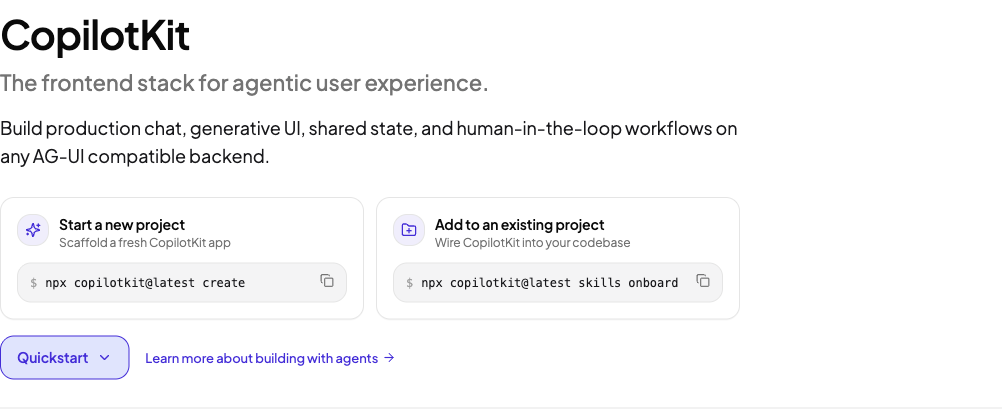
- **Unified `<HeroStartActions>` block**: two equal-weight command cards
plus a quickstart row beneath, shared verbatim by the home hero and the
framework landing heroes (per review: the two surfaces previously
diverged).
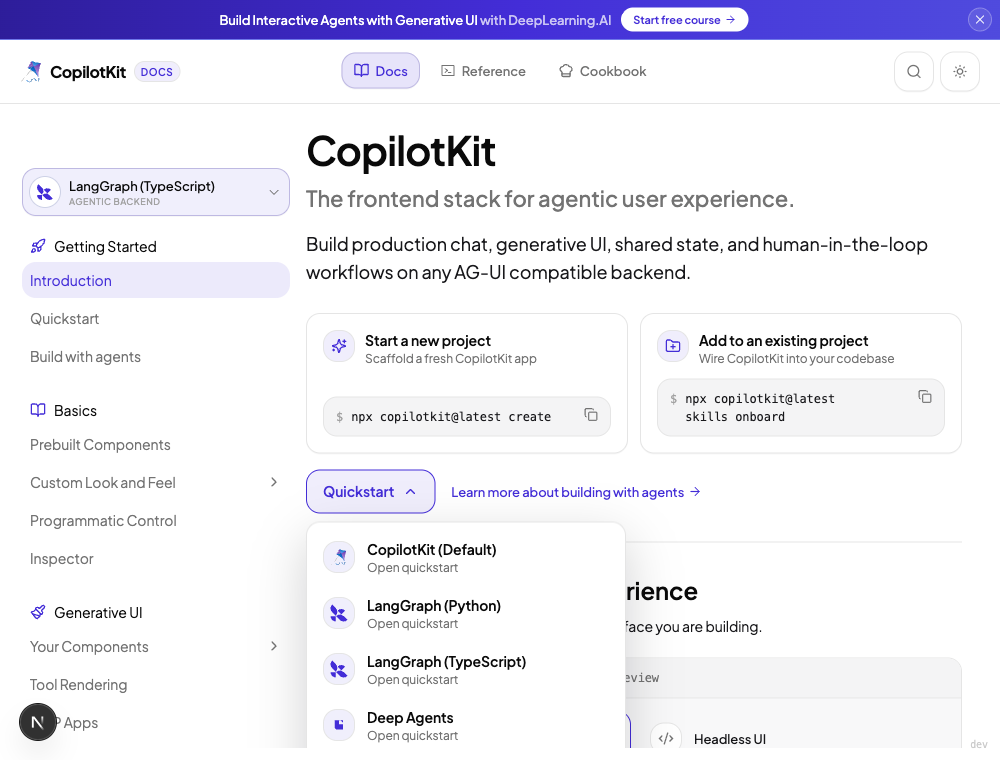
- **Quickstart preserved** in its original accent treatment. On the home
hero it is the framework-picker dropdown (`<HeroQuickstartDropdown>`,
restored); on framework pages it links straight to that framework's
quickstart guide. The home hero also keeps the "Learn more about
building with agents" link in the same row.
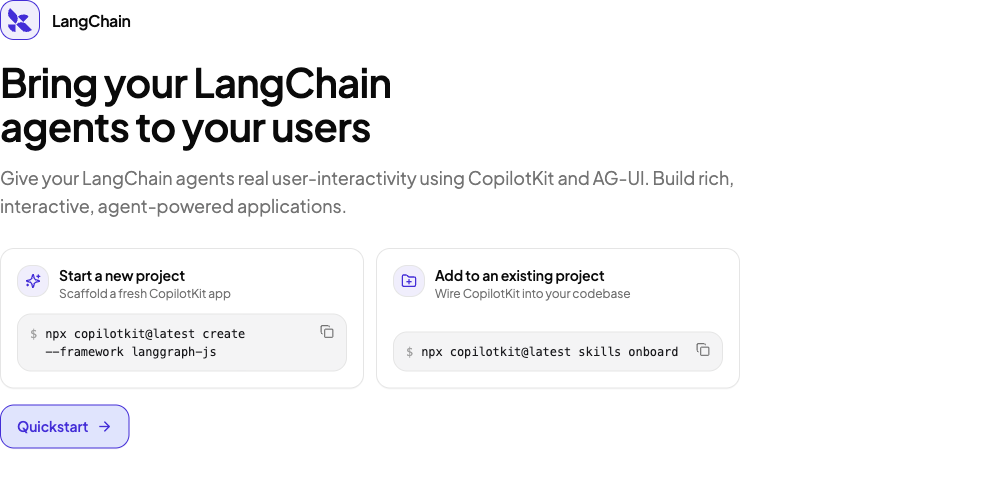
- **Framework landing heroes** (e.g. `/langgraph-typescript`): the
create command **pre-fills the framework** via the CLI's `--framework`
flag (e.g. `--framework langgraph-js`).
**Framework-flag mapping**: docs slug to CLI `--framework` value,
verified against the CLI's `AGENT_FRAMEWORKS` enum
(`langgraph-typescript`→`langgraph-js`,
`langgraph-python`→`langgraph-py`, `google-adk`→`adk`,
`strands`→`aws-strands-py`,
`ms-agent-dotnet`→`microsoft-agent-framework-dotnet`, identical for
`mastra`/`pydantic-ai`/`llamaindex`/`agno`/`ag2`). Slugs with **no** 1:1
CLI template fall back to a bare `npx copilotkit create`, notably
`crewai-crews` (the CLI ships *CrewAI Flows*, not Crews), plus
`langgraph-fastapi`, `claude-sdk-*`, `langroid`, `spring-ai`,
`agent-spec`, `deepagents`. `skills onboard` has no framework flag, so
it is identical everywhere. Frameworks with bespoke setup (`a2a` `git
clone`, `ms-agent-dotnet`) keep the pre-cards layout: quickstart button
plus their own copy-command chip.
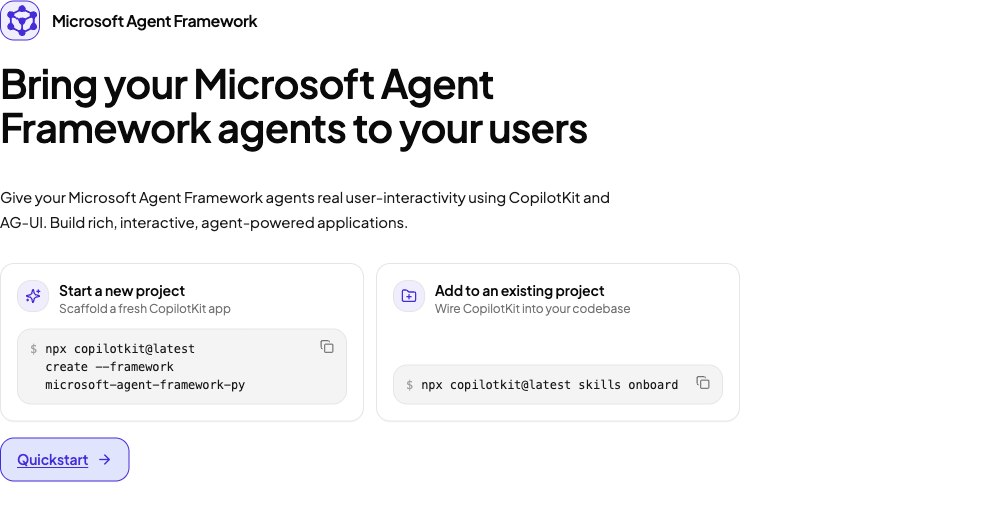
**Responsive, with all text always visible.** Commands **wrap, never
truncate**:
- Wraps happen at spaces only; every token is non-breaking, so
`--framework` can never split into a dangling `-` at a line edge.
- `text-wrap: balance` splits multi-line commands evenly, typically
right at the flag boundary (`npx copilotkit@latest create` /
`--framework langgraph-js`).
- The block caps at 740px with 12px mono, the narrowest cap where both
home commands fit one line with enough headroom to survive platform
mono-font width differences.
- Cards sit two-up from `sm` and stack below it; the grid (`min-w-0`,
`items-stretch`) keeps long commands inside their track and the card
pair equal-height.
## Screenshots
**Home**: two cards, quickstart dropdown, learn-more link
**Home, quickstart dropdown open** (framework picker preserved)
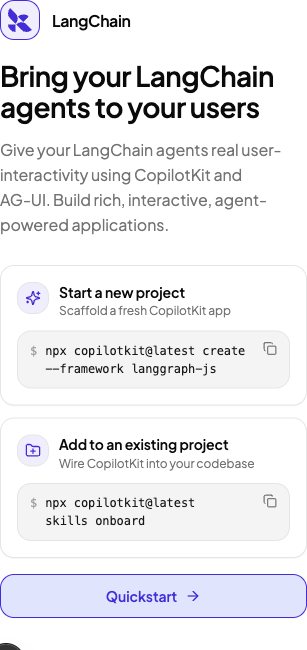
**Framework landing (LangGraph)**: same block, framework pre-filled,
create command balanced across two lines, quickstart links to the guide
**Worst case (Microsoft Agent Framework, Python)**: longest CLI flag
value, three balanced lines, fully readable
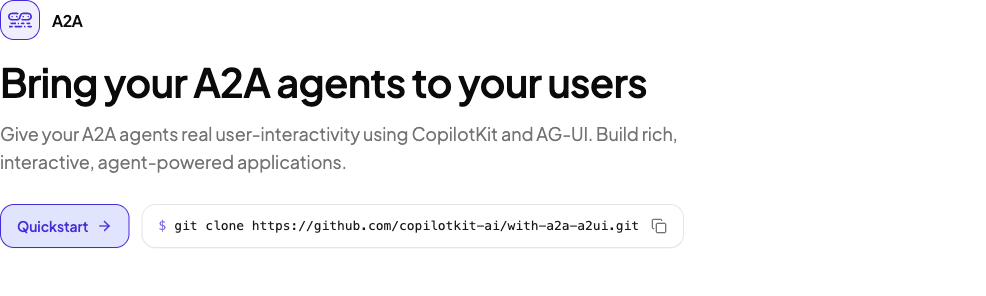
**Bespoke setup (A2A)**: quickstart button plus own command chip
(pre-cards layout preserved)
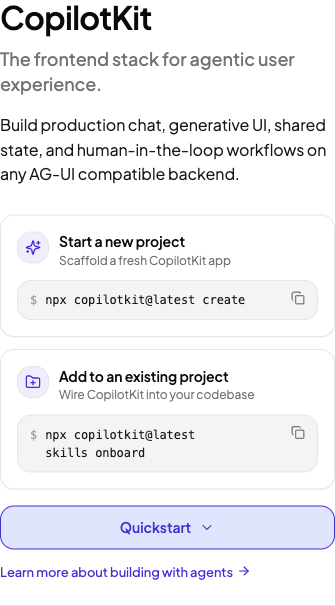
**Mobile (375px)**: cards stack, quickstart goes full-width
| home | framework |
|---|---|
| 
| 
|
## Telemetry
Both hero copy buttons are now explicitly instrumented: each click
captures **`hero_command_copied`** (`command_id`: `create` | `onboard`,
full `command` string, `clipboard_blocked`), so create-vs-onboard
funnels are queryable per landing page. The pre-existing global
`cli_command_copied` (fired by `CopyTracker` on any clipboard copy)
still fires for volume metrics; the new event uses a different name so
that funnel is not double-counted. Validated locally against a live
PostHog client: each click POSTs both events (plus `$autocapture`) to
`/ingest/e` with HTTP 200.
## Notes
- Both cards equal weight; accent only on hover. Copy rows copy on click
with `aria-live` feedback plus a clipboard-blocked fallback; cursor is
`pointer`.
- Removes `agent-start-prompt.tsx` and `hero-command-copy.tsx`.
`hero-quickstart-dropdown.tsx` is back (restored unchanged after review
feedback).
The global CopyTracker already emits the generic cli_command_copied on
any clipboard copy, but it cannot distinguish which hero card was used.
Each card now also captures hero_command_copied with command_id
(create | onboard), the full command string, and clipboard_blocked, so
create-vs-onboard funnels are queryable per landing page.

Validated locally against a live PostHog client: each click POSTs one
$autocapture, one cli_command_copied, and one hero_command_copied to
/ingest/e (HTTP 200) with the expected properties.
Review follow-up: bring back the quickstart button alongside the two
recommended commands, and render the identical <HeroStartActions> block
on the home hero and every framework landing hero.

- Quickstart returns in its original accent treatment: the framework
  dropdown on home, a direct guide link on framework pages; bespoke-init
  frameworks (a2a, ms-agent-dotnet) get back the old button + chip row.
- One layout everywhere: cards are always two-up from sm (no more
  stacked framework variant); commands wrap balanced at token boundaries
  instead of truncating, so long framework-pinned commands stay fully
  readable at every width.
## Summary
Fills documentation gaps that Pathfinder (our docs-indexing /
gap-analysis system) flagged in `showcase/shell-docs` — new backend,
Microsoft Agent Framework / Mastra integration, reference-hook,
troubleshooting, and shared-state pages, plus accuracy corrections to
existing v1/v2 pages. 43 files, 6 by-area commits, rebased onto current
`main`.

## Corrections (source-verified across two review passes)
- **.NET MAF samples:** tool names now match the frontend (`Name =
"get_weather"` / `"step_progress"`) so the renderer/middleware actually
fire.
- **v1/v2 provider identity:** v2-specific examples (e.g.
`showDevConsole="auto"`) now use `<CopilotKitProvider>` — `<CopilotKit>`
exported from `@copilotkit/react-core/v2` is the v1 backward-compat
component, which has no `"auto"` mode.
- **Imports / snippets:** added missing `useRenderTool` / `z` /
`useAgent` imports + `"use client"`; removed a nonexistent
`mcpApps.serverId` field; fixed an off-by-2 code-highlight range.
- **API accuracy:** Express legacy factory is
`copilotRuntimeNodeExpressEndpoint`; v1 `useAgent` `runAgent` signature
+ `UseAgentProps` type name; `useRenderToolCall` falls back to the
default renderer (not `null`); `useComponent` also registers a tool; v1
`enableInspector` localhost/`0.0.0.0` default vs v2 `"auto"` nuance.
- **Nav / icons:** registered `lucide/Map`; wired new pages into
`meta.json`.
- **Deletion:** removed the orphaned
`content/docs/reference/v2/hooks/useAgent.mdx` — verified safe (the
canonical `content/reference/hooks/useAgent.mdx` is intact and all
inbound links resolve).

## Notes for reviewer
- The working tree had no `node_modules`, so the docs build was **not
run locally — relying on CI** for the build / lint / commitlint gate.
- Deferred polish (follow-up): state-rendering "in the chat" framing,
decorative `AgentState` types, `agentId`-key explanation,
`useFrontendTool` migration example, error-reference dev-warn nuance.

## Test plan
- [ ] CI green (shell-docs build, lint, commitlint)
The /strands/deploy-agentcore and /langgraph/deploy-agentcore pages
rendered only their title — the body was empty. <Content> resolved to a
dead stub in the MDX component registry that rendered nothing, despite
the content being authored in the shared agentcore partial.

- mdx-registry.tsx: replace the dead Content stub with a dedicated
  component that renders the agentcore partial via PartialLoader and
  threads the page's framework into MDX scope.
- mdx-registry-loader.tsx: PartialLoader accepts an optional scope,
  forwarded to MDXRemote options.scope so partials can read bare scope
  identifiers (next-mdx-remote binds scope as module identifiers, not as
  the rendered component's props).
- agentcore/index.mdx: reference {framework} (bare scope var) instead of
  props.framework so AgentCoreCommandTabs collapses to the single
  relevant framework per page.
Framework landing heroes (e.g. /langgraph-typescript) now show the same
two StartCommandCards as the home hero, and the "new project" command
pre-fills the framework via the CLI's --framework flag (e.g.
--framework langgraph-js). The mapping from docs slug to CLI framework is
verified against the CLI's AGENT_FRAMEWORKS enum; slugs with no 1:1
template fall back to a bare `npx copilotkit@latest create`. Frameworks
with bespoke setup (a2a git clone, ms-agent-dotnet) keep their own single
copy-command chip. Drops the old "Start the quickstart" button and the
legacy `npx copilotkit@latest init` chip.
Replace the home landing hero's Quickstart dropdown + command-copy chip
with a two-card <HeroStartCommands> block, framed by situation:

  - Start a new project        -> npx copilotkit@latest create
  - Add to an existing project -> npx copilotkit@latest skills onboard

Both cards are equal weight with no pre-selected default. Each command
row copies on click with an aria-live announcement and a clipboard-blocked
fallback. Commands pin @latest so npx never reuses a stale cached CLI.
Removes the now-unused hero-quickstart-dropdown and hero-command-copy
components.
New users were still discovering cloud.copilotkit.ai through docs pages,
the README, example READMEs, and in-app banners/console messages. Replace
all user-facing web links with dashboard.operations.copilotkit.ai (the
destination the marketing-site CTAs already use). Functional API endpoints
(api.cloud.copilotkit.ai) are deliberately untouched since existing cloud
customers depend on them.

Co-Authored-By: Claude Opus 4.8 (1M context) <noreply@anthropic.com>
Our previous doc site had a fumadocs/shadcn theme that was a bit
hodge-podge. This brings all of it into one clean and visually appealing
design. The border radii are standardized, colors are standardized and
bunch of passes for mobile/tablet have been done. An added bonus is that
the header nav has been redone to feel more natural to the eyes.

<img width="1850" height="1256" alt="Screenshot 2026-06-05 at 7 48
00 AM"
src="https://github.com/user-attachments/assets/0c6032f2-e406-4e51-9c31-d69a9d258d61"
/>
Applies the updated shell-docs theme treatment to the overview cards, sample tabs, framework selectors, hero command controls, and Copilot Cloud CTAs.

Call-site enumeration:

- FrameworkSelector/FrameworkTabs/IntegrationGrid changes stay on the docs landing and framework overview surfaces that already own those controls.

- OpsPlatformCTA and LinkToCopilotCloud keep their existing call sites while switching to shared chrome variables.
Refreshes the shell docs chrome around the shared theme tokens, announcement banner, desktop and mobile navigation, search trigger, theme toggle, and sidebar footer actions.

Call-site enumeration:

- PrimaryDocsTabs: rendered by MobileTopNav for tablet header tabs and ShellDocsLayout for mobile sidebar tabs.

- MobileSidebarFooterTalk: rendered by ShellDocsLayout sidebar.footer and hidden outside mobile/tablet sidebar usage via responsive classes.

- INTELLIGENCE_CTA_HREF and TALK_TO_ENGINEER_HREF: exported from BrandNav and reused by BrandNav/MobileSidebarFooterTalk so CTA destinations stay centralized.
Drop the hand-rolled render_a2ui/generate_a2ui + a2ui_prompt framing.
Document the two real paths: prebuilt agent (add CopilotKitMiddleware)
and graph agent (wire get_a2ui_tools). injectA2UITool stays the single
on/off switch. Fixes langgraph + deepagents + the generic page;
corrects the streamed op names (createSurface/updateComponents/
updateDataModel).
Previously only the top-level /build-with-agents and built-in-agent pages
rendered the Skills section (via <BuildWithAgents />). Every framework
integration page used the MCP-only <CodingAgents /> snippet (or, for
langgraph, <MCPSetup /> directly), so Skills — the recommended path — was
hidden there.

Point the shared coding-agents.mdx snippet at <BuildWithAgents /> so all
pages that reference CodingAgents now render Skills + MCP, and switch the
langgraph page from <MCPSetup /> to <BuildWithAgents />. The snippet inliner
recurses with cycle protection, so no duplication is needed.
Addresses review feedback on the Build with agents page:

- Add a top-three skills table (copilotkit-setup / -develop / -integrations)
  and call out that copilotkit-contribute is for working on CopilotKit
  itself, not building with it, so the skills directory's build-vs-contribute
  split is clear from the docs page.
- Clarify where to run `npx skills add`: from the project root, where any
  coding agent (Claude Code, Codex, Cursor, Gemini CLI) discovers the skills
  automatically — answering 'in your agent environment'.
- Demote the MCP per-tool section headers (Cursor, Claude Web, Claude Code,
  ...) from H2 to H3 so they nest under 'MCP Docs Server' in the on-this-page
  TOC instead of sitting as flat siblings; demote the 'Other' subsections to
  H4 accordingly.
Use `CopilotKit/CopilotKit/skills -y` instead of the repo root: root
discovery sweeps in the internal `showcase-demo-debugging` skill
(metadata.internal, lives in .claude/.agents, not skills/), so users got
12 skills incl. one internal. The /skills subpath yields exactly the 11
published skills. Drop -g so install defaults to project scope, letting each
project pin the skills version matching its CopilotKit dependencies.
The build-with-agents guide recommended a bare `npx skills add` that drops
human users into a multi-step interactive flow (skill multiselect, agent
selection, scope, install method, confirm). Recommend `-g -y` so all skills
install globally in one shot, with a Callout pointing to the flag-less command
for users who want to choose interactively.
## Problem
Shell-docs had conflicting v2 guidance around the provider import path.
Some migration/reference/quickstart pages either recommended
`CopilotKitProvider` or kept `CopilotKit` examples on the root
`@copilotkit/react-core` package even though v2 docs should import the
`CopilotKit` component from `@copilotkit/react-core/v2`.
## Why
The correct recommendation is the `CopilotKit` component name, imported
from the v2 entrypoint. Leaving root-package imports in v2-facing docs
makes the migration and reference guidance contradict the v2 package
layout.
## Fix
- Recommend `CopilotKit` from `@copilotkit/react-core/v2`, not
`CopilotKitProvider`.
- Update v2 migration, reference, and quickstart examples to use the v2
provider/style entrypoints.
- Leave root `@copilotkit/react-core` imports only in v1 docs and
explicit migration “Before” examples.
- Add regression coverage for stale provider/style package paths.
- Fix the shell-docs SignupLink SSR test typing exposed by typecheck.
Closes#5153
The reference route rendered fenced code blocks as bare, unstyled
<pre> (no highlighting, no copy button) because its MDXRemote call
omitted the rehypeCode plugin and the pre: MdxCodeBlock override that
the main docs pipeline uses. Wire both in (verbatim from the framework
route) so reference code blocks match the rest of the docs. Fixes
rendering for all reference SDKs (React v2/v1 + Core).
Introduces a third SDK in the reference docs alongside React v2 and v1:
- reference-items.ts: add the 'core' version, generalize root-vs-nested
  routing, add 'types'/'enums' subdirs + categories, recognize a core/
  slug prefix (literal strip), and emit its static params
- reference-version-selector.tsx: relabel the picker as an SDK switch
  (React v2 / React v1 / Core (TypeScript)), import ReferenceVersion from
  reference-items, give listbox options role=option/aria-selected
- app/reference/page.tsx: rename 'API Reference' to 'Overview' and add a
  'Choose your SDK' card chooser
Clarify the wrapper's role (it forces noStore:false because unstable_noStore is
unavailable in middleware/Edge). Pure rename across shell, shell-docs, and
shell-dashboard: definitions, middleware call sites, and tests. No behavior
change.
 Tyler Slaton






