## Summary

This PR updates thread import documentation and threads navigation
across shell-docs, including a follow-up that makes the supported
CLI-only import journey explicit.

## What changed

- Adds thread import documentation:
- Root generic guide at `/threads-import` for frameworks without a
source-specific importer page.
  - Google ADK-specific guide at `/google-adk/threads-import`.
- LangGraph-specific guide at `/langgraph-python/threads-import`, plus
generated LangGraph framework routes through the framework resolver.
- Authored framework wrappers so Mastra, AG2, Agno, Built-in Agent,
CrewAI Flows, DeepAgents, LlamaIndex, Microsoft Agent Framework, and
PydanticAI can surface the generic guide.
- Updates the CLI and import journey:
- Describes the CLI as supporting both cloud-hosted and self-hosted
Enterprise Intelligence.
- States up front that import runs from an app created with the
CopilotKit CLI and Enterprise Intelligence enabled.
- Clarifies that import uses the project already selected for the
current directory.
- Shows the source import commands before the optional `project select`
explanation, while still directing users to change targets before
running the dry run.
- Removes the suggestion that `skills onboard` plus `project select` can
add Enterprise Intelligence to an arbitrary existing app.
- Keeps the CLI import section concise and links to the complete generic
and source-specific guides.
- Clarifies future thread continuity:
- Threads Drawer uses the shared `CopilotChatConfigurationProvider`, so
selecting a thread updates the active `threadId` without separate state
wiring.
- Headless Threads uses `useThreads`; the app stores the selected
`thread.id` and passes it to the chat component as `threadId`.
- ADK and LangGraph guides retain source-specific stable ID mapping
guidance, including the LangGraph UUID caveat.
- Removes source-guide links that rewrote to the current framework page
and created circular navigation.
- Adds and organizes Threads Drawer docs:
  - Extracts shared Threads Drawer content into a reusable snippet.
  - Adds root and authored-framework wrapper pages.
- Moves Threads Drawer into a new expanded Threads nav grouping
alongside Headless Threads and Import Thread History.
- Renames and reorganizes threads docs:
  - Relabels the existing `Threads` guide as `Headless Threads`.
- Removes the root prebuilt-components nav entry for Threads Drawer so
generated frameworks do not show it in two places.
- Updates root, authored, generated, and Built-in Agent nav metadata so
the Threads grouping is consistent.
- Updates nav tests to recognize pages nested inside authored-framework
groups.

## Validation

Run from `showcase/shell-docs`:

- `npm run lint` passes with the existing repository warning set.
- `npm run typecheck` passes.
- `npm run test` passes: 32 files and 167 tests.
- `npm run build` passes and generates 214 static pages; it reports the
existing Turbopack NFT tracing warning.
- Rendered and link-checked locally:
  - `/cli`
  - `/threads-import`
  - `/mastra/threads-import`
  - `/google-adk/threads-import`
  - `/langgraph-python/threads-import`
- Root and framework-specific Threads Drawer and Headless Threads links

## Redirects

No redirect URLs were added or required:

- `Threads` was relabeled to `Headless Threads`, but the slug remains
`/threads`.
- `CopilotThreadsDrawer` was relabeled to `Threads Drawer`, but the URL
remains `/prebuilt-components/copilot-threads-drawer` and framework
equivalents.
- Threads Drawer moved in navigation, but the route did not move.
- `Import Thread History` is new at `/threads-import` and framework
routes such as `/mastra/threads-import`, `/google-adk/threads-import`,
and `/langgraph-python/threads-import`, so there is no prior URL to
redirect.
- The generated-framework routing change only selects framework-specific
content for the new `threads-import` slug.
Renames the Bots SDK to the Channels SDK. Names only — no behavior change.

- 8 packages @copilotkit/bot* -> @copilotkit/channels* (git mv dirs, names,
  workspace: cross-deps). Now includes @copilotkit/bot-intelligence ->
  @copilotkit/channels-intelligence (landed on main via #5761; unpublished, so
  renamed fresh with the family).
- release.config.json scope keys + versionSource; ReleaseScope union;
  canary/stable-release/publish-release scope dropdowns; verify script
- examples/slack (Kite) + examples/teams: deps, jsxImportSource, imports
- showcase/shell-docs: content dirs docs/bots->docs/channels and
  reference/bot->reference/channels, nav registry, redirects

createBot and other API names unchanged. Old @copilotkit/bot* to be deprecated
after the new packages publish (bot-intelligence was never published).

Re-derived onto latest main (was conflicting after #5761 landed).

Refs OSS-438
Add an Angular SDK section to the reference docs (OSS-251), mirroring the
React and Vue references. Registers Angular in the reference infrastructure
(new Services and Directives categories, version selector label, subdir map,
overview card) and adds an index plus 17 pages covering provideCopilotKit and
the config/label functions, the CopilotKit service, injectAgentStore and
context APIs, tool registration (frontend, render, human-in-the-loop), the
CopilotKitAgentContext directive, and the prebuilt chat components.

All pages are written against the actual @copilotkit/angular source, use the
correct package name and top-level imports, and surface in llms.txt and
llms-full.txt.
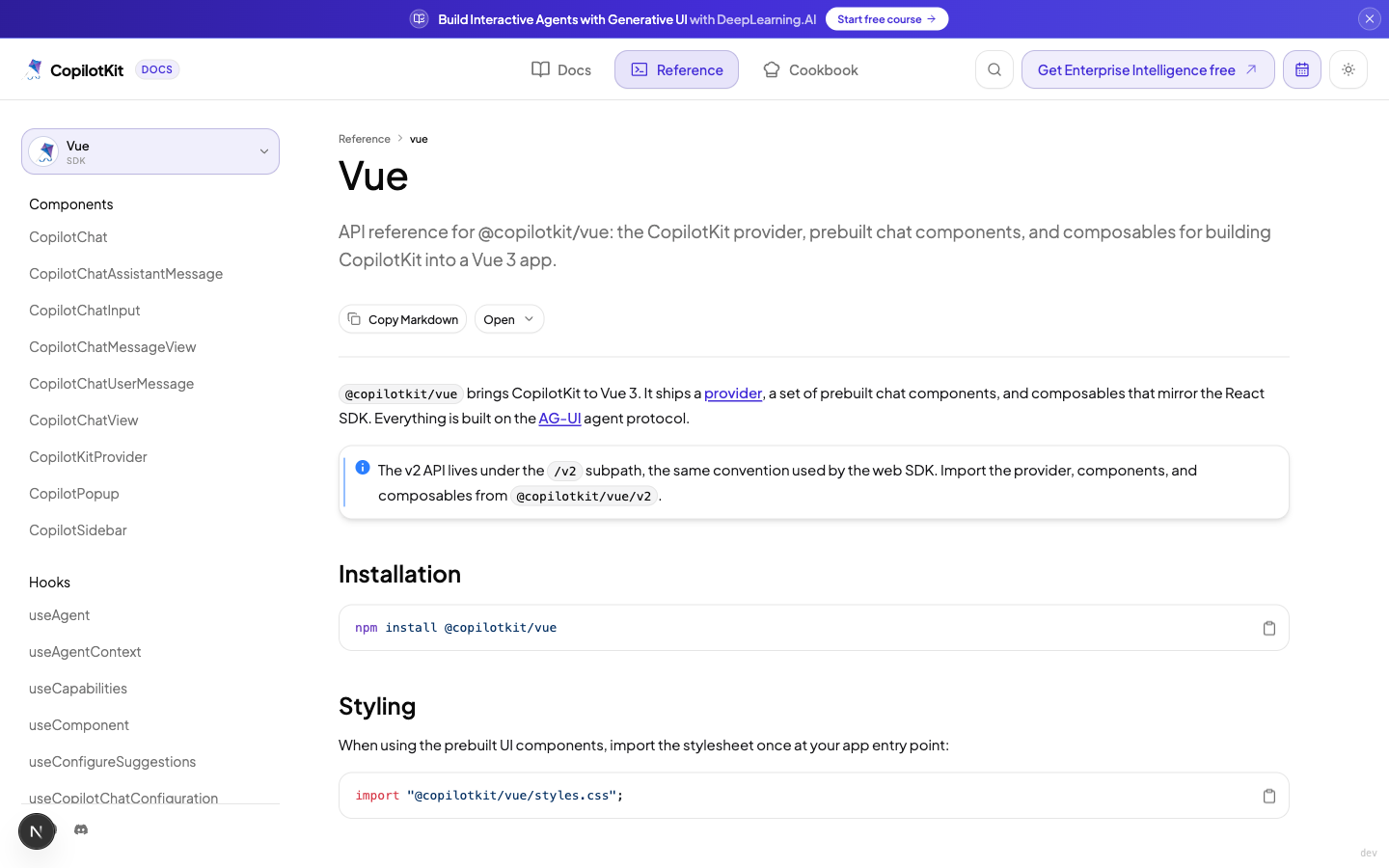
Adds a **Vue** section to the reference docs at `/reference/vue`,
alongside the existing React, React Native, and Core references. Until
now there was no Vue reference, so users and agents had no way to
discover the API.
It mirrors the React v2 reference but documents the real
`@copilotkit/vue/v2` API, with Vue idioms throughout (composables return
refs, slots instead of render props, kebab-case props, Vue SFC
examples).
### What's included
- The Vue index page (install, styling, provider setup)
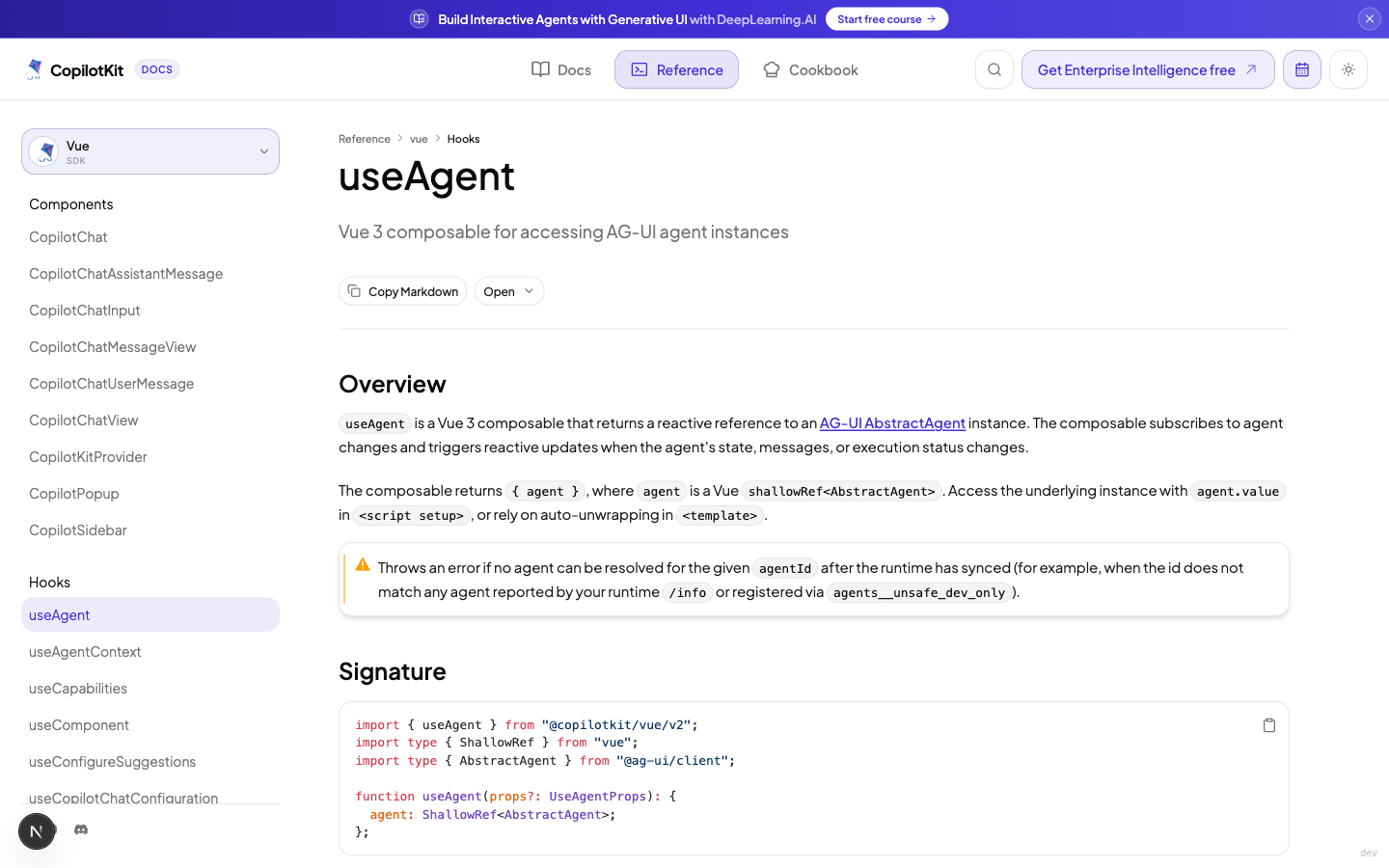
- 14 composables (useAgent, useFrontendTool, useHumanInTheLoop,
useThreads, and the rest)
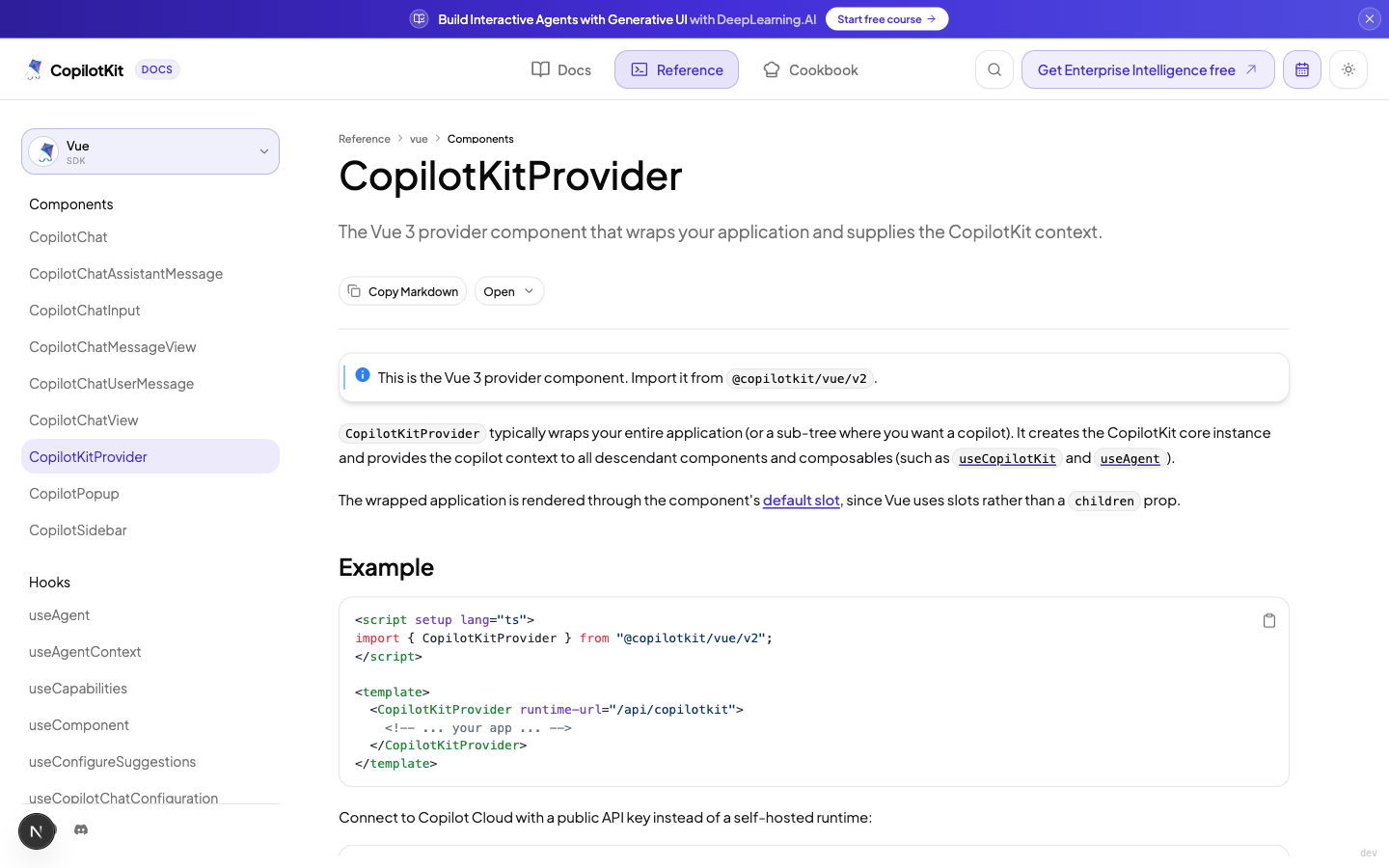
- 9 components (CopilotKitProvider, CopilotChat, CopilotPopup,
CopilotSidebar, and the chat sub-components)
- Vue registered in the SDK picker and the reference landing page
### Screenshots
Landing page (SDK picker set to Vue, full sidebar):
A composable page (useAgent):
A component page (CopilotKitProvider):
### How it was verified
- All 24 pages render (HTTP 200) on the local docs server
- Content shows up in `llms.txt` and `llms-full.txt`
- Each page was written from the Vue source, not copied from React, and
spot-checked for accuracy
Guide content and new demos are out of scope.
Fumadocs' default callout palette (generic blue/amber/green) renders the
docs <Callout> accent and left bar off-brand against the purple-anchored
theme — and on the main docs route the info/success tokens weren't emitted
at all, falling back to the near-white muted color.

Define --color-fd-info/warning/success as plain :root custom properties
(not @theme tokens, which Tailwind v4 tree-shakes when no utility class
references them — the Callout reads them only via inline var()). Map info
-> brand accent (purple), warning -> the existing docs --warning orange,
success -> brand mint (new --success token, mint/800 light, mint/400 dark).
All theme-aware; error stays mapped to --destructive via shadcn.css.
Adds the @copilotkit/vue v2 API reference to shell-docs: 9 component pages
(CopilotKitProvider, CopilotChat, CopilotChatView, CopilotChatInput,
CopilotChatMessageView, CopilotChatAssistantMessage, CopilotChatUserMessage,
CopilotPopup, CopilotSidebar) and 14 composable pages (useAgent, useAgentContext,
useCapabilities, useComponent, useConfigureSuggestions, useCopilotChatConfiguration,
useCopilotKit, useDefaultRenderTool, useFrontendTool, useHumanInTheLoop,
useInterrupt, useRenderTool, useSuggestions, useThreads), an index page, and
wiring into the reference version selector. Every documented API was verified
against packages/vue/src/v2.
The default framework's docs now live at bare root URLs (/quickstart,
/server-tools, ...) instead of under /built-in-agent/. The root
catch-all resolves BIA-authored pages first, /built-in-agent/:path*
permanently redirects to /:path*, and sidebar/landing/selector hrefs
are root-relative.

The whole root surface shares ONE sidebar: the Built-in Agent IA with
the agnostic root sections (Concepts, Runtime, Deploy, Platforms, Other)
folded in via buildRootSurfaceNav. Empty ---Section--- placeholders in
the BIA meta.json position each folded-in section; appendSharedRootSections
fills them, dropEmptySections clears any that stay empty, and route-group
nodes (e.g. the (other) tree) are excluded so the fold never emits a bogus
/(other)/... href. Without this, navigating from a BIA page to an agnostic
page (/concepts/*, /backend/*) swapped the sidebar between two overlapping
IAs. The fold is scoped to the root surface only — deepagents keeps
Platforms-only and generated frameworks are untouched.

Duplicate pages that the fold would otherwise double up are consolidated
onto their canonical root homes:
- The three BIA backend wrappers (copilot-runtime, custom-agent, ag-ui)
  are retired; the folded-in Runtime section is their single home. This
  resolves the /backend/ag-ui collision (the wrapper had shadowed the
  real root page). The bare /ag-ui segment belongs to the AG-UI protocol
  docs, so old /built-in-agent/ag-ui links redirect to /backend/ag-ui.
- The BIA troubleshooting wrappers are retired in favor of the canonical
  /troubleshooting/* pages surfaced by the folded-in Other section, so
  Troubleshooting appears once.

Stale redirect R25 (/runtime-server-adapter -> /backend/copilot-runtime)
is removed: runtime-server-adapter is a distinct, current 'Deploy to any
runtime' page linked from the sidebar, and the redirect had made it
unreachable at its own URL.

Middleware rules that would shadow or loop against the new surface
(M2 /quickstart, BIA_DEFAULT_ROOT_REDIRECTS, MV-telemetry) are retired,
and remaining live destinations move off the old prefix. The sitemap,
llms.txt, per-page .md/.mdx, and OG image routes resolve the same
content the pages serve. The client-side RouterPivot bounce is removed
since root URLs now render real content in place.
Adds a "React Native" SDK to the reference section, documenting the full
public surface of @copilotkit/react-native at /reference/react-native.

Navigation wiring:
- Register `react-native` in REFERENCE_VERSIONS / VERSION_SUBDIRS
- Add the "React Native" label to the SDK version selector
- Add a React Native card to the reference overview page

Content (22 pages, sourced from package source for accuracy):
- index: install, polyfills, provider setup, and the headless vs prebuilt
  two-tier model
- components: CopilotKitProvider, CopilotChat, CopilotModal, CopilotSidebar,
  CopilotPopup, CopilotMarkdown, AssistantMessage, UserMessage — disambiguating
  the headless (root) and prebuilt-UI (/components) variants of CopilotChat and
  CopilotModal by import path
- hooks: RN-specific useAttachments and useRenderTool, plus the platform-
  agnostic hooks re-exported from react-core/v2 adapted to RN imports and
  primitives (useAgent, useCopilotKit, useFrontendTool, useAgentContext,
  useThreads, useCapabilities, useComponent, useHumanInTheLoop, useInterrupt,
  useSuggestions, useConfigureSuggestions)

Content is picked up automatically by llms.txt / llms-full.txt via the
reference content walker.

OSS-250
Blur the Slack guide (/slack and its framework-scoped variants) and the
entire bot reference section behind a client-side unlock card. The card
follows the scroll in a sticky scrollport-height frame, persists unlock
state in localStorage, and leaves the sidebar and top nav usable. Doc
pages opt in via earlyAccess frontmatter; the bot reference gates on
version === "bot". Visitors without the password get a product shot
(light/dark variants in git LFS, shown beside the form on wide cards
via container query) and a link to the beyond-the-web early-access
form.
- New Platforms entry: /platform/slack quickstart — manifest-based app
  creation, Socket Mode tokens, minimal createBot bot run with tsx,
  interactive JSX with inline onClick, slash commands, production split
- New "Bots" SDK tab in the reference picker with per-symbol pages for
  @copilotkit/bot, @copilotkit/bot-ui, and @copilotkit/bot-slack
  (Components / Functions / Classes / Types)
- Rename reference picker labels to React (V2) / React (V1)
- Remove the retired /reference/sdk pages (LangGraph/CrewAI SDK,
  Remote Endpoints); search/sitemap/llms indexes derive from the
  content tree, so they de-index with the deletion
- Retarget the one inbound link to its /reference/v1 copy

Co-Authored-By: Claude <noreply@anthropic.com>
## What
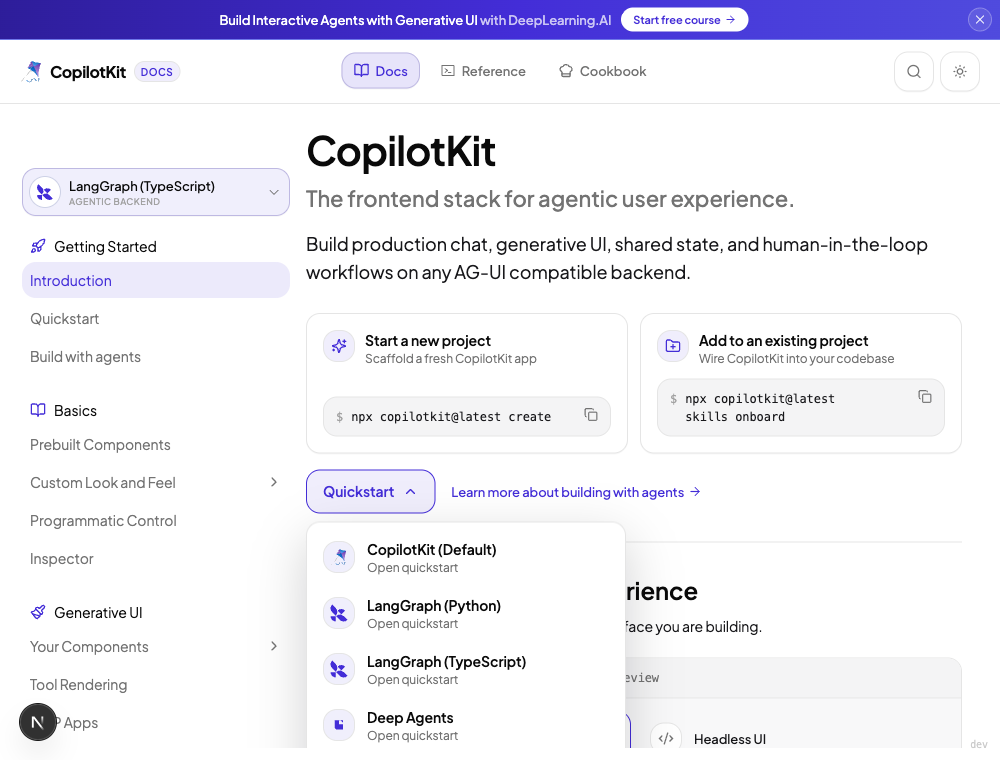
Replaces the landing-page CTA with **three entry points**, framed by
situation, and renders the **identical action block on the home hero and
every framework landing hero**:
| | action |
|---|---|
| **New project** | `npx copilotkit create` |
| **Existing project** | `npx copilotkit skills onboard` |
| **Guided walkthrough** | **Quickstart** button (preserved from the
previous hero) |
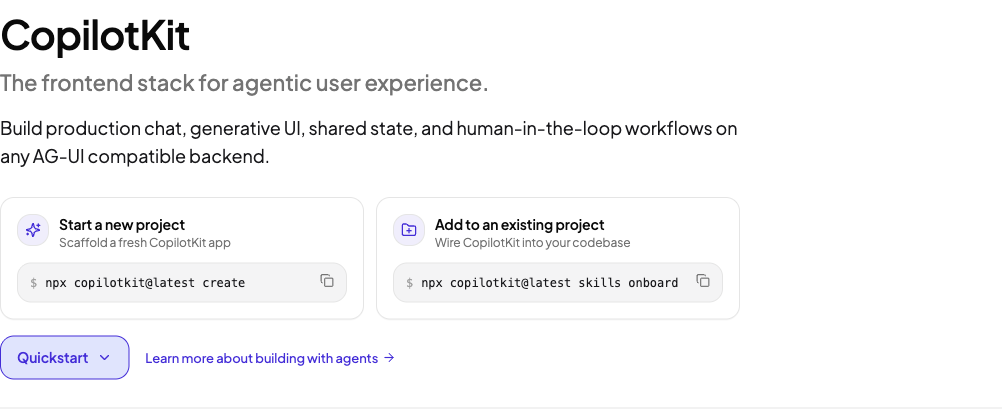
- **Unified `<HeroStartActions>` block**: two equal-weight command cards
plus a quickstart row beneath, shared verbatim by the home hero and the
framework landing heroes (per review: the two surfaces previously
diverged).
- **Quickstart preserved** in its original accent treatment. On the home
hero it is the framework-picker dropdown (`<HeroQuickstartDropdown>`,
restored); on framework pages it links straight to that framework's
quickstart guide. The home hero also keeps the "Learn more about
building with agents" link in the same row.
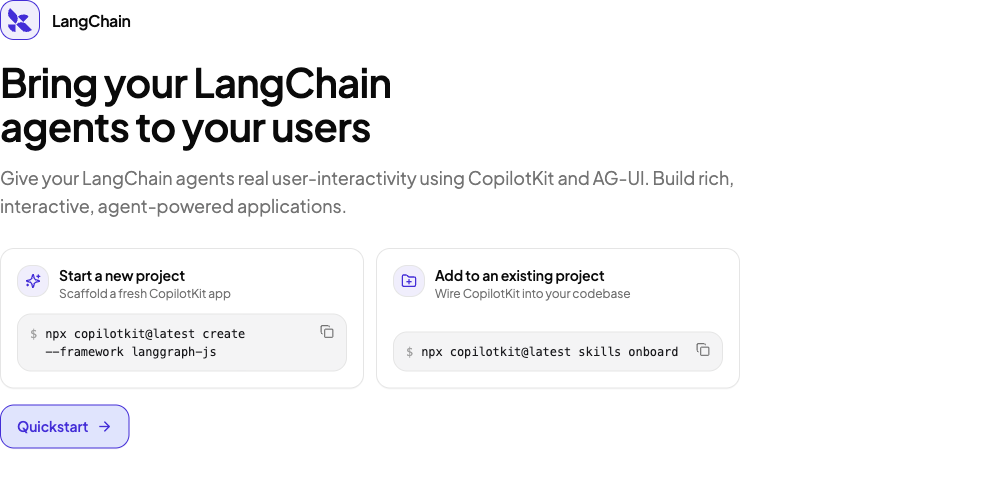
- **Framework landing heroes** (e.g. `/langgraph-typescript`): the
create command **pre-fills the framework** via the CLI's `--framework`
flag (e.g. `--framework langgraph-js`).
**Framework-flag mapping**: docs slug to CLI `--framework` value,
verified against the CLI's `AGENT_FRAMEWORKS` enum
(`langgraph-typescript`→`langgraph-js`,
`langgraph-python`→`langgraph-py`, `google-adk`→`adk`,
`strands`→`aws-strands-py`,
`ms-agent-dotnet`→`microsoft-agent-framework-dotnet`, identical for
`mastra`/`pydantic-ai`/`llamaindex`/`agno`/`ag2`). Slugs with **no** 1:1
CLI template fall back to a bare `npx copilotkit create`, notably
`crewai-crews` (the CLI ships *CrewAI Flows*, not Crews), plus
`langgraph-fastapi`, `claude-sdk-*`, `langroid`, `spring-ai`,
`agent-spec`, `deepagents`. `skills onboard` has no framework flag, so
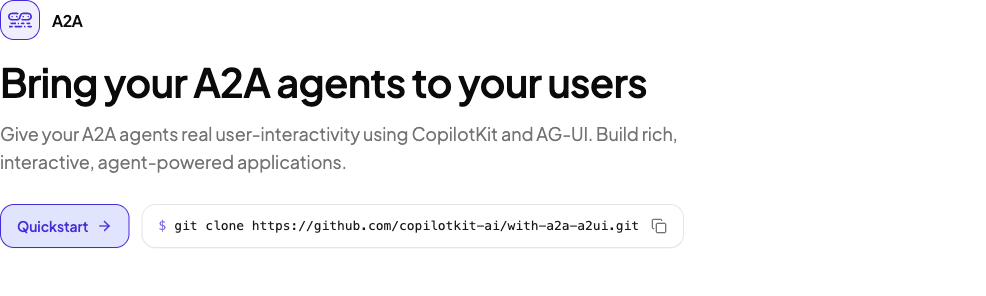
it is identical everywhere. Frameworks with bespoke setup (`a2a` `git
clone`, `ms-agent-dotnet`) keep the pre-cards layout: quickstart button
plus their own copy-command chip.
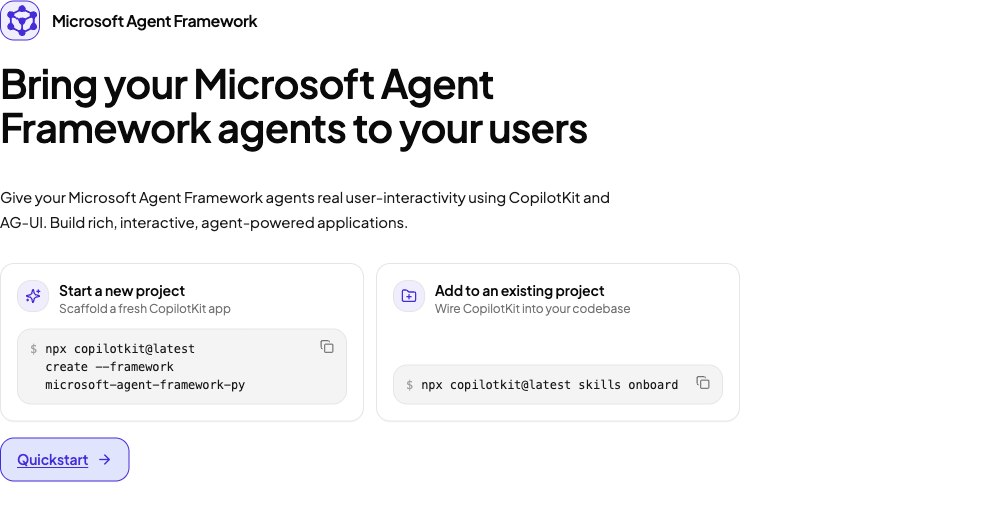
**Responsive, with all text always visible.** Commands **wrap, never
truncate**:
- Wraps happen at spaces only; every token is non-breaking, so
`--framework` can never split into a dangling `-` at a line edge.
- `text-wrap: balance` splits multi-line commands evenly, typically
right at the flag boundary (`npx copilotkit@latest create` /
`--framework langgraph-js`).
- The block caps at 740px with 12px mono, the narrowest cap where both
home commands fit one line with enough headroom to survive platform
mono-font width differences.
- Cards sit two-up from `sm` and stack below it; the grid (`min-w-0`,
`items-stretch`) keeps long commands inside their track and the card
pair equal-height.
## Screenshots
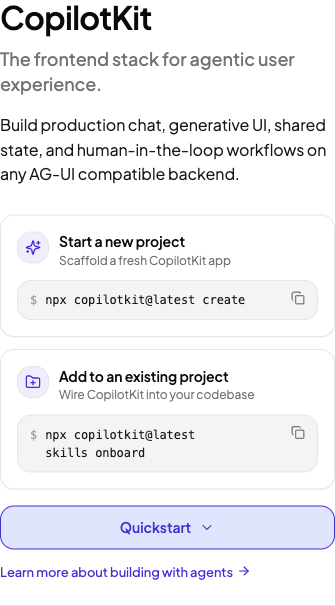
**Home**: two cards, quickstart dropdown, learn-more link
**Home, quickstart dropdown open** (framework picker preserved)
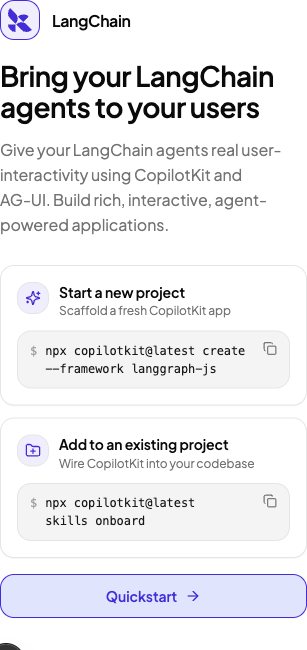
**Framework landing (LangGraph)**: same block, framework pre-filled,
create command balanced across two lines, quickstart links to the guide
**Worst case (Microsoft Agent Framework, Python)**: longest CLI flag
value, three balanced lines, fully readable
**Bespoke setup (A2A)**: quickstart button plus own command chip
(pre-cards layout preserved)
**Mobile (375px)**: cards stack, quickstart goes full-width
| home | framework |
|---|---|
| 
| 
|
## Telemetry
Both hero copy buttons are now explicitly instrumented: each click
captures **`hero_command_copied`** (`command_id`: `create` | `onboard`,
full `command` string, `clipboard_blocked`), so create-vs-onboard
funnels are queryable per landing page. The pre-existing global
`cli_command_copied` (fired by `CopyTracker` on any clipboard copy)
still fires for volume metrics; the new event uses a different name so
that funnel is not double-counted. Validated locally against a live
PostHog client: each click POSTs both events (plus `$autocapture`) to
`/ingest/e` with HTTP 200.
## Notes
- Both cards equal weight; accent only on hover. Copy rows copy on click
with `aria-live` feedback plus a clipboard-blocked fallback; cursor is
`pointer`.
- Removes `agent-start-prompt.tsx` and `hero-command-copy.tsx`.
`hero-quickstart-dropdown.tsx` is back (restored unchanged after review
feedback).
Review follow-up: bring back the quickstart button alongside the two
recommended commands, and render the identical <HeroStartActions> block
on the home hero and every framework landing hero.

- Quickstart returns in its original accent treatment: the framework
  dropdown on home, a direct guide link on framework pages; bespoke-init
  frameworks (a2a, ms-agent-dotnet) get back the old button + chip row.
- One layout everywhere: cards are always two-up from sm (no more
  stacked framework variant); commands wrap balanced at token boundaries
  instead of truncating, so long framework-pinned commands stay fully
  readable at every width.
Replace the home landing hero's Quickstart dropdown + command-copy chip
with a two-card <HeroStartCommands> block, framed by situation:

  - Start a new project        -> npx copilotkit@latest create
  - Add to an existing project -> npx copilotkit@latest skills onboard

Both cards are equal weight with no pre-selected default. Each command
row copies on click with an aria-live announcement and a clipboard-blocked
fallback. Commands pin @latest so npx never reuses a stale cached CLI.
Removes the now-unused hero-quickstart-dropdown and hero-command-copy
components.
 Sam Julien











