Browser extensions such as Grammarly inject attributes onto <body>
(data-gr-ext-installed, data-new-gr-c-s-check-loaded) before React
hydrates, which surfaces as a hydration mismatch error on first load of
the generated Next.js app.

Add suppressHydrationWarning to <body> in the langgraph-python north-star
and propagate to the parity instances (langgraph-js, langgraph-fastapi,
strands-python) via parity:sync. This only relaxes the check for <body>'s
own attributes (one level deep); everything rendered inside <body> is
still fully hydration-checked, and <body>'s className is static so none of
our own markup is masked.
## Summary
- run the plugin metadata sync after release prep updates package
versions
- ensure release PR creation commits include aligned plugin metadata

## Root cause
The release PR action commits generated version bumps, which triggers
the pre-commit plugin sync check. The workflow updated package versions
before committing but did not update plugin metadata first.

## Validation
- bash scripts/release/verify-release-scope-dropdowns.sh
- pre-commit hook

Note: actionlint was not installed locally.
The check-config-files gate requires new build-config files to be listed in
.github/config-allowlist.txt. Registers the new showcase's frontend config.

Co-Authored-By: Claude Opus 4.8 (1M context) <noreply@anthropic.com>
CR-round hardening that builds on the bug #1/#2 fixes: the P2 in-flight race
guard now reads the running digest from meta.imageDigest (the dead guard
never REFUSEd before) and is skipped on the --digest override path. Refresh
the snapshot ivar-lint allowlist line numbers after the surrounding CR line
drift.
Bug #2: promote used serviceInstanceRedeploy, which replays the EXISTING
deployment and never pulls the newly-pinned digest, so prod could keep
serving stale. Switch to serviceInstanceDeployV2 to spawn a NEW deployment
that pulls the pinned digest, then verify_serving_digest! fail-loud asserts
the new deployment reaches SUCCESS and its meta.imageDigest == the pinned
digest. Update the promote mock-GraphQL fixtures across the spec suite to
return serviceInstanceDeployV2 + meta.imageDigest accordingly.
Bug #1: resolved_prod_image re-resolved :latest at promote time, so prod
could be pinned to a digest different from what staging is actually serving.
Now resolve via staging_running_digest (latestDeployment meta.imageDigest)
and REFUSE when unavailable. Add detect_staging_drift +
emit_staging_drift_warnings to surface (non-fatally) when :latest has moved
past staging's running digest; aggregate markers across the fleet in
promote-fleet.sh (printf join) and plumb the drift_line through
showcase_promote.yml (both Slack payloads + fallback log + GITHUB_OUTPUT
single-line guard). Skip drift detection on the --digest override path.
Adds a **Vue** section to the reference docs at `/reference/vue`,
alongside the existing React, React Native, and Core references. Until
now there was no Vue reference, so users and agents had no way to
discover the API.
It mirrors the React v2 reference but documents the real
`@copilotkit/vue/v2` API, with Vue idioms throughout (composables return
refs, slots instead of render props, kebab-case props, Vue SFC
examples).
### What's included
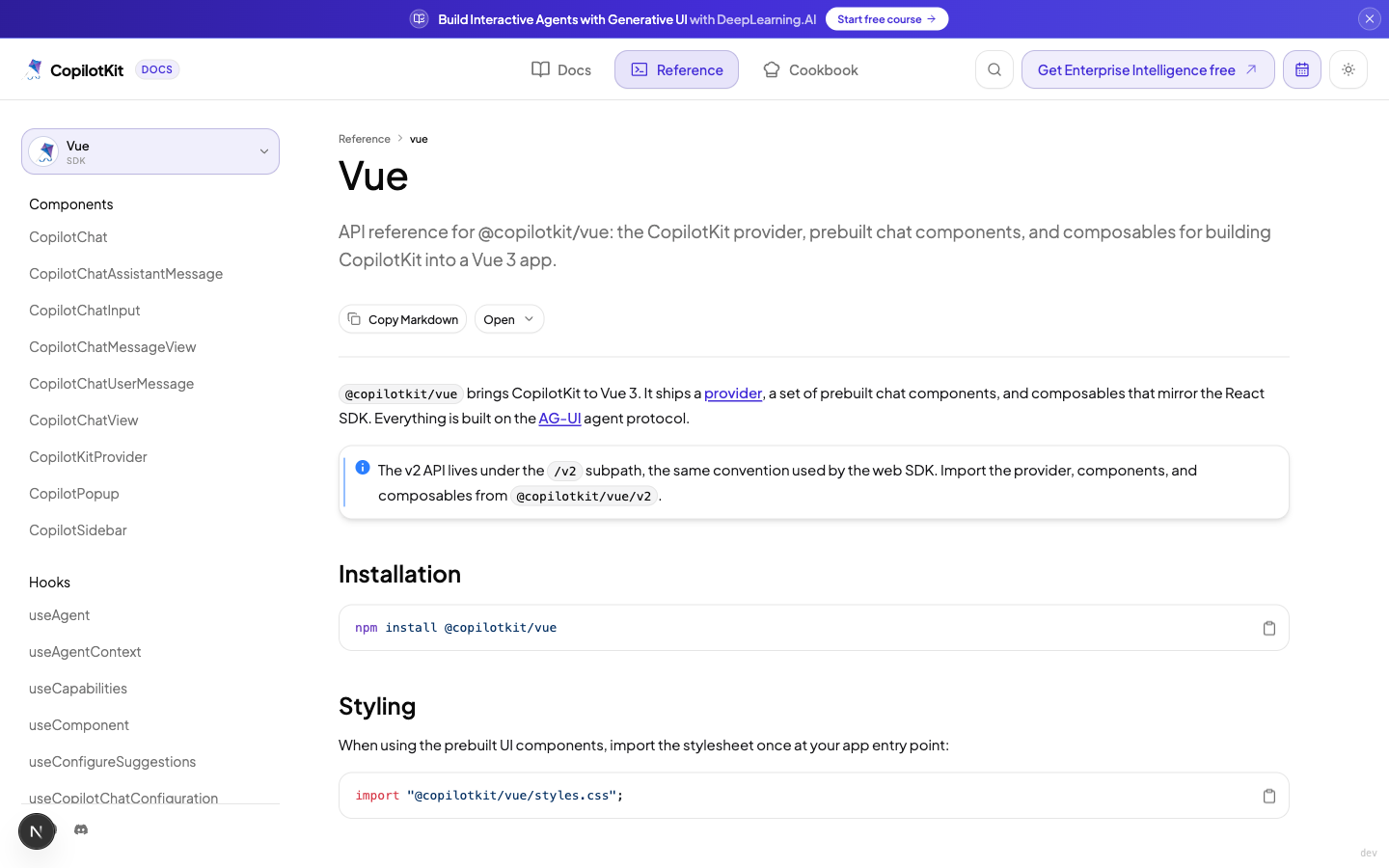
- The Vue index page (install, styling, provider setup)
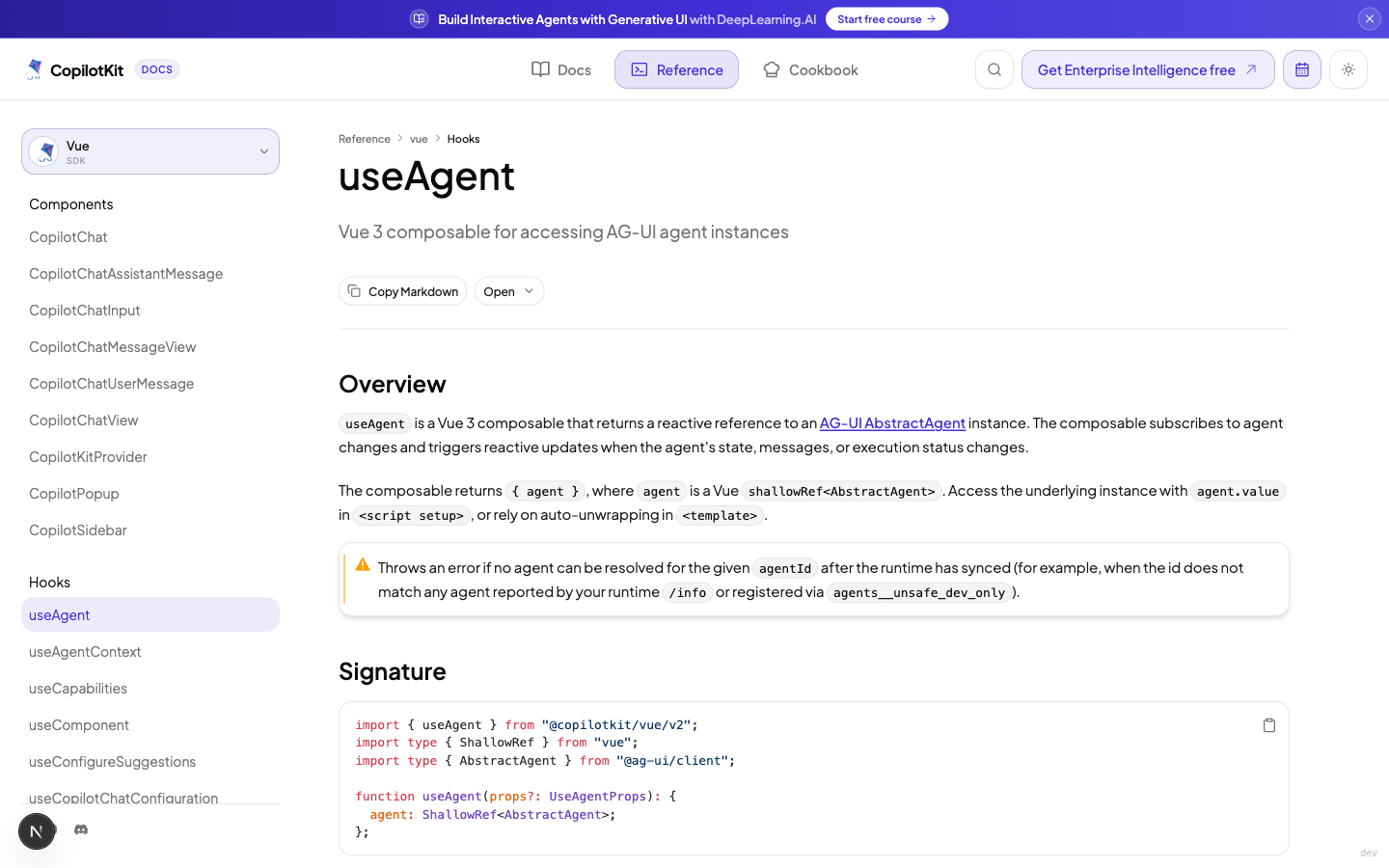
- 14 composables (useAgent, useFrontendTool, useHumanInTheLoop,
useThreads, and the rest)
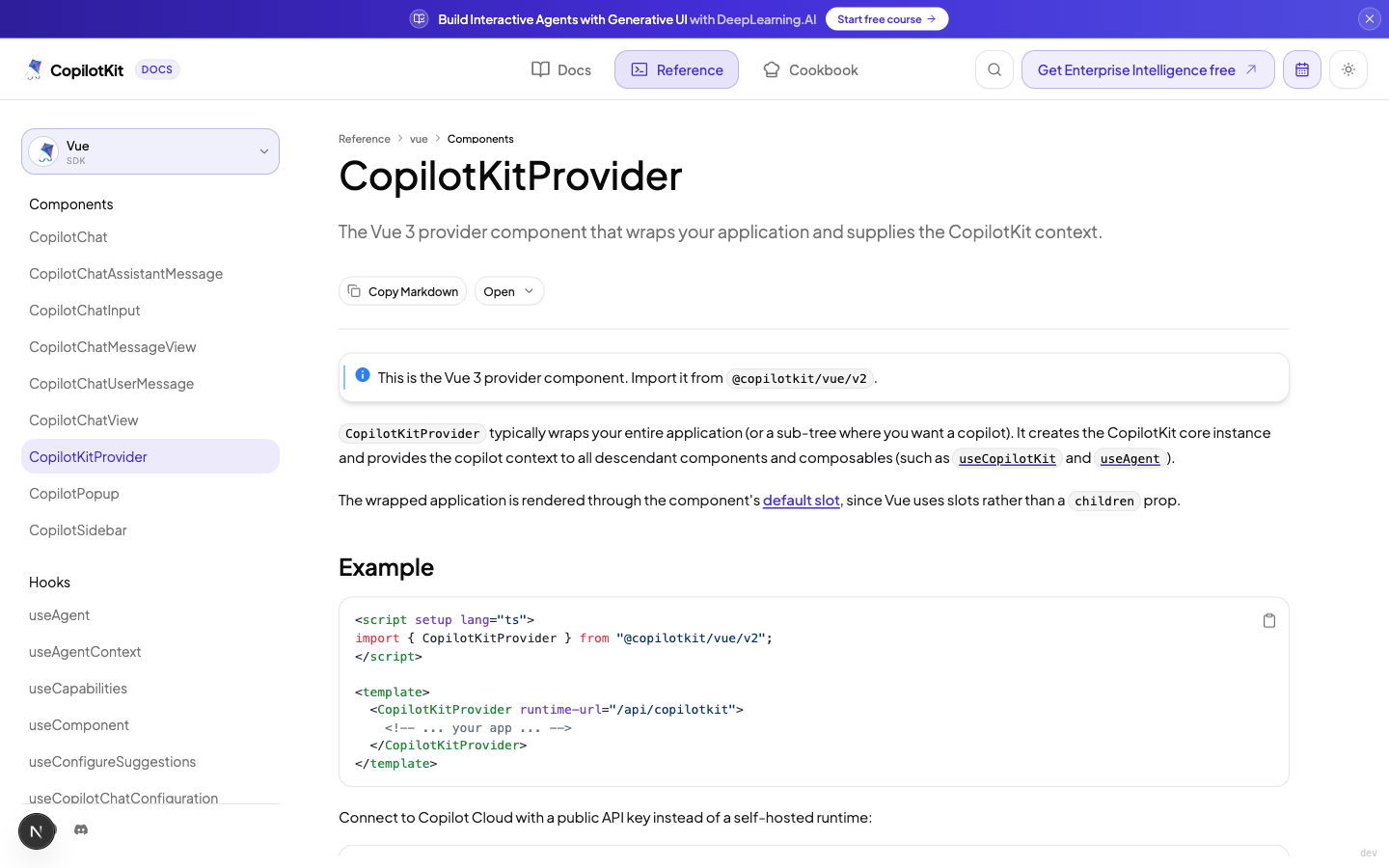
- 9 components (CopilotKitProvider, CopilotChat, CopilotPopup,
CopilotSidebar, and the chat sub-components)
- Vue registered in the SDK picker and the reference landing page
### Screenshots
Landing page (SDK picker set to Vue, full sidebar):
A composable page (useAgent):
A component page (CopilotKitProvider):
### How it was verified
- All 24 pages render (HTTP 200) on the local docs server
- Content shows up in `llms.txt` and `llms-full.txt`
- Each page was written from the Vue source, not copied from React, and
spot-checked for accuracy
Guide content and new demos are out of scope.
## Summary
- Update locked Threads drawer copy in integration examples to use `npx
copilotkit@latest license`
- Keep the command consistent across the example variants that render
the licensed feature panel

## Validation
- Pre-commit hooks ran lint/check package hooks successfully
- Verified integration examples no longer render the stale `copilotkit
license` command
applyByteCap's "hard guarantee" docstring was false: it trimmed only the
metadata bag (Steps 1-3), so caller-supplied variable-length STRING fields
that the caller controls — `slug`, `demo`, `parent_span_id`, `trace_id` —
were never trimmed. A 5000-char `demo`/`slug` enqueued ~5552B over the 2048B
default cap while stamped `_truncated:true` as if bounded (spec §7 R5-F3
violation).

Add Step 4: after the metadata bag is exhausted (dropped to {}), if the
envelope is STILL over cap the excess can only be in those four caller string
fields. Clamp them longest-first to a short prefix + `…[clamped]` marker until
under cap. Minted ids (`test_id`, `span_id`) are left intact — they are
fixed-width by construction and already bounded; `trace_id` mirrors `test_id`
(fixed-width UUIDv7) so it is included only for completeness so the
post-condition holds even for a hand-built oversized `trace_id`. Format-
constrained / enum / numeric fields (`boundary`, `layer`, `outcome`, `ts`,
`mono_ns`, `duration_ms`, `schema_version`, 9-key `edge_headers`) are bounded
by construction and never touched. Post-condition: serializedSize(env) <= cap
for ANY realistic envelope.

Fix `_truncated` semantics: stamp it only when trimming ACTUALLY occurred (a
field was modified), per its documented meaning, rather than on bare over-cap
detection. A detection that finds nothing trimmable until Step 4 ends with
Step 4 trimming and stamping.

applyByteCap is private; its sole caller is buildEnvelope (which both emit()
and flush() route through). Pure instrumentation preserved — never throws.

Adds a durable bytecap-invariant matrix test over pathological shapes (huge
slug/demo/parent_span_id, huge nested + scalar-heavy metadata, default + debug
tiers) asserting serializedSize(env) <= BYTE_CAP_BY_TIER[tier] for every case.
The §6 PII guarantee was incomplete in three ways that three CR rounds kept
re-finding in the same class. This completes the scrub.

1. Nested-value scrub. `validateMetadata` scrubbed ONLY top-level string
   values; secrets buried in allow-listed array/object values (e.g.
   `backend.error.caught.stack_brief`, `aimock.match.decision.reject_reasons`)
   leaked. New `scrubDeep(value)` in scrub.ts (leaf module; called from
   schema.ts which already imports from ./scrub.js — no cycle) applies
   `scrubSecrets` to every string LEAF at any depth, preserving structure and
   non-string leaves. validateMetadata deep-scrubs object/array values on a
   `structuredClone` (cycle-preserving; no caller mutation), falling back to
   in-place scrub on the rare unclonable input (correctness > no-mutation).

   Walker cycle-safety: ITERATIVE (explicit work stack, never the call stack)
   with a WeakSet visited-guard — a self-referential/cyclic or 10k-deep object
   is visited once and never re-entered, so no stack-overflow/hang on untrusted
   metadata. Only plain objects (Object.prototype/null proto) and arrays are
   descended; Date/RegExp/etc. are left as-is.

2. base64url key alphabet. SK_KEY_REGEX
   `/sk-(?:[A-Za-z0-9_-]*[A-Za-z0-9]{12,})[A-Za-z0-9_-]*/g` redacts modern keys
   whose body uses base64url incl. `_`/`-` (sk-ant-api03-AbCd_Ef-…, sk-proj-…),
   with a ≥12-char contiguous-alnum entropy gate (shortest real tail
   `0123456789xyzAB` = 15) so prose ("ask-me-later" → me/later; "task_list_items"
   uses `sk_` not `sk-`) is NOT redacted. Legacy `sk-<16+ alnum>` still matches.

3. multi-@ URL userinfo. URL_USERINFO_REGEX `/([a-z][a-z0-9+.-]*:\/\/)[^/\s]*@/gi`
   redacts the FULL authority up to the LAST `@` before the host/path; excluding
   `/` keeps it from crossing into the path. Fixes `https://a@b@c.com/x` leaking
   `b@c.com`; user:pass@ and bare-token tok@ still work.

scrubSecrets signature + SCRUB_REPLACEMENT unchanged. Call sites of the deep
scrub: schema.ts `validateMetadata` (object/array branch) → scrubDeep; emit.ts
buildEnvelope routes data-plane metadata through validateMetadata unchanged.

Red→green: scrub-coverage corpus (schema.test.ts) + nested array-of-objects
sweep & cyclic-input safety (emit.test.ts) observed RED (base64url key
unredacted; multi-@ tail leaked; nested secret survived envelope JSON), GREEN
after fix. Full cvdiag suite 119/119 (pb-writer live-PB test skipped sans
PB_BIN). tsc clean; oxfmt + oxlint 0 errors on touched files.
1.61.0 is now published. Regenerates all 20 starter package-lock.json files
so @copilotkit/* resolves to 1.61.0 and the transitive
@copilotkit/license-verifier moves 0.4.2 -> 0.5.0 (shipped by runtime@1.61.0).

ENT-939
buildEnvelope's accounting branch aliased args.metadata into the
envelope; applyByteCap's in-place trims (Steps 1/2) then mutated the
caller's object as a side effect of pure instrumentation. Shallow-clone
the accounting bag before it enters the envelope (data-plane events
already get a fresh `survivor` from validateMetadata, so only the
accounting branch needed the clone).

applyByteCap Step 3's full-bag size-drop stamped _metadata_dropped, but
that flag is the §6 PII closed-world signal (set by buildEnvelope when
validateMetadata drops unknown keys); overloading it for a SIZE drop
pollutes PB drift queries. A size-drop is already observable via the
_truncated flag stamped earlier, so Step 3 now drops the bag without
touching _metadata_dropped. The genuine PII stamp is unchanged.

Call sites (both private, in-module only):
  buildEnvelope: emit() (emit.ts:309), flush() accounting (emit.ts:514).
  applyByteCap:  buildEnvelope() (emit.ts:388).
No external callers.
The old SK_KEY_REGEX /sk-[A-Za-z0-9]{16,}/ stopped its character class at
the first hyphen, so modern hyphenated-prefix keys leaked into PocketBase:
the `proj` (4) / `ant` (3) / `api03` (5) prefix segments never reached the
required 16-char run, so `sk-proj-…` and `sk-ant-api03-…` never matched and
were stored verbatim — defeating the §6 secret-scrub guarantee for the two
most common real-world key formats.

New pattern: /sk-(?:[A-Za-z0-9]+-)*[A-Za-z0-9]{16,}/g
  `sk-` then zero-or-more hyphen-terminated alnum SEGMENTS (the prefix words)
  followed by a ≥16-char alnum entropy TAIL.

Why it does not over-redact ordinary hyphenated prose: the mandatory 16+
alphanumeric tail is the entropy gate. Words like "ask-me-later" or
"task-list" have no 16+ contiguous alnum run after an `sk-`, so they never
match (negative test asserts the phrase is returned unchanged). The legacy
`sk-<16+ alnum>` form is preserved as the zero-segment case.

SCRUB_REPLACEMENT and scrubSecrets structure unchanged. Four new tests
(sk-proj-, sk-ant-api03-, legacy sk-<16+>, negative over-redaction);
RED on the two hyphenated cases pre-fix, GREEN after. Full cvdiag suite
110/110.
Move the `pbWriter === undefined` early-return to the TOP of flush(), before
the queue.splice and the drop-accounting block. Previously, with no writer,
flush() spliced the queue into `batch` and discarded it on the trailing
early-return while resetting droppedSinceFlush to 0 — silently losing all
queued telemetry every flush window. Under { autoFlush: true } with no writer
this was continuous data loss, contradicting the documented pbWriter contract
("When absent, events stay queued").

flush() callers: the startBackgroundFlush() interval timer and any manual
flush() call. With a writer present, the A3 drop-accounting + reset-only-
after-landing behavior is unchanged.
Runnable companion to the "Build an Agentic Travel App with Oracle Agent
Memory, Agent Spec, and CopilotKit" cookbook recipe: a portable Oracle Agent
Spec agent on LangGraph over AG-UI, long-term memory on Oracle AI Database,
and a CopilotKit V2 frontend with generative UI + human-in-the-loop.

- agent/    Python (uv) Agent Spec agent + FastAPI AG-UI server
- frontend/ Next.js CopilotKit V2 chat (flight cards, recall chip, HITL booking)
- db/       Oracle AI Database (Free image) + cookbook-user init
- docker-compose.yml for local Oracle; per-service railway.json for deploy

Co-Authored-By: Claude Opus 4.8 (1M context) <noreply@anthropic.com>
flush() previously zeroed droppedSinceFlush BEFORE confirming the accounting
emit() landed, then recovered the just-enqueued event via a fragile second
splice of the whole queue (which APPENDS despite the "prepend" docstring). If
that emit() returned null (validateEnvelope failure / exception) the drop count
AND the cvdiag.queue_dropped record were permanently lost.

Fix: extract the envelope-construction + validateEnvelope + applyByteCap logic
of emit() into a private buildEnvelope() helper (no enqueue side effect). flush()
now calls buildEnvelope() for the accounting event and pushes the result DIRECTLY
into the outgoing batch (no queue round-trip / re-splice). droppedSinceFlush is
reset to 0 ONLY after the accounting envelope is in the batch, so a null/throw
retains the count for the next flush. Docstring updated to "append" (event order
in a best-effort batch is not load-bearing — the classifier re-sorts by mono_ns/ts).

Call sites of the extracted buildEnvelope(): emit() (enqueues result, still
resolves/returns CvdiagEnvelope|null) and flush() (appends to batch, still
resolves/never-rejects). Public method signatures unchanged.

Red-green: src/cvdiag/emit.test.ts. Loss-path test forces the accounting build
to return null and asserts the drop count is retained (lands on the next flush);
RED on original = 0 queue_dropped events land (count silently lost), GREEN after
fix = exactly 1 lands with _dropped_count preserved.
applyByteCap previously stamped _truncated:true and trimmed only >64-char
string values / nested objects in metadata. An envelope over the tier byte
cap due to many short-string or numeric/boolean metadata values (none
reachable by that pass) was stamped truncated yet still enqueued OVER cap,
violating spec §7 R5-F3 ("the whole serialized envelope must fit the tier
byte cap").

Fix escalates while still over cap: (1) legacy >64-char/object trim, then
(2) clamp ALL string values progressively, then (3) drop metadata to {}
(stamping _metadata_dropped). Fixed scalar envelope fields are bounded by
construction, so an empty metadata bag is the hard guarantee the enqueued
row fits any realistic cap. Method stays pure-instrumentation: it never
throws.

Call sites: applyByteCap is private; emit() (emit.ts:361) is the sole caller
and already wraps it in try/catch. Post-condition holds: on return the
serialized envelope is <= cap OR metadata is already {}.
validateMetadata kept surviving metadata VALUES verbatim and never scrubbed
them, so Bearer/sk-/URL-userinfo secrets in free-text fields (e.g.
*.message_scrubbed, probe.*.url) reached PocketBase unscrubbed — violating
spec §6 (the field is literally named message_scrubbed). Now every SURVIVING
string metadata value is run through scrubSecrets; non-string values are left
untouched.

Also tighten URL_USERINFO_REGEX: the old pattern required a user:password@
colon, so a bare-token userinfo (scheme://token@, e.g. https://ghp_xxx@host)
was NOT redacted. The new pattern matches any non-/, non-@, non-ws run before
@, covering BOTH the colon and no-colon forms; the $1[REDACTED]@ replacement
shape is unchanged and the / exclusion confines the match to the authority.

Import-cycle avoidance (approach a): moved scrubSecrets + its regex constants
into a new leaf module scrub.ts that has NO intra-cvdiag imports. Applying the
scrub inside validateMetadata required schema.ts to call scrubSecrets, but
edge-headers.ts already imports EDGE_HEADER_KEYS from schema.ts, so importing
scrubSecrets from edge-headers into schema would form a schema -> edge-headers
-> schema cycle. The leaf module is imported by both; edge-headers re-exports
the symbols so the historical public surface is preserved.

scrubSecrets call-site enumeration (all still resolve):
  - src/probes/drivers/d4-chat-roundtrip.ts (imports from ./cvdiag/index.js;
    index.ts does `export * from ./edge-headers.js`, which re-exports scrub.ts)
  - src/cvdiag/raw-byte-capture.ts (imports from ./edge-headers.js — re-export)
  - src/cvdiag/index.ts (`export *` from edge-headers — re-export intact)
## Summary
- fix Showcase docs snippets that import `randomUUID` from non-existent
`@copilotkit/shared/v2`
- use the published `@copilotkit/shared` entrypoint instead
- move the fix to the publishing Showcase docs source under
`showcase/shell-docs`

## Linear
- FAC-65

## Verification
- `rg -n "@copilotkit/shared/v2" showcase/shell-docs/src/content`
returns no matches
- `pnpm validate:model-names`
- `npm ci --ignore-scripts` in `showcase/shell-docs`
- `npm run build` in `showcase/shell-docs`
- `git diff --check`
- pre-commit passed after refreshing root dependencies with `pnpm
install`
## Summary
- wrap the Deep Agents TypeScript `observed_steps` custom state field in
`zodState`
- clarify that `step_progress_tool.steps` intentionally maps into the
`observed_steps` state field
- move the fix to the publishing Showcase docs source under
`showcase/shell-docs`

## Why
The QA report called out a mismatch between `steps` and
`observed_steps`. That mapping is intentional via `stateItem`; the
actual issue is that the custom state field was declared as plain Zod.
In LangGraph JS, fields that are not wrapped with `zodState` can be
filtered out of the AG-UI state snapshot, so the tool call can happen
while the UI never receives the rendered state.

## Verification
- `pnpm validate:model-names`
- `npm ci --ignore-scripts` in `showcase/shell-docs`
- `npm run build` in `showcase/shell-docs`
- `git diff --check`
 Maximiliano Korp





