## Summary
- Rename the overview capability from "Cloud-hosted web app" to
"Cloud-hosted Intelligence features".
- Remove the redirecting multi-conversation tutorial link from thread
docs, shared thread snippets, and useThreads references.

## Validation
- npm run test (showcase/shell-docs)
- npm run lint (showcase/shell-docs; exits 0 with pre-existing warnings)
- npm run typecheck (showcase/shell-docs)
- npm run build (showcase/shell-docs)
- Manual link sweep for edited MDX confirmed no remaining
/tutorials/multi-conversation-chat links
## What does this PR do?

Adds stable test IDs to the CopilotChat input area so automated tests
can reliably target the default chat UI.

Changes included:

- Adds `data-testid="copilot-chat-input"` to the chat textarea.
- Adds standard `data-testid` values to the send and stop button.
- Keeps the existing `data-test-id` values for backwards compatibility.

This is a small non-breaking testability improvement for the React UI
package.

## Related PRs and Issues

Related to #4215

## Checklist

- [x] I have read the Contribution Guide
- [x] If the PR changes or adds functionality, I have updated the
relevant documentation
- [x] Allow edits by maintainers is checked
## Hotfix — staging harness was crash-looping

PR #5616's on-demand-trigger code (`http/fleet-runs.ts`) imports
`control-plane.js` first, whose transitive load (`control-plane →
job-producer → run-view → control-plane`) evaluated `run-view.ts`'s
top-level `FLEET_FAMILIES` literal **before** `control-plane.ts`
finished assigning `FLEET_PRODUCER_SCHEDULE_ID` (+3 sibling schedule-id
constants) → `ReferenceError: Cannot access 'FLEET_PRODUCER_SCHEDULE_ID'
before initialization` → the harness never bound its port (staging
harness down; workers stuck on the stale digest).

The cycle was latent (prior load order happened to init the constants
first); the trigger change shifted load order and exposed it.

## Fix
New leaf module `fleet/control-plane/schedule-ids.ts` (zero imports)
holds the four `SCHEDULE_ID` constants. `control-plane.ts` re-exports
them (public surface unchanged); `run-view.ts` imports them from the
leaf instead of from `control-plane.js`. No eval-time edge into the
cycle → no TDZ.

## Verification (real boot — not just tsc; tsc passed while it crashed
at runtime)
- **RED** on main: `import('./dist/http/fleet-runs.js')` and
`import('./dist/orchestrator.js')` both threw the exact ReferenceError.
- **GREEN**: all four load orders (fleet-runs, orchestrator entrypoint,
control-plane, run-view) import clean; `FLEET_FAMILIES` builds with 4
entries.
- New regression guard `import-cycle-tdz.test.ts` (3 tests) asserts the
module graph imports without throwing.
- Fleet control-plane suite 347/347; broader fleet + fleet-runs +
orchestrator 814/814; `tsc --noEmit` clean (one pre-existing unrelated
`glob` env error, untouched).

## Note
CI's build-check compiles the harness image but never boots the fleet
control-plane, so this slipped through green. The new import test is a
boot-time regression guard.

🤖 Generated with [Claude Code](https://claude.com/claude-code)
## What

Completes the cvdiag observability subsystem so a single flapping
showcase run is **fully attributable end-to-end** — and makes every
probe reproducible on demand. Four fixes, all proven against the real
surface (live PocketBase writer-role, real `next` build, driver vitest):

1. **Cross-layer `test_id` join (the keystone).** Both sides were using
different ids: the backend minted its own UUIDv7, and the probe
re-minted a random UUIDv7 when its forwarded `X-Test-Id`
(`d6-<slug>-<runId>`) wasn't a UUIDv7. Now both run the same
`sanitizeJoinTestId` over the forwarded id → probe.* and backend.* rows
for one run **share `test_id`** (the join key per `schema.ts`); each
side keeps its own `trace_id`/`span`.
2. **Probe failure classifier.** `probe.exit` now stamps `outcome=err` +
`failure_classifier` (`sse-missing`/`dom-missing`/`text-unstable`) from
`waitForTurnComplete`'s reason, instead of `outcome=ok` on every run —
so reds are labeled, not inferred.
3. **Backend boundaries.** (Confirmed already on main — full 11-boundary
set incl `request.ingress`/`sse.first_byte`/`llm.call.*`.)
4. **On-demand trigger for EVERY probe.** New `POST
/api/runs/:family/trigger` (OPS-token-gated, rate-limited) fires any
fleet/D6 probe via the existing job-producer enqueue; in-process probes
keep their route. No more waiting on the hourly cron to reproduce a
flap.

## Why

cvdiag was live and persisting, but couldn't yet say "backend stall vs
frontend race" for a single red because probe and backend rows couldn't
be joined, reds weren't labeled, and D6 wasn't on-demand reproducible.
These close those gaps.

## Verification
- harness `tsc --noEmit` clean · cvdiag + drivers vitest **665 passed /
31 files** (join + classifier + boundary + trigger together) · 4
fix-test files 151 passed
- codegen `--check` + `cvdiag-stage-ts --check` in-sync (schema.json + 4
staged copies regenerated, not hand-merged)
- real Docker `next build` of built-in-agent succeeded (backend boundary
+ writer code bundles)
- live-PB writer-role RED→GREEN for the join; driver RED→GREEN for the
classifier; enqueue-assertion RED→GREEN for the trigger

## Follow-ups (not in this PR)
- Python dual-process (:8123) backend→PB shipping gap (python
integrations emit zero backend rows despite the auth fix)
- liveness-probe 400 noise → `outcome=info` + plumb real `model_id`
- Java/.NET backend writer-role auth
- break the run-view⇄control-plane import cycle the trigger routes
around

🤖 Generated with [Claude Code](https://claude.com/claude-code)
schema.json regenerated from the merged canonical schema.ts (failure_classifier
probe.exit additions UNION backend request.ingress/sse.first_byte/llm.call.*
boundaries + test_id adoption). Per-integration staged schema.ts copies
re-derived via 'showcase cvdiag-stage-ts' so codegen --check and stage --check
are both in sync. No hand-merge of generated artifacts.
## Summary

- `upload-artifact`'s `!**/node_modules/**` filters are post-walk: the
action still descends into every `node_modules` and stats every file
(~6M with pnpm's `.pnpm/` symlink farm) before applying negations. That
enumeration is the actual bottleneck — `Upload workspace` runs 10+
minutes even with the filters added in #5044.
- Replace the filtered upload with: `rm -rf` the heavy dirs
(`node_modules`, `.nx`, `.turbo`, `.next`), `tar -czf /tmp/workspace.tgz
.`, upload that single file. Publish job `tar -xzf`'s it after download
and continues unchanged.
- Applied symmetrically to `prerelease.yml` and `publish-release.yml`.

## Measured impact

Verified on a dry-run dispatch of `release / pre` against this branch
([run
26531785850](https://github.com/CopilotKit/CopilotKit/actions/runs/26531785850)):

| Step | Before (run 26529550757) | After (this PR) |
| ------------------------------- | ------------------------ |
--------------- |
| Upload workspace | ~800s (cancelled) | **3s** |
| Pack workspace | — | 9s |
| Download workspace | — | 1s |
| Unpack workspace | — | 1s |
| **Total artifact round-trip** | **~800s** | **14s** |

- `Upload workspace` step alone: **~99.6% reduction (~267× faster)**.
- Full pack/upload/download/unpack pipeline vs the prior single upload:
**~98% reduction (~57× faster)**.

The 800s baseline is from a cancelled run, so both numbers are
conservative.

## Test plan

- [x] Dispatch `release / pre` against this branch with `dry_run=true`
- [x] Confirm `Upload workspace` completes in seconds instead of 10+ min
- [x] Confirm publish job `Unpack workspace` restores the tree and `pnpm
install` succeeds
- [x] Confirm dry-run publish step exits clean (no missing files from
the tarball round-trip)

🤖 Generated with [Claude Code](https://claude.com/claude-code)
## What

A new Cookbook recipe — **Build an agentic app on Angular + Google ADK**
— covering the non-obvious production gotchas when you wire an Angular
frontend to a Google ADK agent over AG-UI, with optional CopilotKit
Intelligence threads and memory. Written in the existing cookbook house
style (symptom → cause → fix callouts), and it links out to the Angular
and ADK quickstarts rather than re-teaching setup.

## Why

The Angular + ADK combination has a handful of correctness issues that
only surface in a real, multi-user, governed app, and they aren't
covered by the per-piece quickstarts:

- One agent, one store (a second composer must not create its own store)
- Scope the user via the **run body**, not an HTTP header (a header lags
by one in-session switch)
- Never reconfigure the runtime mid-submit (it recreates the agent store
and drops the message)
- Governance is server-side; the per-request allow-list rides the run
body
- Choose a capable model, and degrade gracefully when the Intelligence
platform is absent

The recipe is **model-flexible**: it frames ADK as running Gemini by
default but supporting any model ADK supports, consistent with the ADK
quickstart.

## Changes

- **New** `cookbook/angular-adk-agentic-app.mdx` — the recipe
- `cookbook/meta.json` — register in nav
- `cookbook/index.mdx` — add the index card (uses
`/logos/google-adk.svg`)
- `src/lib/sidebar-icon.tsx` — add `custom/google-adk` sidebar icon
entry
- `frontends/angular.mdx` — bidirectional cross-link into the recipe
- `src/lib/__tests__/docs-render.test.ts` — update the cookbook nav test
for the new page

## Test plan

Run from `showcase/shell-docs`:

- `npm run typecheck` — passes
- `npm run lint` — passes (only pre-existing warnings; none in changed
files)
- `npm run test` — the cookbook-nav test passes. Two
`public-assets.test.ts` cases fail **only locally** because git-LFS PNGs
are unmaterialized in a fresh worktree (the tests assert assets are not
LFS pointer stubs); they are unrelated to this change and pass in CI.
- `npm run build` — passes; all 211 static pages generate, including
`/cookbook` and `/cookbook/[...slug]`.

Verified in the browser at `localhost:3003`: recipe renders with correct
callout styling, code highlighting, populated TOC, sidebar entry, and
index card.

🤖 Generated with [Claude Code](https://claude.com/claude-code)

<img width="1026" height="586" alt="image"
src="https://github.com/user-attachments/assets/4c8d61ef-d74b-40fa-9e54-807750daed24"
/>
Two PR checks were red on the new integration:

- check-config-files: add strands-typescript/next.config.ts to the build-
  config allowlist.
- Validate Showcase: update the new-integration guard pins that intentionally
  trip when an integration is added — BORN_IN_SHOWCASE 6→7, calculator
  _from-feature-parity count 18→19, catalog cross-join 874→920 / total_cells
  855→900 / docs_only 19→20 (46 features × 20 integrations), and the aimock
  substring-shadow ceiling 132→133 (+1 from the strands-typescript calculator
  fixture).

Also drop the premature deploy wiring: strands-typescript is removed from
showcase_build.yml (matrix + path filter + ALL_SERVICES) because it has no
Railway service yet (deployed: false) and the railway-envs SSOT test requires
a real service entry. It re-enters the deploy pipeline when the Railway
service is provisioned (external setup per INTEGRATION-CHECKLIST).
Bring the TypeScript AWS Strands integration to parity with the Python
strands sibling now that the @ag-ui/aws-strands TS adapter is confirmed to
support the same feature surface (per its examples/server):

- Restore A2UI: the declarative-gen-ui + a2ui-fixed-schema demos, their
  routes, qa, specs, the @copilotkit/a2ui-renderer dep, beautiful-chat's
  A2UI catalog, and the manifest entries (generative_ui / features / demos /
  a2ui_pattern). manifest now matches strands-python feature-for-feature.
- Header forwarding: attach `x-aimock-context: strands-typescript` as a
  static defaultHeader on the OpenAI client (model-factory + sub-agent
  client) — the TS analog of the Python integration's _header_forwarding
  shim — so aimock matches this integration's fixtures.
- aimock fixtures: add d6/strands-typescript + d4/strands-typescript
  (ported from the Python sibling, context retargeted).
- playwright.config: X-AIMock-Context → strands-typescript.

Note: the raw tests/e2e Playwright suite is flaky and not a CI merge gate
(demo e2e / `/eval` D5 are comment-triggered, not required) — it fails the
same specs for strands-python too. The auto-gates (build, validate-
constraints, oxlint/oxfmt, unit) are green.
A catalog on <CopilotKit a2ui={{ catalog }}> is now enough to use A2UI
end to end. Previously developers also had to set a2ui.injectA2UITool: true
on the runtime.

The provider forwards an a2uiCatalogAvailable signal per run whenever it has
a catalog (and renders surfaces locally). handle-run reads that signal and
hands it to configureAgentForRequest, which enables A2UIMiddleware and defaults
injectA2UITool to true. An explicit injectA2UITool value (including false) and
an explicit a2ui.enabled: false are always respected via ?? / short-circuit, so
this only fills the default and never overrides a deeper opt-out.
## What

Fixes a production defect in the cvdiag observability subsystem (#5591):
**backend emitters never persisted to PocketBase.** The `cvdiag_events`
createRule requires an authenticated `cvdiag_api_keys` record with
`role="writer"`, but:
- The **Python** writer sent a custom `X-Cvdiag-Writer-Key` header and
never authenticated → every CREATE 403'd and was silently dropped by the
never-throw daemon.
- The **TS** backends had a *type-only* PB-writer seam — the concrete
writer lived in `harness/` and was never bundled into the deployed
Next.js runtime → `pbWriter` undefined → flush was a no-op.

So backend boundaries (`request.ingress`, `llm.call.*`, `sse.*`,
`error.caught`) emitted to stdout but never reached the DB. (The
probe/harness side already persists — it auths as superuser.)

**Why #5591's CR didn't catch it:** the M2 persistence tests
authenticated as **superuser**, which the migration itself notes
bypasses *all* collection rules — so the real writer-role auth path was
never exercised.

## Fix
- **Python** (`cvdiag_pb_writer.py`): `auth-with-password` against
`cvdiag_api_keys` (identity `cvdiag-writer@keys.local`, password =
`CVDIAG_WRITER_KEY`) → cache Bearer token → `Authorization: Bearer` on
CREATE; re-auth on token expiry; auth failure degrades to no-op
(never-throw). Identity overridable via `CVDIAG_WRITER_IDENTITY`.
- **TS** (`harness/src/cvdiag/pb-writer-fetch.ts`, staged into the 4
integrations): a plain-`fetch` writer-role writer (no SDK, bundles
cleanly in Next), injected by `withCvdiagBackend` only when
`CVDIAG_PB_URL` is set.

The writer credential already exists — the migration seeds the `writer`
record — so no provisioning needed.

## Verification (against a LIVE PocketBase, authenticating as the writer
role — not superuser)
- Python: live-PB writer-role test — header-only → **0 rows**; after fix
→ **row persists**; wrong password → **0 rows, daemon alive**. `_shared`
pytest 16/16.
- TS: live-PB writer-role tests — 0 rows → rows persist; stale-token
re-auth lands; wrong-key/no-url no-op. harness cvdiag vitest 255/255.
Real Docker `next build` of built-in-agent succeeds (writer bundles).
- `cvdiag-stage-ts --check` in-sync.

## Follow-up (not in this PR)
Java/.NET backends have the same auth gap; they're not the flap-heavy
integrations and will be fixed before enabling their columns.

🤖 Generated with [Claude Code](https://claude.com/claude-code)
Replace the placeholder logo with the official Agent Development Kit mark
from google/adk-python (assets/agent-development-kit.png), committed as an
LFS PNG like the other recipe logos (Daytona, Arcade). Point the card and
sidebar at /logos/google-adk.png and revert the unused google-adk.svg back
to its original state.

Co-Authored-By: Claude Opus 4.8 (1M context) <noreply@anthropic.com>
public/logos/google-adk.svg was a placeholder (a grey tile with the text
"Go"), like the other letter-stub SVGs in that directory. Replace it with
the real ADK glyph, reusing the vector paths from the `AdkIcon` component
(src/components/icons/framework-icons.tsx) on a light tile so it renders
on both light and dark surfaces. Only the new cookbook recipe references
this file, so no other page is affected. Monochrome for now; design can
recolor to official ADK colors at approval.

Co-Authored-By: Claude Opus 4.8 (1M context) <noreply@anthropic.com>
The ADK adapter (ag_ui_adk) builds session state from `dict(input.state)`
plus `input.context` (under `_ag_ui_context`); it does not mirror
`forwarded_props` into session state (it only reads it for the
`injectA2UITool` flag). So a user id sent via CopilotKit `properties`
(-> forwardedProps) never reaches `tool_context.state`, and the documented
scoping silently failed — the exact bug class the section warns about.

Carry the user id as agent context via `connectAgentContext` (or shared
agent state) instead, and read it from `tool_context.state["_ag_ui_context"]`
(or directly from state). Reconcile the contradictory forwardedProps/state
lines and fix the coding-agent prompt to match.

Co-Authored-By: Claude Opus 4.8 (1M context) <noreply@anthropic.com>
Add a cookbook recipe covering the non-obvious production gotchas when
wiring an Angular frontend to a Google ADK agent over AG-UI, with optional
CopilotKit Intelligence threads and memory: one agent store, run-body user
scoping (not a header), never reconfiguring the runtime mid-submit,
server-side governance, model selection, and graceful platform degradation.

- New recipe at cookbook/angular-adk-agentic-app.mdx
- Register in cookbook nav (meta.json) and add an index card
- Add a custom/google-adk sidebar icon entry
- Cross-link from frontends/angular
- Update the cookbook nav test for the new page

Co-Authored-By: Claude Opus 4.8 (1M context) <noreply@anthropic.com>
## What

Adds **cvdiag** — a permanent, always-available observability subsystem
for the showcase, built to diagnose the red↔green cell flap on the
staging dashboard and to make that diagnosis a dashboard query rather
than a multi-day forensic hunt in the future.

Captures the full request path with `X-Test-Id` correlation across
**probe → backend → aimock → edge**, across every integration
(TypeScript, Python, Java/spring-ai, .NET):
- Per-language backend emitters (canonical + staged/compile-linked
mirrors), all sharing one schema (`schema.json`, closed-world
`additionalProperties:false`).
- CREATE-only writes to two new PocketBase collections: `cvdiag_events`
and `cvdiag_raw_byte_samples` (additive migrations — no existing data
touched).
- An 8-class flap classifier mapping to the observed failure signatures
(`sse-missing` / `text-unstable` / `dom-missing`).
- DEBUG-tier raw-byte capture (secret-scrubbed) and HMAC-guarded A/B
edge-interference detection.

## Why

The runId flap-fix (`cdc1e90e`, 2026-06-09) did **not** fully resolve
the flap — it was still observed 2026-06-19. cvdiag exists so the
*remaining* cause is observed live with full correlation instead of
inferred.

## Safety / enablement

- **Inert by default.** With `CVDIAG_BACKEND_EMITTER` unset the
subsystem performs zero host mutation (no logging-config changes, no
threads/tasks, no stdout) — verified by
`test_cvdiag_inert_when_disabled`. **To accumulate data, set
`CVDIAG_BACKEND_EMITTER=1` on the showcase services.**
- All per-language scrubbers match the canonical `scrubSecrets`
(sk-/base64url, Bearer, colon-less URL userinfo, size-guard) — verified
with real toolchains (vitest / mvn / dotnet).
- Merged latest `main` (only conflict: a clean `.csproj` include union).

## Verification
- harness `tsc --noEmit` ✓ · `src/cvdiag` vitest 251/251 ✓ ·
`cvdiag-stage-ts --check` in-sync ✓
- Java MessageScrubber 17/17 (mvn) ✓ · .NET CvdiagBackend 5/5 (dotnet
sdk:9.0) ✓ · Python emitters 93/93 (3.12) ✓

🤖 Generated with [Claude Code](https://claude.com/claude-code)
The inspector's owned thread store (created when useThreads() isn't mounted)
initialized its context with empty headers, so its /threads requests omitted
the headers configured on <CopilotKit> (e.g. X-CSRF, auth). This produced
HTTP 403 in environments that enforce CSRF/auth checks.

Source the headers from core.headers at store creation, and re-apply them via
onHeadersChanged so the owned store stays authorized when headers are updated
at runtime, mirroring how useThreads() keeps its context in sync.
## Summary
- Rework Angular, React Native, Vue, Slack, and Teams frontend docs to
center on Copilot Runtime instead of direct AG-UI agent endpoints
- Add local runtime setup examples, package install updates, and
troubleshooting guidance for runtime auth and connectivity
- Update language, prerequisites, and next-step links to match the new
runtime-based quickstarts

## Testing
- Not run (not requested)
## What does this PR do?

Adds a Cookbook recipe and a runnable showcase that give CopilotKit's
Built-in Agent
**authenticated tools** through [Arcade](https://www.arcade.dev). The
agent calls OAuth-backed
tools (Gmail send/list, Google News search), and Arcade's one-time
authorization step renders
as a generative-UI **Connect** card in the chat. Approve once, and the
agent completes the action.

Included:
- **Docs:** `showcase/shell-docs/src/content/docs/cookbook/arcade.mdx`,
plus the
  `cookbook/meta.json` entry and an `index.mdx` card.
- **Showcase app:** `examples/showcases/arcade-tools/` (Next.js App
Router). Three Arcade tools
on a Built-in Agent, the Connect-card flow, and a no-keys `/mock`
preview of the cards.

Design notes:
- Single-route runtime: `createCopilotRuntimeHandler({ mode:
"single-route" })` paired with
  `<CopilotKit useSingleEndpoint />`.
- Auth and identity fail closed in production by default (a per-request
user id is required and
the runtime is gated), with the multi-user path documented. Credentials
are vaulted by Arcade
  and never reach the model.

## Related PRs and Issues

- Proposal: #5513

## Checklist

- [x] I have read the [Contribution
Guide](https://github.com/copilotkit/copilotkit/blob/master/CONTRIBUTING.md)
- [x] If the PR changes or adds functionality, I have updated the
relevant documentation
- [x] "Allow edits by maintainers" is checked

Made with [Cursor](https://cursor.com)
## Summary
Fixes#5535.
`CopilotKitCore.setHeaders` was typed `Record<string, string>`, so there
was no type-safe way to clear a header like `Authorization` on logout.
`null` was a TS error, and an empty string leaves the header present
with a blank value.
## Change
- Widen `setHeaders` to `Record<string, string | null | undefined>` and
drop any `null`/`undefined` entry. A shared `normalizeHeaders` helper
enforces the same string-only invariant at both write paths (the
constructor and `setHeaders`).
- `setHeaders` stays a full overwrite, so clearing one header while
keeping the rest uses the spread pattern:
```ts
copilotkit.setHeaders({ ...copilotkit.headers, Authorization: token ?
`Bearer ${token}` : null });
```
- Update the `react-core` `AuthTokenSync` skill example to show the
logout/clear path, and warn that a header must not be managed via both
the `headers` prop and imperative `setHeaders` (the provider re-applies
its prop-derived headers as a full overwrite whenever its inputs
change).
## Tests
Added `packages/core` coverage: drop `null`/`undefined` keys,
empty-string preservation, overwrite-not-merge semantics, single-header
clear via spread, `onHeadersChanged` notification, and propagation to
local and remote (`ProxiedCopilotRuntimeAgent`) agents.
## Notes
- No API break: `Record<string, string>` is assignable to the widened
type, so existing callers are unaffected.
- The second commit syncs the plugin manifest version (`plugin.json` +
`marketplace.json` `plugins[0].version`) to `1.60.2` via `pnpm
sync:plugin-skills`. This drift pre-existed on `main` and surfaced in CI
only because this PR touches skill files; it is unrelated to the fix.
Adds a minimal Angular quick-start guide and wires Angular into the docs
**frontend picker** introduced in #5586. Connects directly to an AG-UI
agent via `HttpAgent`, no runtime required.
Closes
[OSS-252](https://linear.app/copilotkit/issue/OSS-252/add-angular-quick-start-guide).
### Angular in the frontend picker
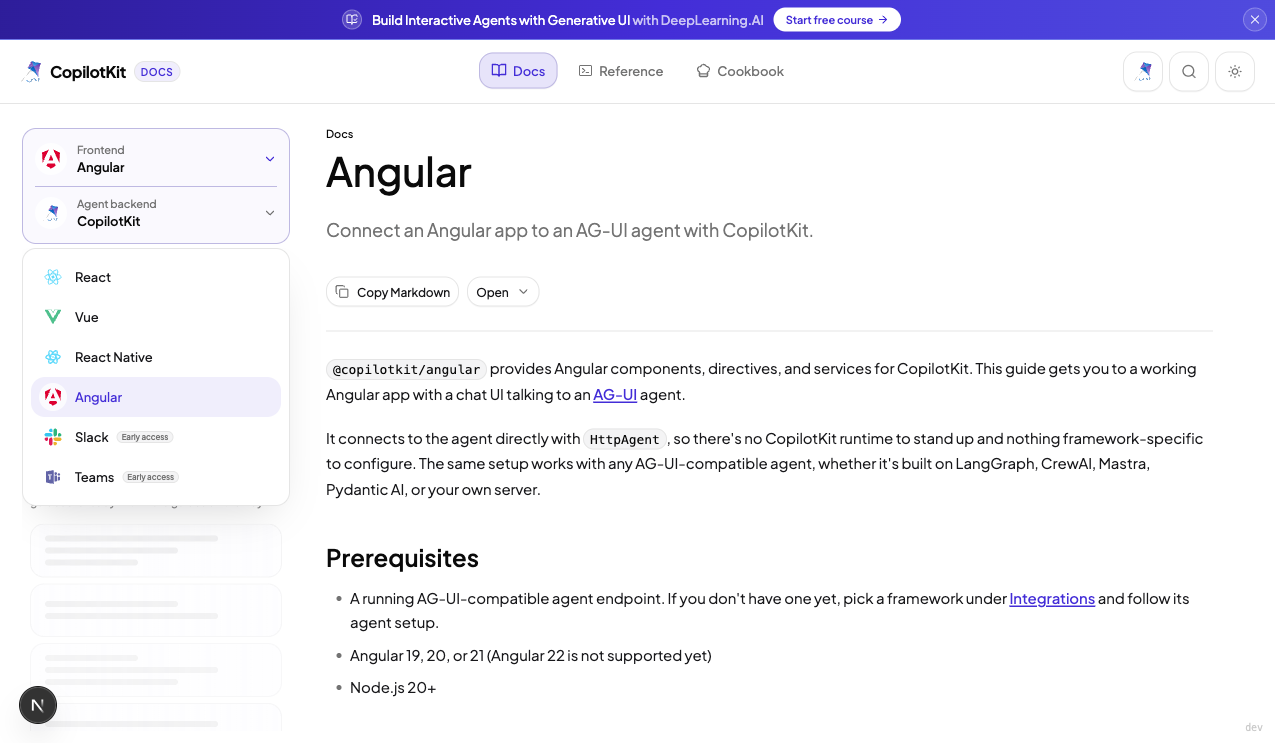
- Guide lives at `content/docs/frontends/angular.mdx`, served at
`/angular` like the other frontends
- Registered `angular` in `frontend-options` (+ `SiAngular` logo),
`search-hrefs`, the search-index pages, and the typed reference-slug
record
- Not flagged early access (parity with Vue / React Native)
### Verified end-to-end
Built a fresh Angular 21 app, followed the guide verbatim, and got a
live streamed reply. shell-docs typecheck and the frontend unit tests
(8/8) pass.
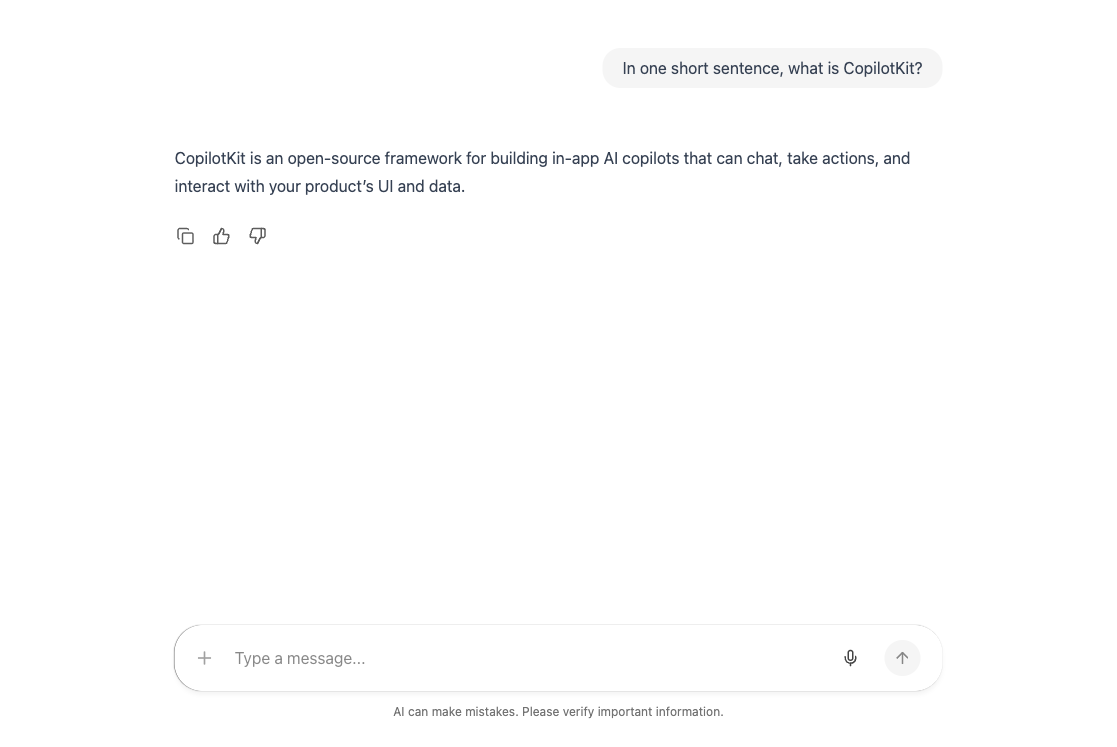
Key specifics from that validation: install **`@copilotkit/angular`**
(the deprecated `@copilotkitnext/angular` is renamed), no TS7016
workaround needed (the package ships types), and pin `@angular/cli@21`
since `@latest` (v22) is outside the `19-21` peer range.
> Reference-docs link points at `/reference` for now; it should switch
to `/reference/angular` once the Angular reference PR (#5585) lands.
> The in-repo package is still `@copilotkitnext/angular`; the
`@copilotkit/angular` rename only landed on npm 2026-06-18. Renaming in
source is a separate follow-up.
_Screenshots live on the `assets/oss-252-angular-quickstart` branch to
keep this diff scoped._
 Sam Julien



