## Summary
- Rename the overview capability from "Cloud-hosted web app" to
"Cloud-hosted Intelligence features".
- Remove the redirecting multi-conversation tutorial link from thread
docs, shared thread snippets, and useThreads references.

## Validation
- npm run test (showcase/shell-docs)
- npm run lint (showcase/shell-docs; exits 0 with pre-existing warnings)
- npm run typecheck (showcase/shell-docs)
- npm run build (showcase/shell-docs)
- Manual link sweep for edited MDX confirmed no remaining
/tutorials/multi-conversation-chat links
schema.json regenerated from the merged canonical schema.ts (failure_classifier
probe.exit additions UNION backend request.ingress/sse.first_byte/llm.call.*
boundaries + test_id adoption). Per-integration staged schema.ts copies
re-derived via 'showcase cvdiag-stage-ts' so codegen --check and stage --check
are both in sync. No hand-merge of generated artifacts.
## What

A new Cookbook recipe — **Build an agentic app on Angular + Google ADK**
— covering the non-obvious production gotchas when you wire an Angular
frontend to a Google ADK agent over AG-UI, with optional CopilotKit
Intelligence threads and memory. Written in the existing cookbook house
style (symptom → cause → fix callouts), and it links out to the Angular
and ADK quickstarts rather than re-teaching setup.

## Why

The Angular + ADK combination has a handful of correctness issues that
only surface in a real, multi-user, governed app, and they aren't
covered by the per-piece quickstarts:

- One agent, one store (a second composer must not create its own store)
- Scope the user via the **run body**, not an HTTP header (a header lags
by one in-session switch)
- Never reconfigure the runtime mid-submit (it recreates the agent store
and drops the message)
- Governance is server-side; the per-request allow-list rides the run
body
- Choose a capable model, and degrade gracefully when the Intelligence
platform is absent

The recipe is **model-flexible**: it frames ADK as running Gemini by
default but supporting any model ADK supports, consistent with the ADK
quickstart.

## Changes

- **New** `cookbook/angular-adk-agentic-app.mdx` — the recipe
- `cookbook/meta.json` — register in nav
- `cookbook/index.mdx` — add the index card (uses
`/logos/google-adk.svg`)
- `src/lib/sidebar-icon.tsx` — add `custom/google-adk` sidebar icon
entry
- `frontends/angular.mdx` — bidirectional cross-link into the recipe
- `src/lib/__tests__/docs-render.test.ts` — update the cookbook nav test
for the new page

## Test plan

Run from `showcase/shell-docs`:

- `npm run typecheck` — passes
- `npm run lint` — passes (only pre-existing warnings; none in changed
files)
- `npm run test` — the cookbook-nav test passes. Two
`public-assets.test.ts` cases fail **only locally** because git-LFS PNGs
are unmaterialized in a fresh worktree (the tests assert assets are not
LFS pointer stubs); they are unrelated to this change and pass in CI.
- `npm run build` — passes; all 211 static pages generate, including
`/cookbook` and `/cookbook/[...slug]`.

Verified in the browser at `localhost:3003`: recipe renders with correct
callout styling, code highlighting, populated TOC, sidebar entry, and
index card.

🤖 Generated with [Claude Code](https://claude.com/claude-code)

<img width="1026" height="586" alt="image"
src="https://github.com/user-attachments/assets/4c8d61ef-d74b-40fa-9e54-807750daed24"
/>
Two PR checks were red on the new integration:

- check-config-files: add strands-typescript/next.config.ts to the build-
  config allowlist.
- Validate Showcase: update the new-integration guard pins that intentionally
  trip when an integration is added — BORN_IN_SHOWCASE 6→7, calculator
  _from-feature-parity count 18→19, catalog cross-join 874→920 / total_cells
  855→900 / docs_only 19→20 (46 features × 20 integrations), and the aimock
  substring-shadow ceiling 132→133 (+1 from the strands-typescript calculator
  fixture).

Also drop the premature deploy wiring: strands-typescript is removed from
showcase_build.yml (matrix + path filter + ALL_SERVICES) because it has no
Railway service yet (deployed: false) and the railway-envs SSOT test requires
a real service entry. It re-enters the deploy pipeline when the Railway
service is provisioned (external setup per INTEGRATION-CHECKLIST).
Bring the TypeScript AWS Strands integration to parity with the Python
strands sibling now that the @ag-ui/aws-strands TS adapter is confirmed to
support the same feature surface (per its examples/server):

- Restore A2UI: the declarative-gen-ui + a2ui-fixed-schema demos, their
  routes, qa, specs, the @copilotkit/a2ui-renderer dep, beautiful-chat's
  A2UI catalog, and the manifest entries (generative_ui / features / demos /
  a2ui_pattern). manifest now matches strands-python feature-for-feature.
- Header forwarding: attach `x-aimock-context: strands-typescript` as a
  static defaultHeader on the OpenAI client (model-factory + sub-agent
  client) — the TS analog of the Python integration's _header_forwarding
  shim — so aimock matches this integration's fixtures.
- aimock fixtures: add d6/strands-typescript + d4/strands-typescript
  (ported from the Python sibling, context retargeted).
- playwright.config: X-AIMock-Context → strands-typescript.

Note: the raw tests/e2e Playwright suite is flaky and not a CI merge gate
(demo e2e / `/eval` D5 are comment-triggered, not required) — it fails the
same specs for strands-python too. The auto-gates (build, validate-
constraints, oxlint/oxfmt, unit) are green.
Replace the placeholder logo with the official Agent Development Kit mark
from google/adk-python (assets/agent-development-kit.png), committed as an
LFS PNG like the other recipe logos (Daytona, Arcade). Point the card and
sidebar at /logos/google-adk.png and revert the unused google-adk.svg back
to its original state.

Co-Authored-By: Claude Opus 4.8 (1M context) <noreply@anthropic.com>
public/logos/google-adk.svg was a placeholder (a grey tile with the text
"Go"), like the other letter-stub SVGs in that directory. Replace it with
the real ADK glyph, reusing the vector paths from the `AdkIcon` component
(src/components/icons/framework-icons.tsx) on a light tile so it renders
on both light and dark surfaces. Only the new cookbook recipe references
this file, so no other page is affected. Monochrome for now; design can
recolor to official ADK colors at approval.

Co-Authored-By: Claude Opus 4.8 (1M context) <noreply@anthropic.com>
The ADK adapter (ag_ui_adk) builds session state from `dict(input.state)`
plus `input.context` (under `_ag_ui_context`); it does not mirror
`forwarded_props` into session state (it only reads it for the
`injectA2UITool` flag). So a user id sent via CopilotKit `properties`
(-> forwardedProps) never reaches `tool_context.state`, and the documented
scoping silently failed — the exact bug class the section warns about.

Carry the user id as agent context via `connectAgentContext` (or shared
agent state) instead, and read it from `tool_context.state["_ag_ui_context"]`
(or directly from state). Reconcile the contradictory forwardedProps/state
lines and fix the coding-agent prompt to match.

Co-Authored-By: Claude Opus 4.8 (1M context) <noreply@anthropic.com>
Add a cookbook recipe covering the non-obvious production gotchas when
wiring an Angular frontend to a Google ADK agent over AG-UI, with optional
CopilotKit Intelligence threads and memory: one agent store, run-body user
scoping (not a header), never reconfiguring the runtime mid-submit,
server-side governance, model selection, and graceful platform degradation.

- New recipe at cookbook/angular-adk-agentic-app.mdx
- Register in cookbook nav (meta.json) and add an index card
- Add a custom/google-adk sidebar icon entry
- Cross-link from frontends/angular
- Update the cookbook nav test for the new page

Co-Authored-By: Claude Opus 4.8 (1M context) <noreply@anthropic.com>
## What

Adds **cvdiag** — a permanent, always-available observability subsystem
for the showcase, built to diagnose the red↔green cell flap on the
staging dashboard and to make that diagnosis a dashboard query rather
than a multi-day forensic hunt in the future.

Captures the full request path with `X-Test-Id` correlation across
**probe → backend → aimock → edge**, across every integration
(TypeScript, Python, Java/spring-ai, .NET):
- Per-language backend emitters (canonical + staged/compile-linked
mirrors), all sharing one schema (`schema.json`, closed-world
`additionalProperties:false`).
- CREATE-only writes to two new PocketBase collections: `cvdiag_events`
and `cvdiag_raw_byte_samples` (additive migrations — no existing data
touched).
- An 8-class flap classifier mapping to the observed failure signatures
(`sse-missing` / `text-unstable` / `dom-missing`).
- DEBUG-tier raw-byte capture (secret-scrubbed) and HMAC-guarded A/B
edge-interference detection.

## Why

The runId flap-fix (`cdc1e90e`, 2026-06-09) did **not** fully resolve
the flap — it was still observed 2026-06-19. cvdiag exists so the
*remaining* cause is observed live with full correlation instead of
inferred.

## Safety / enablement

- **Inert by default.** With `CVDIAG_BACKEND_EMITTER` unset the
subsystem performs zero host mutation (no logging-config changes, no
threads/tasks, no stdout) — verified by
`test_cvdiag_inert_when_disabled`. **To accumulate data, set
`CVDIAG_BACKEND_EMITTER=1` on the showcase services.**
- All per-language scrubbers match the canonical `scrubSecrets`
(sk-/base64url, Bearer, colon-less URL userinfo, size-guard) — verified
with real toolchains (vitest / mvn / dotnet).
- Merged latest `main` (only conflict: a clean `.csproj` include union).

## Verification
- harness `tsc --noEmit` ✓ · `src/cvdiag` vitest 251/251 ✓ ·
`cvdiag-stage-ts --check` in-sync ✓
- Java MessageScrubber 17/17 (mvn) ✓ · .NET CvdiagBackend 5/5 (dotnet
sdk:9.0) ✓ · Python emitters 93/93 (3.12) ✓

🤖 Generated with [Claude Code](https://claude.com/claude-code)
## Summary
Fixes#5535.
`CopilotKitCore.setHeaders` was typed `Record<string, string>`, so there
was no type-safe way to clear a header like `Authorization` on logout.
`null` was a TS error, and an empty string leaves the header present
with a blank value.
## Change
- Widen `setHeaders` to `Record<string, string | null | undefined>` and
drop any `null`/`undefined` entry. A shared `normalizeHeaders` helper
enforces the same string-only invariant at both write paths (the
constructor and `setHeaders`).
- `setHeaders` stays a full overwrite, so clearing one header while
keeping the rest uses the spread pattern:
```ts
copilotkit.setHeaders({ ...copilotkit.headers, Authorization: token ?
`Bearer ${token}` : null });
```
- Update the `react-core` `AuthTokenSync` skill example to show the
logout/clear path, and warn that a header must not be managed via both
the `headers` prop and imperative `setHeaders` (the provider re-applies
its prop-derived headers as a full overwrite whenever its inputs
change).
## Tests
Added `packages/core` coverage: drop `null`/`undefined` keys,
empty-string preservation, overwrite-not-merge semantics, single-header
clear via spread, `onHeadersChanged` notification, and propagation to
local and remote (`ProxiedCopilotRuntimeAgent`) agents.
## Notes
- No API break: `Record<string, string>` is assignable to the widened
type, so existing callers are unaffected.
- The second commit syncs the plugin manifest version (`plugin.json` +
`marketplace.json` `plugins[0].version`) to `1.60.2` via `pnpm
sync:plugin-skills`. This drift pre-existed on `main` and surfaced in CI
only because this PR touches skill files; it is unrelated to the fix.
Adds a minimal Angular quick-start guide and wires Angular into the docs
**frontend picker** introduced in #5586. Connects directly to an AG-UI
agent via `HttpAgent`, no runtime required.
Closes
[OSS-252](https://linear.app/copilotkit/issue/OSS-252/add-angular-quick-start-guide).
### Angular in the frontend picker
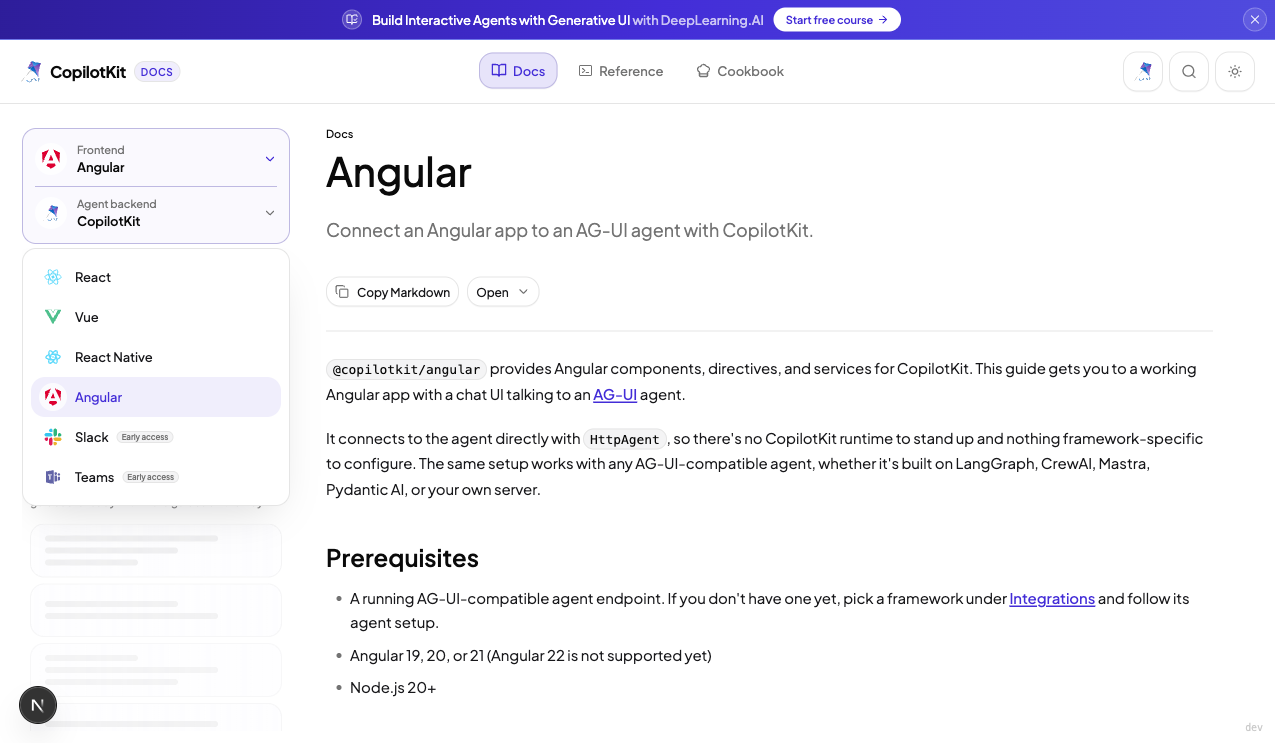
- Guide lives at `content/docs/frontends/angular.mdx`, served at
`/angular` like the other frontends
- Registered `angular` in `frontend-options` (+ `SiAngular` logo),
`search-hrefs`, the search-index pages, and the typed reference-slug
record
- Not flagged early access (parity with Vue / React Native)
### Verified end-to-end
Built a fresh Angular 21 app, followed the guide verbatim, and got a
live streamed reply. shell-docs typecheck and the frontend unit tests
(8/8) pass.
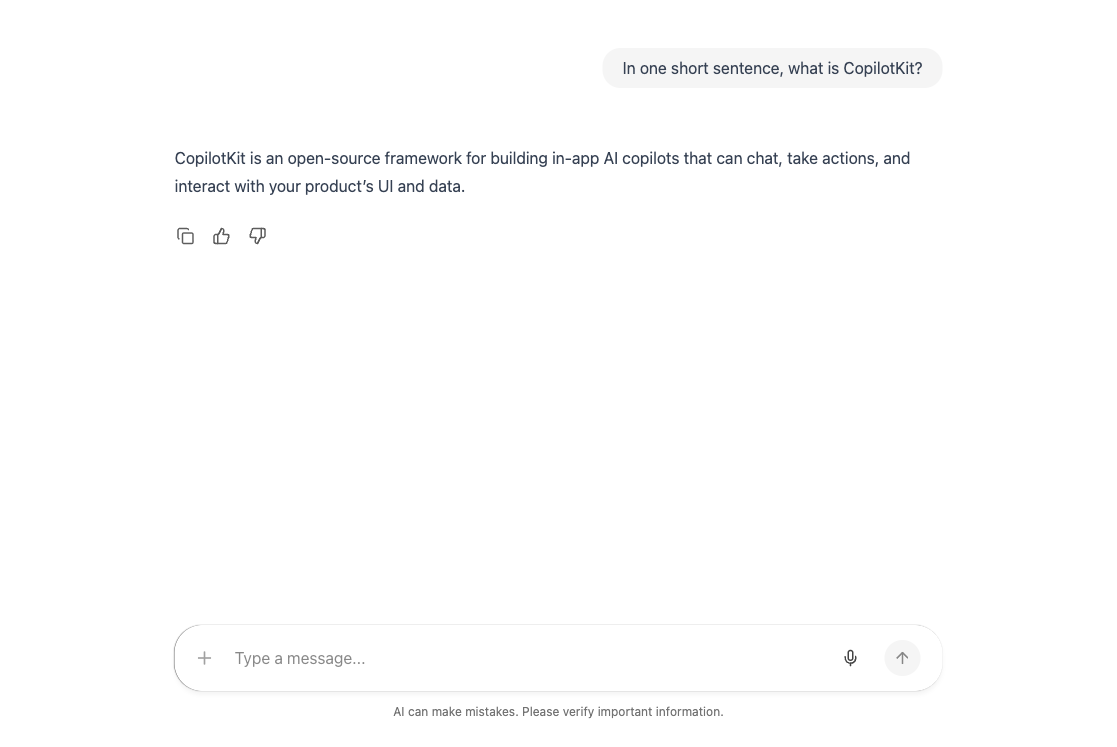
Key specifics from that validation: install **`@copilotkit/angular`**
(the deprecated `@copilotkitnext/angular` is renamed), no TS7016
workaround needed (the package ships types), and pin `@angular/cli@21`
since `@latest` (v22) is outside the `19-21` peer range.
> Reference-docs link points at `/reference` for now; it should switch
to `/reference/angular` once the Angular reference PR (#5585) lands.
> The in-repo package is still `@copilotkitnext/angular`; the
`@copilotkit/angular` rename only landed on npm 2026-06-18. Renaming in
source is a separate follow-up.
_Screenshots live on the `assets/oss-252-angular-quickstart` branch to
keep this diff scoped._
The showcase_promote.yml resolve-targets job runs
`emit-railway-envs-json.ts`, which shells out to the repo-root
`node_modules/.bin/oxfmt` to produce oxfmt-canonical JSON. That job's
`npm ci` runs in showcase/scripts only and never installs the root oxfmt
binary, so every promote dispatch died at "Generate SSOT artifact" with
`spawnSync .../node_modules/.bin/oxfmt ENOENT` (exit 1) — blocking ALL
promotes, including the team's regular shell-docs promote, since the last
green run on 2026-06-18.

The emitted JSON on the resolve-targets / promote path is EPHEMERAL: it
is parsed in-memory by jq (resolve-promote-targets.sh) and bin/railway to
pick the promote target and is NEVER committed, so oxfmt-canonical
formatting is irrelevant there. Add an explicit `EMIT_SKIP_OXFMT=1`
opt-out that returns the raw `JSON.stringify` form, and set it on both
ephemeral workflow steps.

The DEFAULT (committed-artifact) path is unchanged: oxfmt stays REQUIRED
and fails loud if the binary is absent, because the committed
railway-envs.generated.json must stay oxfmt-canonical or CI's
static_quality.yml `oxfmt --check` auto-format bot fires on the drift.
This is opt-IN-to-skip, never silent-on-absence.

Call sites of emit-railway-envs-json.ts:
- showcase_promote.yml resolve-targets — EMIT_SKIP_OXFMT=1 (this fix).
- showcase_promote.yml promote — EMIT_SKIP_OXFMT=1 (this fix).
- static_quality.yml committed-artifact `--check` — unset, oxfmt required.
- resolve-verify-matrix.ts (showcase_deploy.yml) — only invokes the
  emitter when the committed JSON is absent; the checkout always has it,
  so the default (oxfmt) path is correct and unchanged.

Tests: 2037 showcase/scripts tests pass; 2 new EMIT_SKIP_OXFMT unit tests
assert the skip path emits valid (raw) JSON; the existing oxfmt-canonical
golden tests still gate the committed path.
> **DRAFT / WIP — not reviewed, not ready to merge.** Checkpoint per
request. The mandatory 7-agent cr-loop + CI-green gate runs before this
leaves draft. LGP and ADK ship together in this PR.

## Problem (a false-D6 in both directions)
Declarative A2UI demos wire `a2ui.injectA2UITool: true`, so the response
is a rendered `render_a2ui` surface with **no assistant text bubble**.
The D6 conversation-runner's turn-completion gate required the assistant
**text** to stabilize — so on a working declarative demo the run
finished and the dashboard painted, but text never settled →
`waitForTurnComplete` timed out (`reason=text-unstable`) **before the
render assertion ran**.

Result: `langgraph-python:declarative-gen-ui` (the gold standard)
reported **false-RED while rendering correctly** (all 4 pills verified
live on staging), while `google-adk` reported **false-GREEN**.

## Fix
Opt-in `ConversationTurn.completeOnMount` (set only by
`d5-gen-ui-declarative.ts`). For those turns the text-stability
completion conjunct is **replaced** by a surface-mount predicate:
run-finished (sseOk) + a new assistant bubble + the expected declarative
testids **newly mounting**. A non-rendering surface now yields a new
`surface-missing` failure reason (truthful RED). Text-based demos are
byte-for-byte unchanged (opt-in, per-turn).

## Proof (both directions, live D6)
- RED (before): `text-unstable` timeout; dashboard text painted.
- GREEN (after): passes in ~5s; `buildDeclarativeAssertion` actually
runs and verifies testids mount for all 4 pills.
- INTEGRITY: forced a broken render (renamed testids) → test goes
**red** (`surface-missing`). Not "always green now."
- Unit: 89/89 + 3 new (green-on-mount, red-on-surface-missing).

## Scope: LGP + ADK (ship together) — both truthful GREEN
- **LGP** gold-standard cell: false-RED → truthful GREEN (all 4 pills
assert).
- **ADK** realignment: **test-only, complete.** The shared-script fix
auto-applies; verified all 4 ADK pills truthfully GREEN (each surface
mounts from baseline 0 via surface-mount completion). Prior false-green
closed; **no ADK backend gap**.

## Out of scope (someone else's problem)
This shared-script change re-evaluates **every** declarative-gen-ui cell
truthfully. Integrations beyond LGP/ADK that don't actually render will
flip to **truthful RED** — e.g. `langgraph-typescript` pill 2
(team-performance `declarative-data-table` doesn't mount). Those are
real per-demo render gaps for their owners; **not fixed here.**

## Follow-up (not in this PR)
The `render_a2ui` call returns a ~5.9 MB SSE for a ~2 KB surface (LGT
worse) — a separate runtime amplification concern in the
`injectA2UITool:true` middleware path.

## Before ready/merge
- [x] ADK empirical verdict — all 4 pills truthful GREEN, realignment
test-only, no backend gap
- [ ] mandatory cr-loop → zero findings
- [ ] CI green
setHeaders typed headers as Record<string, string>, so there was no
type-safe way to clear a header (e.g. Authorization on logout) — passing
an empty string left the header present with a blank value.
Widen the signature to Record<string, string | null | undefined> and drop
any entry whose value is null/undefined. setHeaders remains a full overwrite,
so clearing one header while keeping the rest is the spread pattern:
setHeaders({ ...copilotkit.headers, Authorization: null }). A shared
normalizeHeaders helper enforces the same string-only invariant at both
write paths (constructor and setHeaders).
Update the react-core AuthTokenSync skill example to show the logout/clear
path and warn that a header must not be managed via both the headers prop and
imperative setHeaders (the provider re-applies prop-derived headers as a full
overwrite when its inputs change). Also update the setHeaders reference
signature docs. Tests cover null/undefined stripping, empty-string
preservation, overwrite-not-merge semantics, single-header clear via spread,
subscriber notification, and propagation to local and remote
(ProxiedCopilotRuntimeAgent) agents.
Fixes#5535
Opts each declarative-gen-ui pill into the new `completeOnMount` turn
completion so these surface-rendering demos are gated on their expected
declarative testids mounting rather than assistant-text stability.
Declarative A2UI demos render a surface (mounted testids) with no assistant
text bubble, so the assistant-text-stability completion gate never settled and
timed out on working demos — a false-RED.

This adds an opt-in `completeOnMount` turn-completion path that replaces the
assistant-text-stability conjunct with a surface-mount predicate: run-finished
+ a new assistant bubble + the expected declarative testids newly mounting.
A new `surface-missing` failure reason reports when the run finishes but the
expected surface never mounts. Turns that do not opt in keep the existing
text-stability behavior unchanged.
Add the Angular frontend quick-start at content/docs/frontends/angular.mdx
and wire it into the frontend picker (options, logo, page content, search
hrefs, search-index generation).
## Summary

Fixes the showcase promote dropdown so the 12 `starter-*` services are
dispatchable. The committed `.github/workflows/showcase_promote.yml`
`service` choice list was never regenerated after the starters landed in
the SSOT, so `gh workflow run showcase_promote.yml -f service=starter-*`
was rejected by GitHub with `HTTP 422: not in the list of allowed
values` (GitHub validates the `choice` enum server-side against the
default branch). This left main's "Showcase: Build & Push" red via
`verify-railway-image-refs`.

## Changes

- Regenerated `showcase_promote.yml` — the `service` dropdown now
includes all 12 starters plus `shell-docs` and every previously-listed
target (nothing dropped). 41 options total.
- `isProdPromotable` reads the canonical env-map shape
(`environments.prod.probe`), equivalent to the workflow resolve
predicate (`select(.probe.prod==true)` against the emitted JSON).
- Added a durable regression test asserting `shell-docs` AND all 12
starters are present in both the generator output and the committed
dropdown, so a future generator regression can't silently drop a promote
target.

## Test plan

- [x] `--check` exits 0 (committed dropdown in sync with SSOT)
- [x] vitest 24/24 pass; regression guard asserts shell-docs + 12
starters
- [x] every emitted token resolves to exactly one prod-eligible service
under the real resolve predicate
- [x] oxfmt/oxlint/typecheck clean on the diff
Regenerated the stale committed showcase_promote.yml so the 12 starter-*
services (+ shell-docs and all existing targets) appear in the service
dispatch choice list (fixes HTTP 422 on
gh workflow run -f service=starter-*). Reverted isProdPromotable to
env-map-only (environments.prod.probe), equivalent to the workflow resolve
predicate. Added a regression test asserting shell-docs + all 12 starters
remain in the generated AND committed dropdown.
## Summary

- Add a top-level Enterprise Intelligence Platform overview that
clarifies platform features, hosting options, plans/access, and the path
from cloud-hosted to self-hosted.
- Add Cloud-Hosted Enterprise Intelligence documentation covering
dashboard login, organization/workspace flow, projects, project API
keys, thread history/detail, and plan management.
- Refresh the Enterprise Intelligence Architecture and Threads &
Persistence Architecture pages so they are architecture-focused instead
of overlapping self-hosting/how-to content.
- Update self-hosting documentation to use the current product taxonomy,
call out Team self-hosted/custom Enterprise availability, and use a
tracked Enterprise-styled CTA for talking to an engineer.
- Add the CopilotKit CLI doc plus shared CLI content across root docs
and all visible authored/generated integration routes.
- Add CLI sidebar entries for authored framework docs and test that CLI
appears in both generated and authored framework nav.
- Add dashboard screenshots for ready, projects, thread list, API keys,
thread detail, and plan management/pricing.
- Update Threads, useThreads reference, multi-conversation tutorial,
architecture/concepts pages, and runtime snippets to point at the new
Enterprise Intelligence docs and remove early-access language from
Threads.
- Retire legacy Observability docs, remove observability references from
quickstarts/runtime docs/nav, and add SEO redirects from root,
troubleshooting, and framework observability URLs to the Intelligence
overview.
- Instrument Enterprise Intelligence CTAs with PostHog: signup CTAs fire
`try_for_free_clicked`, self-hosting engineer CTA fires
`talk_to_us_clicked`, and CLI command copying continues through
`cli_command_copied`.
- Rebase the PR branch onto current `origin/main` and fix the
integration docs doctest by adding LangGraph quickstart Python
dependencies plus clearer server-start diagnostics.

## Commits

- `docs(shell-docs): instrument intelligence ctas`
- `docs(shell-docs): add copilotkit cli docs`
- `docs(shell-docs): refresh intelligence platform docs`
- `docs(shell-docs): retire observability docs`
- `test(doc-tests): fix langgraph quickstart doctest`

## Validation

- `pnpm tsx scripts/doc-tests/extract.ts && pnpm tsx
scripts/doc-tests/run.ts`
- `pnpm exec vitest run scripts/doc-tests/__tests__/extract.test.ts`
- `pnpm exec oxfmt --check scripts/doc-tests/run.ts
showcase/shell-docs/src/content/docs/integrations/langgraph/doctest.json`
- `npm run test` in `showcase/shell-docs`
- `npm run typecheck` in `showcase/shell-docs`
- `npm run build` in `showcase/shell-docs`
- `pnpm run lint` at the repo root (0 errors; existing repo warnings
remain)
- `pnpm exec oxfmt --check` against PR-changed text files
- Local route checks for `/cli`, `/mastra/cli`, `/langgraph-python/cli`,
`/premium/managed-intelligence-platform`, `/premium/self-hosting`
- Local redirect checks for `/premium/observability`,
`/troubleshooting/observability-connectors`,
`/mastra/premium/observability`

Notes: build still reports the existing Next/Turbopack warnings about
deprecated middleware and NFT tracing in `next.config.ts`, but completes
successfully. Full repo `pnpm run check-format` currently fails on
pre-existing files outside this PR:
`examples/v2/react/demo/tsconfig.json`, `migrations.json`, and
`nx.json`; the PR-changed text files pass `oxfmt --check`.
Add an Angular SDK section to the reference docs (OSS-251), mirroring the
React and Vue references. Registers Angular in the reference infrastructure
(new Services and Directives categories, version selector label, subdir map,
overview card) and adds an index plus 17 pages covering provideCopilotKit and
the config/label functions, the CopilotKit service, injectAgentStore and
context APIs, tool registration (frontend, render, human-in-the-loop), the
CopilotKitAgentContext directive, and the prebuilt chat components.

All pages are written against the actual @copilotkit/angular source, use the
correct package name and top-level imports, and surface in llms.txt and
llms-full.txt.
## What

Adds the **"Build an Agentic Travel App with Oracle Agent Memory, Agent
Spec, and CopilotKit"** cookbook recipe, alongside `daytona.mdx` and
following the same section pattern (Try it live → Prerequisites → setup
→ Try it → key code → Going further → coding-agent prompt).

It wires together:
- **Oracle Agent Spec** — define the agent once as portable JSON
(`pyagentspec`)
- **LangGraph + AG-UI** — run that spec via the `ag_ui_agentspec`
adapter, served over AG-UI (SSE)
- **Oracle AI Database** — long-term memory (`oracleagentmemory`) so the
agent remembers across sessions
- **CopilotKit V2** — the chat frontend (generative UI +
human-in-the-loop), consuming the AG-UI endpoint with `HttpAgent`

The example is a travel concierge that recalls your preferences across
sessions, searches flights, and books them with a human-in-the-loop
confirmation card that stamps into a boarding pass.

## Try it live

Embeds the hosted demo as a live `<iframe>` — **cross-session recall
verified working end-to-end** (teach a preference in one thread, open a
new thread, it recalls from Oracle AI Database).

## Files
- `cookbook/oracle-agent-spec-memory.mdx` (new)
- `cookbook/meta.json` — sidebar entry
- `cookbook/index.mdx` — overview card

## Companion code
**#5563** adds the runnable demo at
`examples/showcases/oracle-agent-memory` (Python agent + Next.js
frontend + Oracle AI Database), beside `daytona-runcode`. The recipe's
"Get the code" links point there.

## No external asset dependencies
- "Try it live" is a live `<iframe>` — no CDN video to upload.
- The architecture diagram is an inline base64 data-URI SVG — no CDN
image to upload.

## Caveat kept honest in the doc
- **Recall is eventually consistent** — memory is
extracted/embedded/indexed asynchronously, so a just-taught fact becomes
recallable after a short delay.

## Verified
- `book_flight` is a CopilotKit **ClientTool** (`useHumanInTheLoop`) —
the confirm→book HITL resolves in a single agent run. Multi-turn
follow-ups work via a server-side full-history replace that sidesteps an
upstream Agent Spec × AG-UI `tool_call_id` correlation bug (documented
inline + in #5563's known-issues).
- Playwright E2E covers cross-session recall, flight search, and the
booking HITL (3/3 green).
- All CI green; ready for review.

🤖 Generated with [Claude Code](https://claude.com/claude-code)
 Sam Julien



