Add a new node/TypeScript-backed AWS Strands showcase integration at
showcase/integrations/strands-typescript.

Backend: a node/TS agent server (src/agent/) built on @strands-agents/sdk
`Agent`/`tool` wrapped in @ag-ui/aws-strands `StrandsAgent` and served via
@ag-ui/aws-strands/server (`createStrandsApp`/`addStrandsExpressEndpoint`),
modeled on the upstream ag-ui aws-strands TS example server and the
langgraph-typescript infra. A single shared agent at "/" serves most demos
(tools, shared state via toolBehaviors/stateContextBuilder, HITL,
sub-agents), with tool-free specialized agents mounted at /voice,
/byoc-hashbrown, /byoc-json-render. model-factory targets OpenAI chat
completions and honors OPENAI_API_KEY / OPENAI_BASE_URL so it works behind
the showcase aimock proxy. Node-based Dockerfile + entrypoint run the agent
server (:8000) alongside the Next.js frontend.

Frontend mirrors the strands (Python) sibling's demo set and the
langgraph-typescript conventions, with HttpAgent routes proxying to the TS
agent server.

Scope: base integration + standard demos only. A2UI / declarative-gen-ui /
a2ui-fixed-schema is intentionally excluded (no A2UI agents, routes, demos,
or deps) and layered on later.

Platform wiring (mirrors langgraph-typescript): docker-compose local/dev
services on host port 3119, local-ports.json, packages.json, slug-map.ts
(born-in-showcase), showcase_build.yml matrix + path filter + metadata,
shell-docs/dashboard registries, and a logo asset. The python strands
integration is untouched.
## Summary
- remove the retired top-level `docs/` Next app and the disabled
docs-sync workflow/script
- add `docs -> showcase/shell-docs` as a top-level symlink for `cd docs`
muscle memory without restoring the old docs tree
- move the docs model allowlist into `showcase/shell-docs/` and retarget
docs validation/doctest extraction to shell-docs content
- update docs/agent guidance and CI path filters so `docs/` is treated
as an alias, not an active separate docs surface
- tighten the pre-commit package check so non-package docs/tooling
changes do not fan out into the full package matrix

## Validation
- `pnpm exec tsx scripts/validate-doc-model-names.ts`
- `pnpm exec tsx scripts/doc-tests/extract.ts`
- `pnpm exec vitest run
scripts/__tests__/validate-doc-model-names.test.ts
scripts/doc-tests/__tests__/extract.test.ts
showcase/harness/src/cli/eval/scope.test.ts`
- `pnpm exec oxlint showcase/harness/src/cli/eval/scope.test.ts
scripts/doc-tests/extract.ts`
- `git diff --cached --check` before follow-up commit
- `test "$(readlink docs)" = "showcase/shell-docs"`
- `test -f docs/package.json`
- `pnpm exec oxfmt --check .claude/docs/documentation.md
.claude/docs/hooks.md AGENTS.md CLAUDE.md CONTRIBUTING.md
showcase/shell-docs/README.md`
- commit hooks passed

## Notes
- historical docs remain recoverable from
`archive/docs-save-do-not-prune` and `archive/docs-retired-2026-06-17`
- I intentionally left Vercel/project teardown out of this PR; this is
repo cleanup only
## What

Updates the v2 `useRenderToolCall` reference page and makes opting a
tool out of the default rendering a single, schema-free call.

## Why

The reference page had drifted out of sync with the hook implementation
(`packages/react-core/src/v2/hooks/use-render-tool-call.tsx`) — most
notably `toolCallId` in the render props, added after the doc was last
touched. While documenting how to opt out of rendering, the natural
example (`useRenderTool({ name: "...", render: () => <></> })`) only
type-checked for the wildcard `"*"`; a named tool required a
`parameters` schema, forcing a throwaway `z.any()`. This PR re-aligns
the doc and removes that rough edge.

## Changes

### Docs (`showcase/shell-docs`)
- `useRenderToolCall.mdx`:
- Document `toolCallId` in the render-prop shape (previously
undocumented).
- Describe agentId-scoped lookup priority: agent-specific → unscoped →
wildcard `"*"` → built-in `DefaultToolCallRenderer`.
- Note args are parsed with `partialJSONParse` (streaming), not strict
`JSON.parse`.
- Correct `toolCall` prop to `toolCall.function.name` /
`toolCall.function.arguments`.
- Rewrite the Status Resolution table to match real logic (`toolMessage`
presence + provider executing set).
- New **"Disable default tool rendering"** section, ordered least→most
specific: wildcard first (all tools), then a **"For specific tools"**
subsection. Both use a schema-free `useRenderTool` call; dropped the old
`useFrontendTool` handler/schema boilerplate.
- `useRenderTool.mdx`: document the render-only (no-schema) named
overload.

### react-core
- Make `parameters` optional on the named `useRenderTool` overload,
mirroring the existing wildcard path; `defineToolCallRenderer` defaults
the args schema to `z.any()` when none is given.
- This lets `useRenderTool({ name: "myTool", render: () => <></> }, [])`
type-check with no Zod schema. Typed `parameters` behavior is unchanged.
- Added a test for the named render-only registration.

## Verification

- `@copilotkit/react-core` tests pass (1280) including the new case;
`build` (tsc) passes.
- Opt-out snippets type-checked in-package (`tsc`): wildcard,
specific-name (no schema), and named-with-schema all compile.
- `oxlint` (shell-docs) passes — 0 errors.
- Previewed locally at `/reference/hooks/useRenderToolCall`.
Adds a **Vue** section to the reference docs at `/reference/vue`,
alongside the existing React, React Native, and Core references. Until
now there was no Vue reference, so users and agents had no way to
discover the API.
It mirrors the React v2 reference but documents the real
`@copilotkit/vue/v2` API, with Vue idioms throughout (composables return
refs, slots instead of render props, kebab-case props, Vue SFC
examples).
### What's included
- The Vue index page (install, styling, provider setup)
- 14 composables (useAgent, useFrontendTool, useHumanInTheLoop,
useThreads, and the rest)
- 9 components (CopilotKitProvider, CopilotChat, CopilotPopup,
CopilotSidebar, and the chat sub-components)
- Vue registered in the SDK picker and the reference landing page
### Screenshots
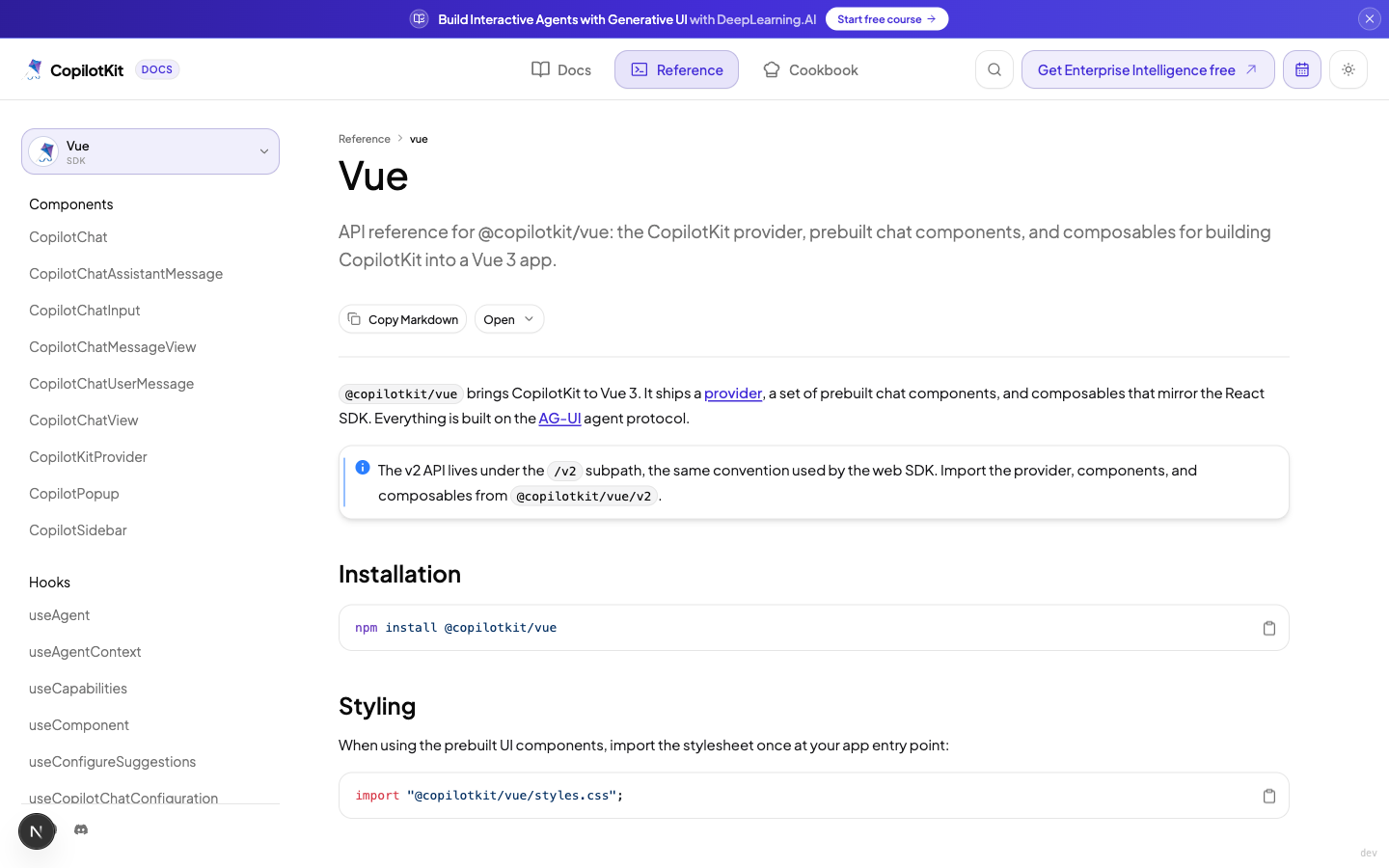
Landing page (SDK picker set to Vue, full sidebar):
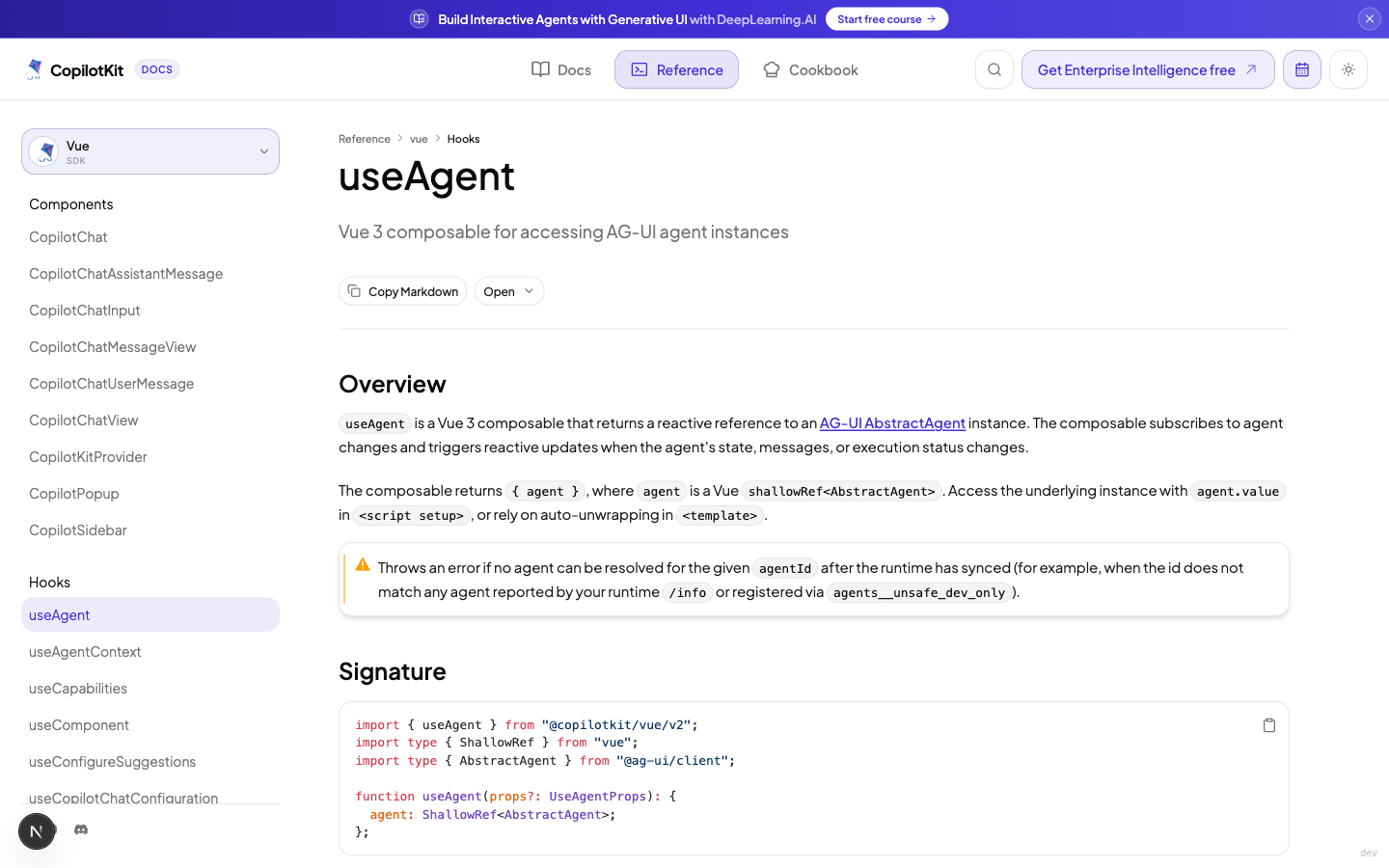
A composable page (useAgent):
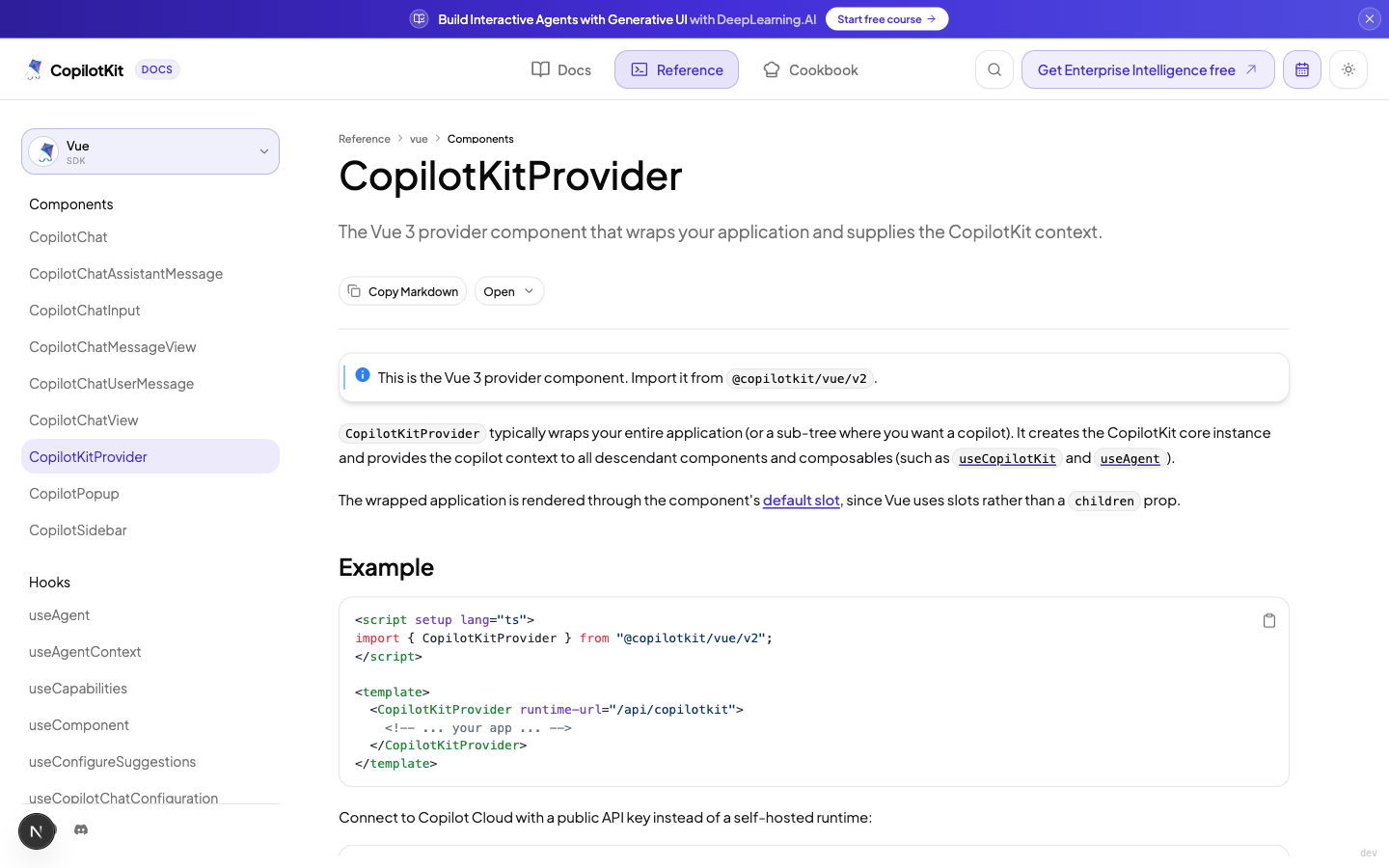
A component page (CopilotKitProvider):
### How it was verified
- All 24 pages render (HTTP 200) on the local docs server
- Content shows up in `llms.txt` and `llms-full.txt`
- Each page was written from the Vue source, not copied from React, and
spot-checked for accuracy
Guide content and new demos are out of scope.
## Summary
- fix Showcase docs snippets that import `randomUUID` from non-existent
`@copilotkit/shared/v2`
- use the published `@copilotkit/shared` entrypoint instead
- move the fix to the publishing Showcase docs source under
`showcase/shell-docs`

## Linear
- FAC-65

## Verification
- `rg -n "@copilotkit/shared/v2" showcase/shell-docs/src/content`
returns no matches
- `pnpm validate:model-names`
- `npm ci --ignore-scripts` in `showcase/shell-docs`
- `npm run build` in `showcase/shell-docs`
- `git diff --check`
- pre-commit passed after refreshing root dependencies with `pnpm
install`
Fumadocs' default callout palette (generic blue/amber/green) renders the
docs <Callout> accent and left bar off-brand against the purple-anchored
theme — and on the main docs route the info/success tokens weren't emitted
at all, falling back to the near-white muted color.

Define --color-fd-info/warning/success as plain :root custom properties
(not @theme tokens, which Tailwind v4 tree-shakes when no utility class
references them — the Callout reads them only via inline var()). Map info
-> brand accent (purple), warning -> the existing docs --warning orange,
success -> brand mint (new --success token, mint/800 light, mint/400 dark).
All theme-aware; error stays mapped to --destructive via shadcn.css.
## Summary
Fixes#5417. The v1 `<CopilotKit>` wrapper's `validateProps` threw
`ConfigurationError: Missing required prop: 'runtimeUrl' or
'publicApiKey' or 'publicLicenseKey'` whenever neither `runtimeUrl` nor
a public key was supplied — without considering self-managed agents.
This rejected the documented self-managed-agent setup, even though the
underlying v2 `CopilotKitProvider` accepts it via its `hasLocalAgents`
gate.
- **Fix:** `validateProps` now mirrors the provider's `hasLocalAgents`
check, so `selfManagedAgents` and `agents__unsafe_dev_only` satisfy the
requirement without a `runtimeUrl` or Cloud key.
- **Test:** new rendering test pins the behavior — still throws when
nothing is configured, no longer throws when local agents are supplied.
- **Docs:** the showcase error-reference "v1 behaves differently"
callout claimed the wrapper throws unconditionally and rejects
`selfManagedAgents` (both now false); corrected, and dropped the "(v2
only)" label on the self-managed example.
## Test plan
- [x] `nx test react-core` — 1284 passing, 0 failing
- [x] New test fails before the fix (red) and passes after (green)
- [x] No new type errors introduced (pre-existing `tsc` noise unchanged
vs `main`)
The callout claimed the v1 <CopilotKit> wrapper has no dev-only
console.warn branch, but it composes CopilotKitV2Provider, which does
warn in development before the v1 validateProps throw. Drop the
misleading clause and contrast the throw-in-dev behavior instead.

Refs #5417
Adds the @copilotkit/vue v2 API reference to shell-docs: 9 component pages
(CopilotKitProvider, CopilotChat, CopilotChatView, CopilotChatInput,
CopilotChatMessageView, CopilotChatAssistantMessage, CopilotChatUserMessage,
CopilotPopup, CopilotSidebar) and 14 composable pages (useAgent, useAgentContext,
useCapabilities, useComponent, useConfigureSuggestions, useCopilotChatConfiguration,
useCopilotKit, useDefaultRenderTool, useFrontendTool, useHumanInTheLoop,
useInterrupt, useRenderTool, useSuggestions, useThreads), an index page, and
wiring into the reference version selector. Every documented API was verified
against packages/vue/src/v2.
The self-managed example sits under the "Fix (v2)" heading and uses
<CopilotKitProvider>, so the prior "works on both ... wrapper and v2"
comment read as if the v2 component itself were v1. Attribute the
portability to the selfManagedAgents prop instead of the component.

Refs #5417
Note on the self-managed agents page that selfManagedAgents is part of
the Enterprise Intelligence offering, with a pointer to discuss
licensing for production use.

Refs #5417
The error-reference callout claimed the v1 <CopilotKit> wrapper throws
unconditionally and does not accept selfManagedAgents. Both are no
longer true now that the wrapper honors local agents; update the note
and drop the "(v2 only)" label on the self-managed example.

Refs #5417
## Summary
- remove duplicated OpsPlatformCTA blocks from A2A, CrewAI Flows, and
LangGraph prebuilt components docs
- add missing production CTA cards to integration quickstarts that only
had the inline signup step
- audit shell-docs CTA usage so each integration quickstart has exactly
one OpsPlatformCTA and no duplicate CTA blocks remain

## Verification
- npm run test (showcase/shell-docs)
- npm run typecheck (showcase/shell-docs)
- npm run lint (showcase/shell-docs; existing warnings only)
- npm run build (showcase/shell-docs; existing Next/Turbopack warning
only)
- duplicate CTA scanner: no duplicate CTA blocks found
- quickstart CTA scanner: every integration quickstart has exactly one
OpsPlatformCTA
Closes#3190.
## Summary
- update the configurable guide links to the current LangGraph
use-graph-api documentation
- remove an encoded `%23` fragment from the runtime configuration link
- point the AI travel tutorial Studio setup link directly to the current
LangGraph Studio docs
## Verification
- `npx --yes prettier --check
docs/content/docs/integrations/langgraph/configurable.mdx
docs/content/docs/integrations/langgraph/tutorials/ai-travel-app/step-2-langgraph-agent.mdx`
- `git diff --check`
- checked the updated LangChain/LangGraph URLs with `curl -L -I` and
confirmed HTTP 200
Note: `node scripts/check-broken-links.js` was also attempted from
`docs/`, but this sparse checkout does not include all docs pages and
lacks `fumadocs-mdx`, so it reports pre-existing missing internal pages
unrelated to this docs-only change.
Retitles to 'Build an Agentic Travel App with Oracle Agent Memory, Agent Spec, and CopilotKit' and syncs the recipe with the latest example: adds the memory-ownership diagram + 'what's CopilotKit, what's Oracle' section, documents memory reconciliation/supersession, and updates booking + multi-turn guidance (follow-ups now work via a server-side history-replace). Keeps the CDN media + clone conventions.

Co-Authored-By: Claude Opus 4.8 (1M context) <noreply@anthropic.com>
Per review, keep this PR docs-only. Restores defineToolCallRenderer and
useRenderTool (and its test) to main. The specific-tool opt-out example
now passes a pass-through schema (parameters: z.any()) since the named
overload requires a schema.
Unify WhatsApp with main's Slack+Discord multi-adapter demo: WhatsApp becomes a
third env-gated platform block in examples/slack/app/index.ts (listening on
Railway $PORT, with a malformed-PORT guard). Keep the platform-aware
senderContext (also fixes the Discord 'Slack user' label); drop the superseded
buildAdapters helper for main's inline per-platform pattern. package.json takes
main's ~0.0.2 bumps + bot-discord and adds bot-whatsapp (workspace:~); README
intro + deploy section cover all three surfaces.
Adds a cookbook recipe showing how to define an agent once in Oracle
Agent Spec, run it on LangGraph over AG-UI, give it long-term memory on
Oracle AI Database, and render it in CopilotKit. Registers the page in
the cookbook sidebar (meta.json) and overview (index.mdx).

Draft: live-demo video pending CDN upload; example source repo
(CopilotKit/oracle-cookbook) pending publish.

Co-Authored-By: Claude Opus 4.8 (1M context) <noreply@anthropic.com>
 Ran Shem Tov





