## What

Adds **`@copilotkit/bot-whatsapp`** — a WhatsApp Business **Cloud API**
`PlatformAdapter` for the platform-agnostic `@copilotkit/bot` engine —
plus a runnable **`examples/whatsapp`** app and docs. This brings
WhatsApp to the bots ecosystem alongside the existing Slack support,
reusing the engine, the `@copilotkit/bot-ui` IR, and the pluggable
`ActionStore` untouched.

## How it works

- **Ingress:** the adapter owns its own HTTP server — GET verification
handshake (`hub.challenge`) + POST intake validated by
`X-Hub-Signature-256` HMAC (timing-safe), acked `200` immediately then
processed async.
- **No streaming:** WhatsApp messages are immutable, so the run renderer
**buffers** text and sends once on `TEXT_MESSAGE_END`
(`supportsStreaming: false`; `update()` posts fresh, `delete()` no-ops).
- **Interactive mapping:** text/section → text; ≤3 buttons →
reply-button message; `Select` or 4–10 actions → list message; >10 →
numbered-text fallback. A control's `value` round-trips by encoding it
into the reply id (`ck:…::<json>`), since WhatsApp replies carry no
value field; oversized encodings fail loud rather than corrupt silently.
- **Memory:** WhatsApp exposes no readable history, so a pluggable
**`HistoryStore`** (default `InMemoryHistoryStore`) holds it and replays
it into `agent.messages` each turn (fresh threadId per turn, mirroring
`bot-slack`). Swap in a durable backend to persist across restarts.
- **Commands:** leading-keyword matching (`commandPrefix`, default `/`);
the command text is injected via the engine's `runAgent({ prompt })`
path (not persisted at ingress).
- **Inbound media** → AG-UI multimodal content parts; **HITL** via
interactive replies.

## Example

`examples/whatsapp` mirrors `examples/slack`: a CopilotKit
`BuiltInAgent` over MCP (Linear + Notion), with `issue_list`, an
interactive `show_incident`, and a `confirm_write` HITL gate.

## Tests & verification

- 62 unit tests across the package (render mapping, markdown→WhatsApp,
signature verification incl. wrong-but-equal-length, interaction
decode/round-trip, buffered renderer, webhook listener/server, stores,
media, adapter).
- `build` ✅, package `check-types` ✅, `publint`/`attw` (ESM-only) ✅,
example `check-types` ✅. Full `nx run-many -t test
--projects=packages/**` passes.
- Two rounds of code review (APPROVE) — fixed slash-command history
double-append and silent value-truncation; minors (HMAC over raw bytes,
conversationKey invariant, offset-correct Blob, unused-dep pruning,
added tests).

## Docs

Package `README.md` + `ARCHITECTURE.md`, example setup guide (Meta app +
webhook + tunnel), and a `shell-docs` WhatsApp guide page (registered in
`meta.json` + early-access gate).

## Notes / out of scope (v1)

- No template-send path for messaging outside WhatsApp's 24-hour
customer-service window (documented limitation).
- Pre-existing, unrelated `@copilotkit/core` `phoenix-observable.ts`
typecheck error exists on the branch base (missing `@types/phoenix`) —
not introduced here.
## Summary

- Backports the generated/root Threads guide content into the shared
authored Threads snippet.
- Adds the CLI “Choose your starting point” path, manual path, thread
lock options, Enterprise Intelligence CTA, and corrected next-step links
to authored Threads docs.
- Standardizes authored integration Threads pages to explicitly import
the shared snippet with `components={props.components}` so authored
routes stay aligned.

## Authored routes covered

- AG2
- Agno
- AWS Strands
- Built-in Agent
- CrewAI Flows
- LangGraph
- LlamaIndex
- Mastra
- Microsoft Agent Framework
- PydanticAI

## Validation

- `npm run pretypecheck` in `showcase/shell-docs`
- `npm run lint` in `showcase/shell-docs` (passes with existing
warnings)
- `npm run test` in `showcase/shell-docs`
- `npm run typecheck` in `showcase/shell-docs`
- `npm run build` in `showcase/shell-docs` (passes with existing
Next/Turbopack warnings)
- `git diff --check`
- Manual MDX link sweep for changed docs links (`/premium/self-hosting`,
`/premium/threads-explained`, `/reference/hooks/useThreads`, and
`http://localhost:3000`)

## Formatter note

- `pnpm run check-format` currently fails on unrelated existing files
under `examples/showcases/arcade-tools/*`,
`examples/v2/react/demo/tsconfig.json`, `migrations.json`, and
`nx.json`.
- Scoped `oxfmt --check` does not treat the changed MDX files as target
files, so there is no formatter-owned MDX change to apply here.
Replace the placeholder logo with the official Agent Development Kit mark
from google/adk-python (assets/agent-development-kit.png), committed as an
LFS PNG like the other recipe logos (Daytona, Arcade). Point the card and
sidebar at /logos/google-adk.png and revert the unused google-adk.svg back
to its original state.

Co-Authored-By: Claude Opus 4.8 (1M context) <noreply@anthropic.com>
The ADK adapter (ag_ui_adk) builds session state from `dict(input.state)`
plus `input.context` (under `_ag_ui_context`); it does not mirror
`forwarded_props` into session state (it only reads it for the
`injectA2UITool` flag). So a user id sent via CopilotKit `properties`
(-> forwardedProps) never reaches `tool_context.state`, and the documented
scoping silently failed — the exact bug class the section warns about.

Carry the user id as agent context via `connectAgentContext` (or shared
agent state) instead, and read it from `tool_context.state["_ag_ui_context"]`
(or directly from state). Reconcile the contradictory forwardedProps/state
lines and fix the coding-agent prompt to match.

Co-Authored-By: Claude Opus 4.8 (1M context) <noreply@anthropic.com>
Add a cookbook recipe covering the non-obvious production gotchas when
wiring an Angular frontend to a Google ADK agent over AG-UI, with optional
CopilotKit Intelligence threads and memory: one agent store, run-body user
scoping (not a header), never reconfiguring the runtime mid-submit,
server-side governance, model selection, and graceful platform degradation.

- New recipe at cookbook/angular-adk-agentic-app.mdx
- Register in cookbook nav (meta.json) and add an index card
- Add a custom/google-adk sidebar icon entry
- Cross-link from frontends/angular
- Update the cookbook nav test for the new page

Co-Authored-By: Claude Opus 4.8 (1M context) <noreply@anthropic.com>
## Summary
Fixes#5535.
`CopilotKitCore.setHeaders` was typed `Record<string, string>`, so there
was no type-safe way to clear a header like `Authorization` on logout.
`null` was a TS error, and an empty string leaves the header present
with a blank value.
## Change
- Widen `setHeaders` to `Record<string, string | null | undefined>` and
drop any `null`/`undefined` entry. A shared `normalizeHeaders` helper
enforces the same string-only invariant at both write paths (the
constructor and `setHeaders`).
- `setHeaders` stays a full overwrite, so clearing one header while
keeping the rest uses the spread pattern:
```ts
copilotkit.setHeaders({ ...copilotkit.headers, Authorization: token ?
`Bearer ${token}` : null });
```
- Update the `react-core` `AuthTokenSync` skill example to show the
logout/clear path, and warn that a header must not be managed via both
the `headers` prop and imperative `setHeaders` (the provider re-applies
its prop-derived headers as a full overwrite whenever its inputs
change).
## Tests
Added `packages/core` coverage: drop `null`/`undefined` keys,
empty-string preservation, overwrite-not-merge semantics, single-header
clear via spread, `onHeadersChanged` notification, and propagation to
local and remote (`ProxiedCopilotRuntimeAgent`) agents.
## Notes
- No API break: `Record<string, string>` is assignable to the widened
type, so existing callers are unaffected.
- The second commit syncs the plugin manifest version (`plugin.json` +
`marketplace.json` `plugins[0].version`) to `1.60.2` via `pnpm
sync:plugin-skills`. This drift pre-existed on `main` and surfaced in CI
only because this PR touches skill files; it is unrelated to the fix.
setHeaders typed headers as Record<string, string>, so there was no
type-safe way to clear a header (e.g. Authorization on logout) — passing
an empty string left the header present with a blank value.
Widen the signature to Record<string, string | null | undefined> and drop
any entry whose value is null/undefined. setHeaders remains a full overwrite,
so clearing one header while keeping the rest is the spread pattern:
setHeaders({ ...copilotkit.headers, Authorization: null }). A shared
normalizeHeaders helper enforces the same string-only invariant at both
write paths (constructor and setHeaders).
Update the react-core AuthTokenSync skill example to show the logout/clear
path and warn that a header must not be managed via both the headers prop and
imperative setHeaders (the provider re-applies prop-derived headers as a full
overwrite when its inputs change). Also update the setHeaders reference
signature docs. Tests cover null/undefined stripping, empty-string
preservation, overwrite-not-merge semantics, single-header clear via spread,
subscriber notification, and propagation to local and remote
(ProxiedCopilotRuntimeAgent) agents.
Fixes#5535
Add the Angular frontend quick-start at content/docs/frontends/angular.mdx
and wire it into the frontend picker (options, logo, page content, search
hrefs, search-index generation).
## Summary

- Add a top-level Enterprise Intelligence Platform overview that
clarifies platform features, hosting options, plans/access, and the path
from cloud-hosted to self-hosted.
- Add Cloud-Hosted Enterprise Intelligence documentation covering
dashboard login, organization/workspace flow, projects, project API
keys, thread history/detail, and plan management.
- Refresh the Enterprise Intelligence Architecture and Threads &
Persistence Architecture pages so they are architecture-focused instead
of overlapping self-hosting/how-to content.
- Update self-hosting documentation to use the current product taxonomy,
call out Team self-hosted/custom Enterprise availability, and use a
tracked Enterprise-styled CTA for talking to an engineer.
- Add the CopilotKit CLI doc plus shared CLI content across root docs
and all visible authored/generated integration routes.
- Add CLI sidebar entries for authored framework docs and test that CLI
appears in both generated and authored framework nav.
- Add dashboard screenshots for ready, projects, thread list, API keys,
thread detail, and plan management/pricing.
- Update Threads, useThreads reference, multi-conversation tutorial,
architecture/concepts pages, and runtime snippets to point at the new
Enterprise Intelligence docs and remove early-access language from
Threads.
- Retire legacy Observability docs, remove observability references from
quickstarts/runtime docs/nav, and add SEO redirects from root,
troubleshooting, and framework observability URLs to the Intelligence
overview.
- Instrument Enterprise Intelligence CTAs with PostHog: signup CTAs fire
`try_for_free_clicked`, self-hosting engineer CTA fires
`talk_to_us_clicked`, and CLI command copying continues through
`cli_command_copied`.
- Rebase the PR branch onto current `origin/main` and fix the
integration docs doctest by adding LangGraph quickstart Python
dependencies plus clearer server-start diagnostics.

## Commits

- `docs(shell-docs): instrument intelligence ctas`
- `docs(shell-docs): add copilotkit cli docs`
- `docs(shell-docs): refresh intelligence platform docs`
- `docs(shell-docs): retire observability docs`
- `test(doc-tests): fix langgraph quickstart doctest`

## Validation

- `pnpm tsx scripts/doc-tests/extract.ts && pnpm tsx
scripts/doc-tests/run.ts`
- `pnpm exec vitest run scripts/doc-tests/__tests__/extract.test.ts`
- `pnpm exec oxfmt --check scripts/doc-tests/run.ts
showcase/shell-docs/src/content/docs/integrations/langgraph/doctest.json`
- `npm run test` in `showcase/shell-docs`
- `npm run typecheck` in `showcase/shell-docs`
- `npm run build` in `showcase/shell-docs`
- `pnpm run lint` at the repo root (0 errors; existing repo warnings
remain)
- `pnpm exec oxfmt --check` against PR-changed text files
- Local route checks for `/cli`, `/mastra/cli`, `/langgraph-python/cli`,
`/premium/managed-intelligence-platform`, `/premium/self-hosting`
- Local redirect checks for `/premium/observability`,
`/troubleshooting/observability-connectors`,
`/mastra/premium/observability`

Notes: build still reports the existing Next/Turbopack warnings about
deprecated middleware and NFT tracing in `next.config.ts`, but completes
successfully. Full repo `pnpm run check-format` currently fails on
pre-existing files outside this PR:
`examples/v2/react/demo/tsconfig.json`, `migrations.json`, and
`nx.json`; the PR-changed text files pass `oxfmt --check`.
Add an Angular SDK section to the reference docs (OSS-251), mirroring the
React and Vue references. Registers Angular in the reference infrastructure
(new Services and Directives categories, version selector label, subdir map,
overview card) and adds an index plus 17 pages covering provideCopilotKit and
the config/label functions, the CopilotKit service, injectAgentStore and
context APIs, tool registration (frontend, render, human-in-the-loop), the
CopilotKitAgentContext directive, and the prebuilt chat components.

All pages are written against the actual @copilotkit/angular source, use the
correct package name and top-level imports, and surface in llms.txt and
llms-full.txt.
## What

Adds the **"Build an Agentic Travel App with Oracle Agent Memory, Agent
Spec, and CopilotKit"** cookbook recipe, alongside `daytona.mdx` and
following the same section pattern (Try it live → Prerequisites → setup
→ Try it → key code → Going further → coding-agent prompt).

It wires together:
- **Oracle Agent Spec** — define the agent once as portable JSON
(`pyagentspec`)
- **LangGraph + AG-UI** — run that spec via the `ag_ui_agentspec`
adapter, served over AG-UI (SSE)
- **Oracle AI Database** — long-term memory (`oracleagentmemory`) so the
agent remembers across sessions
- **CopilotKit V2** — the chat frontend (generative UI +
human-in-the-loop), consuming the AG-UI endpoint with `HttpAgent`

The example is a travel concierge that recalls your preferences across
sessions, searches flights, and books them with a human-in-the-loop
confirmation card that stamps into a boarding pass.

## Try it live

Embeds the hosted demo as a live `<iframe>` — **cross-session recall
verified working end-to-end** (teach a preference in one thread, open a
new thread, it recalls from Oracle AI Database).

## Files
- `cookbook/oracle-agent-spec-memory.mdx` (new)
- `cookbook/meta.json` — sidebar entry
- `cookbook/index.mdx` — overview card

## Companion code
**#5563** adds the runnable demo at
`examples/showcases/oracle-agent-memory` (Python agent + Next.js
frontend + Oracle AI Database), beside `daytona-runcode`. The recipe's
"Get the code" links point there.

## No external asset dependencies
- "Try it live" is a live `<iframe>` — no CDN video to upload.
- The architecture diagram is an inline base64 data-URI SVG — no CDN
image to upload.

## Caveat kept honest in the doc
- **Recall is eventually consistent** — memory is
extracted/embedded/indexed asynchronously, so a just-taught fact becomes
recallable after a short delay.

## Verified
- `book_flight` is a CopilotKit **ClientTool** (`useHumanInTheLoop`) —
the confirm→book HITL resolves in a single agent run. Multi-turn
follow-ups work via a server-side full-history replace that sidesteps an
upstream Agent Spec × AG-UI `tool_call_id` correlation bug (documented
inline + in #5563's known-issues).
- Playwright E2E covers cross-session recall, flight search, and the
booking HITL (3/3 green).
- All CI green; ready for review.

🤖 Generated with [Claude Code](https://claude.com/claude-code)
Add a new node/TypeScript-backed AWS Strands showcase integration at
showcase/integrations/strands-typescript.

Backend: a node/TS agent server (src/agent/) built on @strands-agents/sdk
`Agent`/`tool` wrapped in @ag-ui/aws-strands `StrandsAgent` and served via
@ag-ui/aws-strands/server (`createStrandsApp`/`addStrandsExpressEndpoint`),
modeled on the upstream ag-ui aws-strands TS example server and the
langgraph-typescript infra. A single shared agent at "/" serves most demos
(tools, shared state via toolBehaviors/stateContextBuilder, HITL,
sub-agents), with tool-free specialized agents mounted at /voice,
/byoc-hashbrown, /byoc-json-render. model-factory targets OpenAI chat
completions and honors OPENAI_API_KEY / OPENAI_BASE_URL so it works behind
the showcase aimock proxy. Node-based Dockerfile + entrypoint run the agent
server (:8000) alongside the Next.js frontend.

Frontend mirrors the strands (Python) sibling's demo set and the
langgraph-typescript conventions, with HttpAgent routes proxying to the TS
agent server.

Scope: base integration + standard demos only. A2UI / declarative-gen-ui /
a2ui-fixed-schema is intentionally excluded (no A2UI agents, routes, demos,
or deps) and layered on later.

Platform wiring (mirrors langgraph-typescript): docker-compose local/dev
services on host port 3119, local-ports.json, packages.json, slug-map.ts
(born-in-showcase), showcase_build.yml matrix + path filter + metadata,
shell-docs/dashboard registries, and a logo asset. The python strands
integration is untouched.
## What

Updates the v2 `useRenderToolCall` reference page and makes opting a
tool out of the default rendering a single, schema-free call.

## Why

The reference page had drifted out of sync with the hook implementation
(`packages/react-core/src/v2/hooks/use-render-tool-call.tsx`) — most
notably `toolCallId` in the render props, added after the doc was last
touched. While documenting how to opt out of rendering, the natural
example (`useRenderTool({ name: "...", render: () => <></> })`) only
type-checked for the wildcard `"*"`; a named tool required a
`parameters` schema, forcing a throwaway `z.any()`. This PR re-aligns
the doc and removes that rough edge.

## Changes

### Docs (`showcase/shell-docs`)
- `useRenderToolCall.mdx`:
- Document `toolCallId` in the render-prop shape (previously
undocumented).
- Describe agentId-scoped lookup priority: agent-specific → unscoped →
wildcard `"*"` → built-in `DefaultToolCallRenderer`.
- Note args are parsed with `partialJSONParse` (streaming), not strict
`JSON.parse`.
- Correct `toolCall` prop to `toolCall.function.name` /
`toolCall.function.arguments`.
- Rewrite the Status Resolution table to match real logic (`toolMessage`
presence + provider executing set).
- New **"Disable default tool rendering"** section, ordered least→most
specific: wildcard first (all tools), then a **"For specific tools"**
subsection. Both use a schema-free `useRenderTool` call; dropped the old
`useFrontendTool` handler/schema boilerplate.
- `useRenderTool.mdx`: document the render-only (no-schema) named
overload.

### react-core
- Make `parameters` optional on the named `useRenderTool` overload,
mirroring the existing wildcard path; `defineToolCallRenderer` defaults
the args schema to `z.any()` when none is given.
- This lets `useRenderTool({ name: "myTool", render: () => <></> }, [])`
type-check with no Zod schema. Typed `parameters` behavior is unchanged.
- Added a test for the named render-only registration.

## Verification

- `@copilotkit/react-core` tests pass (1280) including the new case;
`build` (tsc) passes.
- Opt-out snippets type-checked in-package (`tsc`): wildcard,
specific-name (no schema), and named-with-schema all compile.
- `oxlint` (shell-docs) passes — 0 errors.
- Previewed locally at `/reference/hooks/useRenderToolCall`.
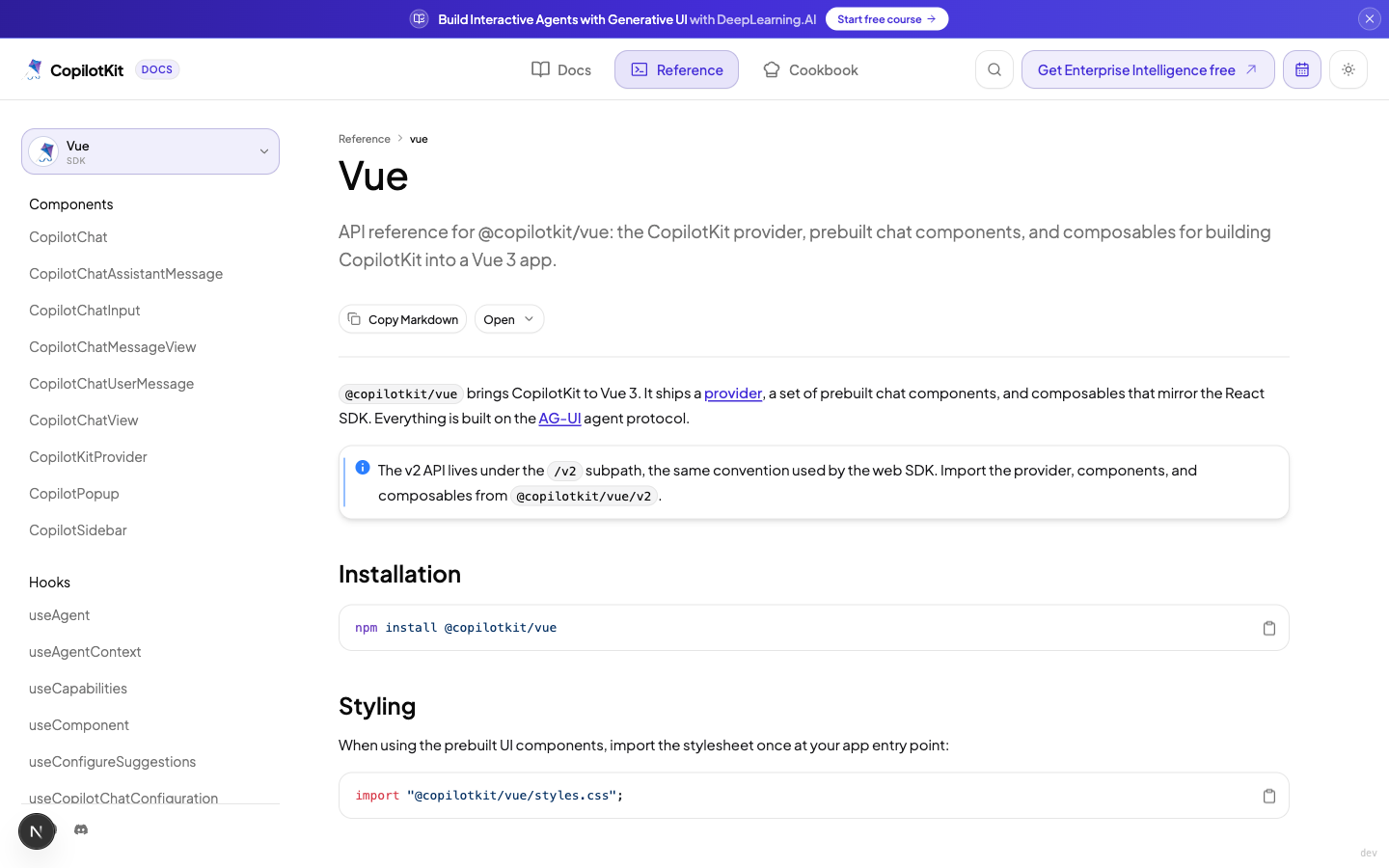
Adds a **Vue** section to the reference docs at `/reference/vue`,
alongside the existing React, React Native, and Core references. Until
now there was no Vue reference, so users and agents had no way to
discover the API.
It mirrors the React v2 reference but documents the real
`@copilotkit/vue/v2` API, with Vue idioms throughout (composables return
refs, slots instead of render props, kebab-case props, Vue SFC
examples).
### What's included
- The Vue index page (install, styling, provider setup)
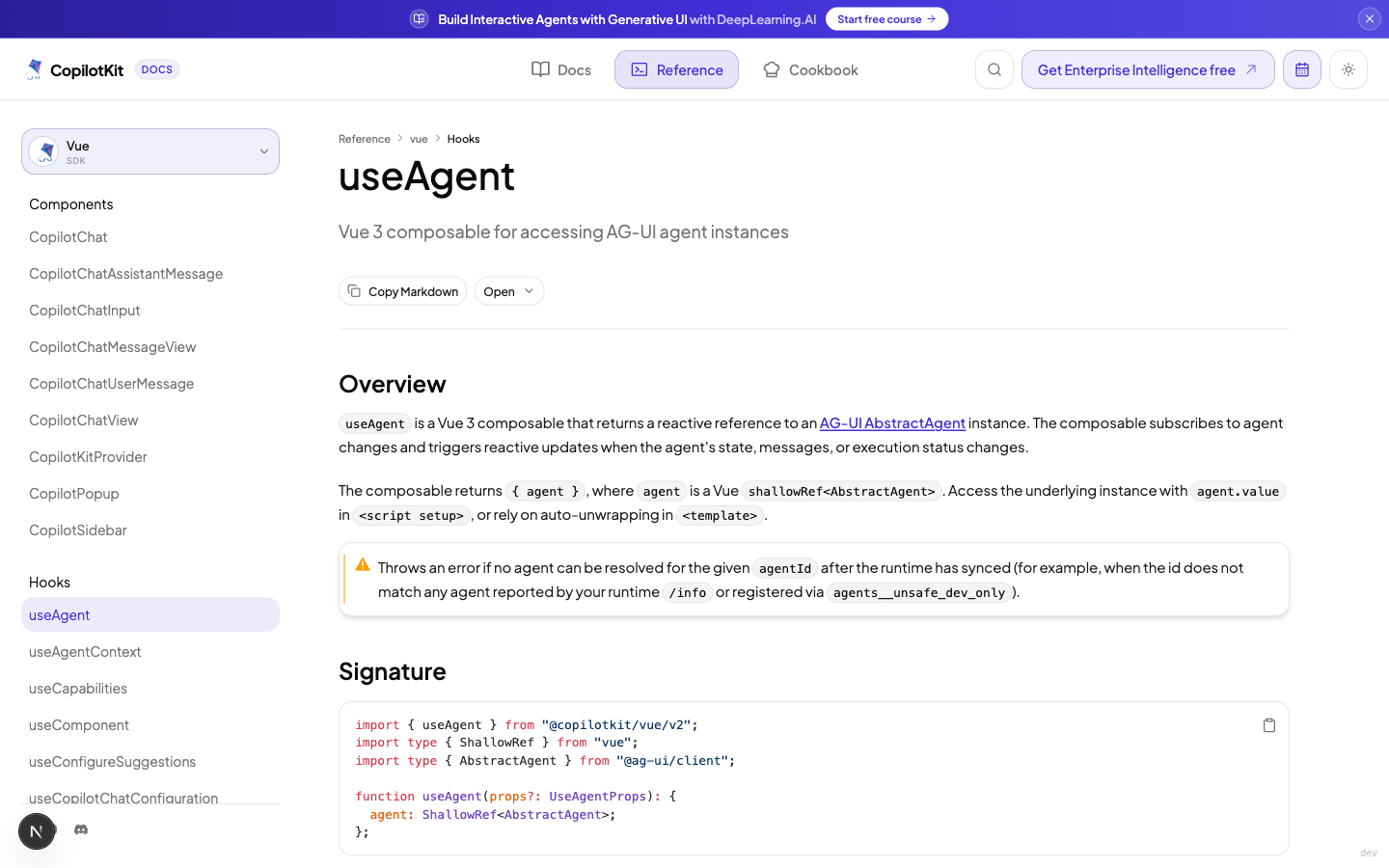
- 14 composables (useAgent, useFrontendTool, useHumanInTheLoop,
useThreads, and the rest)
- 9 components (CopilotKitProvider, CopilotChat, CopilotPopup,
CopilotSidebar, and the chat sub-components)
- Vue registered in the SDK picker and the reference landing page
### Screenshots
Landing page (SDK picker set to Vue, full sidebar):
A composable page (useAgent):
A component page (CopilotKitProvider):
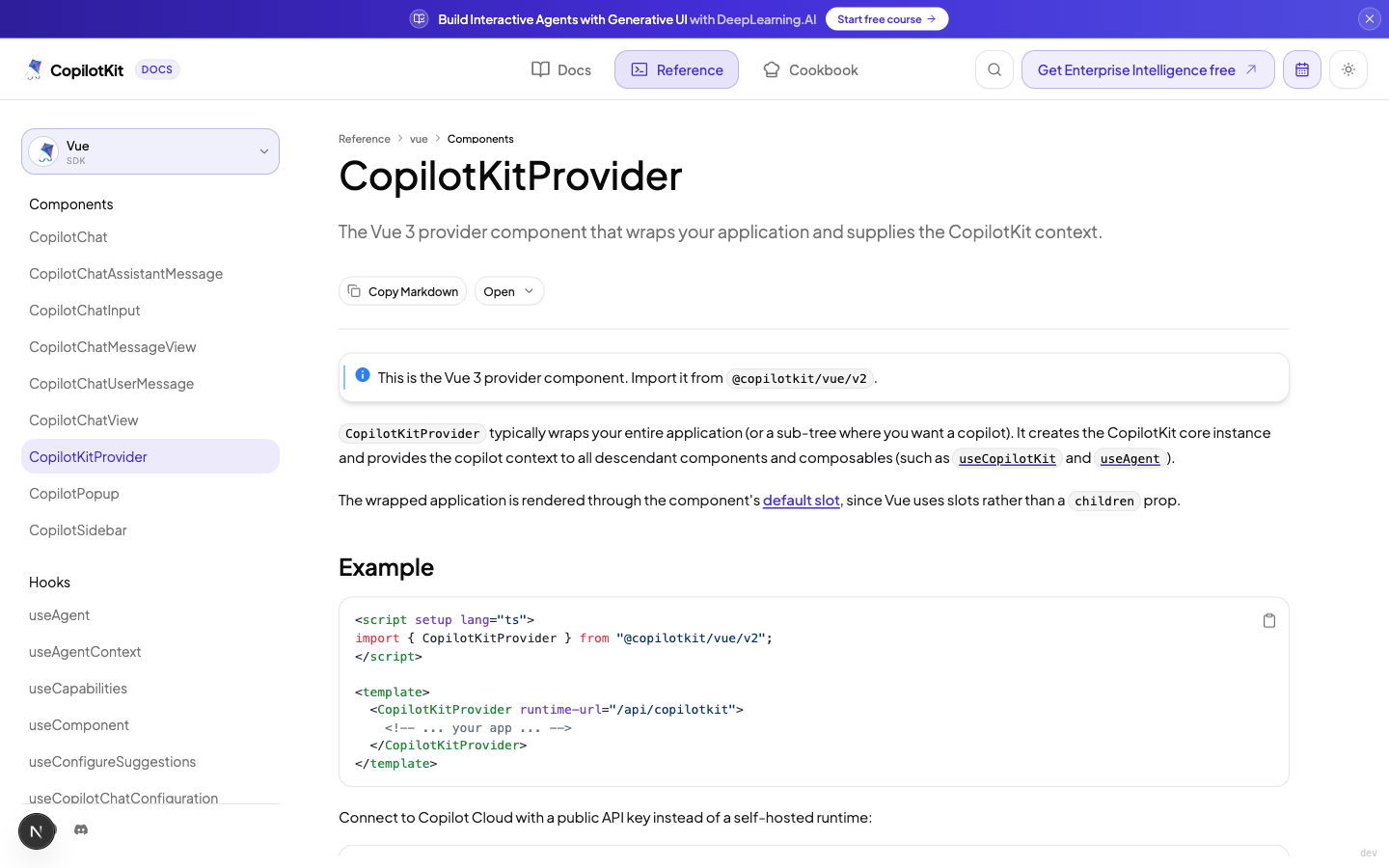
### How it was verified
- All 24 pages render (HTTP 200) on the local docs server
- Content shows up in `llms.txt` and `llms-full.txt`
- Each page was written from the Vue source, not copied from React, and
spot-checked for accuracy
Guide content and new demos are out of scope.
## Summary
- fix Showcase docs snippets that import `randomUUID` from non-existent
`@copilotkit/shared/v2`
- use the published `@copilotkit/shared` entrypoint instead
- move the fix to the publishing Showcase docs source under
`showcase/shell-docs`

## Linear
- FAC-65

## Verification
- `rg -n "@copilotkit/shared/v2" showcase/shell-docs/src/content`
returns no matches
- `pnpm validate:model-names`
- `npm ci --ignore-scripts` in `showcase/shell-docs`
- `npm run build` in `showcase/shell-docs`
- `git diff --check`
- pre-commit passed after refreshing root dependencies with `pnpm
install`
Fumadocs' default callout palette (generic blue/amber/green) renders the
docs <Callout> accent and left bar off-brand against the purple-anchored
theme — and on the main docs route the info/success tokens weren't emitted
at all, falling back to the near-white muted color.

Define --color-fd-info/warning/success as plain :root custom properties
(not @theme tokens, which Tailwind v4 tree-shakes when no utility class
references them — the Callout reads them only via inline var()). Map info
-> brand accent (purple), warning -> the existing docs --warning orange,
success -> brand mint (new --success token, mint/800 light, mint/400 dark).
All theme-aware; error stays mapped to --destructive via shadcn.css.
## Summary
Fixes#5417. The v1 `<CopilotKit>` wrapper's `validateProps` threw
`ConfigurationError: Missing required prop: 'runtimeUrl' or
'publicApiKey' or 'publicLicenseKey'` whenever neither `runtimeUrl` nor
a public key was supplied — without considering self-managed agents.
This rejected the documented self-managed-agent setup, even though the
underlying v2 `CopilotKitProvider` accepts it via its `hasLocalAgents`
gate.
- **Fix:** `validateProps` now mirrors the provider's `hasLocalAgents`
check, so `selfManagedAgents` and `agents__unsafe_dev_only` satisfy the
requirement without a `runtimeUrl` or Cloud key.
- **Test:** new rendering test pins the behavior — still throws when
nothing is configured, no longer throws when local agents are supplied.
- **Docs:** the showcase error-reference "v1 behaves differently"
callout claimed the wrapper throws unconditionally and rejects
`selfManagedAgents` (both now false); corrected, and dropped the "(v2
only)" label on the self-managed example.
## Test plan
- [x] `nx test react-core` — 1284 passing, 0 failing
- [x] New test fails before the fix (red) and passes after (green)
- [x] No new type errors introduced (pre-existing `tsc` noise unchanged
vs `main`)
 Mike Ryan







