## Summary
Un-fences the `ms-agent-harness-dotnet` showcase column from per-cell
probe enumeration. The exclude was a placeholder added 2026-06-07
(commit f0edcd5d) before the column existed; the column shipped (PR
#5569) and its d6/d4 aimock fixtures landed today (e10df0b4), so the
fence is stale. Removed the slug from all 8 SSOT exclude sites
(catalog-enumerator.ts nameExcludes, 5 probe YAMLs, aimock-wiring.ts,
baseline-types.ts) + updated 3 stale comments/tests.

## Red-green proof (local, real control-plane surface)
- **RED** (origin/main): `enumerated services: [langgraph-python,
ms-agent-dotnet]` — slug present-in-nameExcludes:true → **0 d6 cells**.
- **GREEN (enumeration)**: after the edits, `enumerated services: [...,
ms-agent-harness-dotnet]` → slug enumerates (via the real
`railwayServicesSource.enumerate` + real `D6_DISCOVERY_FILTER`).
- **GREEN (value-test)**: live local control-plane D6 stack (aimock
fixtures) → **35 passed, 1 failed, 3 skipped, 3 incapable**.
- The single fail (`gen-ui-declarative` / sales-dashboard pie+bar charts
not rendering) is **at parity with the gold-standard sibling**:
PocketBase `d6:ms-agent-dotnet/gen-ui-declarative` is RED with the
byte-identical error (fail_count 92, since 2026-06-15) and is the
sibling's sole tolerated `1✗`. Shared sales-dashboard chart gap in the
ms-agent-dotnet family — not a regression from the AsHarnessAgent port.
Harness lands 35✓/1✗, matching the sibling.

## Test plan
- [ ] CI green
- [ ] After deploy, staging dashboard shows ms-agent-harness-dotnet
cells populating (BE✓, D6 filling) on the next probe tick
The ms-agent-harness-dotnet slug was excluded from per-cell D6/BE/smoke
probe enumeration by a placeholder fence added 2026-06-07, before the
real column existed. The column shipped in PR #5569 and its d6/d4 aimock
fixtures landed on main today (e10df0b4), so the fence is now stale.
Remove the slug from all 8 exclude SSOT sites so the column populates.
## Summary

Fixes two correctness bugs in the showcase staging→prod promote path
(`showcase/bin/railway`), discovered + live-validated while promoting
the full 19-service cluster.

**Bug #1 — promote pinned the wrong digest.** `resolved_prod_image`
re-resolved the mutable `:latest` tag against *current* GHCR instead of
pinning the digest staging is actually *running*
(`latestDeployment.meta.imageDigest`). When `:latest` drifted after
staging deployed, promote pushed an unvalidated (and once, regressed)
image to prod. Now pins staging's running digest. Adds a loud `⚠️
STAGING DRIFT` warning (promote stdout + `STAGING_DRIFT_MARKER:` →
`promote-fleet.sh` aggregation → both Slack payloads) when staging's
running digest ≠ current `:latest`, so the gap is visible without
blocking the promote.

**Bug #2 — the pin never activated.** `pin_and_verify` used
`serviceInstanceRedeploy`, which replays the *existing* deployment's old
image rather than the just-pinned `source.image`. Config showed the new
digest while prod kept serving the old one (this is why earlier promotes
"succeeded" while prod stayed broken). Switched to
`serviceInstanceDeployV2` + a new `verify_serving_digest!` gate that
polls the new deployment to SUCCESS and **fails loud** if the running
digest ≠ pinned.

Plus CR-round hardening: P2 in-flight race check now reads
`meta.imageDigest` (was dead on tag-form staging) and skips on
`--digest` override; `detect_staging_drift` fails loud (WARN) on
GHCR-resolve failure instead of swallowing; `--digest` override
suppresses spurious drift; `drift_line` LF-stripped at the
`GITHUB_OUTPUT` boundary; multi-service drift join fixed; fallback-log
drift preserved.

## Commits
1. `fix(showcase): pin prod to staging's running digest + loud
staging-drift warning`
2. `fix(showcase): activate prod pin via serviceInstanceDeployV2 +
verify running==pinned`
3. `fix(showcase): harden promote P2 race check + refresh ivar-lint
allowlist`

## Validation
- Live red-green on real Railway: claude-sdk-python prod flipped from
stale → pinned digest via the fixed CLI; all 19 cluster services
promoted green; 5 previously-degraded backends (ag2, llamaindex,
pydantic-ai, ms-agent-python, strands) recovered.
- 15/15 Ruby specs + 15/15 bats green; ruby -c, shellcheck (CI
invocation), actionlint clean.
- 3-round cr-loop (7 agents/round) converged to zero bucket-(a).

## Follow-ups (not in this PR)
- Defensive `.to_s.empty?` on `meta.imageDigest` extraction
(can't-happen on real Railway).
- Test-quality nits (capture_io scoping, weak bats glob, shared mock
fixture).
- Pre-existing verify-prod `succeeded_csv`/`GITHUB_OUTPUT` coupling
(graceful-degraded, audited STAY_IN_C).
- `deploy-to-railway.ts` births prod on `:latest` (the root provisioning
gap); CLI↔workflow notify equivalence (PR2).

## Test plan
- [ ] CI green on PR HEAD
- [ ] (post-merge) a real `gh workflow run showcase_promote.yml` shows
the drift line in the #team-showcase notification when staging is behind
:latest
## What

Brings `@copilotkit/bot-slack` up to the **current** Slack native
streaming API surface (`chat.startStream` / `appendStream` /
`stopStream`, GA Oct 2025; structured chunks + AI feedback elements) and
removes the type-erasure workarounds. Result of an audit
cross-referencing the live `@slack/web-api@7.16.0` /
`@slack/types@2.21.1` types and Vercel's `vercel/chat` Slack adapter.

## Changes

- **No more `as unknown as Parameters<…>` casts** — every
streaming/post/update call uses the SDK's typed args.
- **One streamed message per turn** — dropped the per-message
continuation splitting (Slack documents only a 12k-per-append limit, no
cumulative cap; matches `vercel/chat`), keeping ≤12k per-append
chunking.
- **Native `task_update` tool-progress chunks** (`task_display_mode:
"timeline"`) interleaved into the streamed reply, replacing the separate
`🔧` status messages — with automatic degradation back to
`🔧` rows where structured chunks aren't supported.
- **Opt-in AI feedback buttons** via `slack({ feedback })` — a typed
`context_actions` + `feedback_buttons` row attached at `stopStream`;
clicks are routed adapter-locally (bypassing the engine's interaction
dispatch). No handler ⇒ no buttons.
- **Recipient scoping** — `recipient_user_id` / `recipient_team_id` only
for channel targets.
- **Cadence** — native flush floor lowered to ~600ms (appendStream
Tier-4); legacy `chat.update` stays 800ms.

### Engine (`@copilotkit/bot`)
One small, backward-compatible addition: optional
`RunRenderer.finish?()`, called after `runAgentLoop` resolves, so a
turn-scoped renderer can finalize its single stream. No-op for existing
adapters.

## Verification

- `bot-slack`: type-check (both tsconfigs) clean, **208 tests pass**,
oxfmt + oxlint clean.
- `bot`: type-check clean, **33 tests pass** (incl. a new `finish()`
test).
- Reviewed for correctness (stream lifecycle, finish/interrupt
interaction, delta tracking, degradation) — no high-confidence bugs;
feedback-on-interrupt and missing-ref-logging were tightened.

### Not verifiable without a live workspace (flagged in-code)
- That a >12k reply truly streams into one message (the
no-cumulative-cap assumption).
- `startStream` with no initial content.
## Summary

Two follow-up fixes that complete the pinned-prod / floating-staging
contract for the showcase fleet (the contract enforced by the promote
CLI in #5566). Prod services must be digest-pinned (`@sha256`), staging
floats `:latest`.

**Fix 1 — `showcase/scripts/deploy-to-railway.ts`: provision prod
digest-pinned, not `:latest`.**
Prod services were being *born* on the mutable `:latest` tag, then later
pinned only at promote time. Now they are born pinned to a resolved
`@sha256` digest at create time, via a new TS GHCR resolver that mirrors
the Ruby promote CLI (`/token` exchange → manifest HEAD →
`Docker-Content-Digest`). Resolution failure is **fail-loud**
(`process.exit(1)`, never a `:latest` fallback). `goLive` asserts the
prod `source.image` is digest-pinned (`assertProdDigestPinned`,
refactored to be dependency-injectable and to throw a typed
`ProdPinError` instead of exiting inline).

**Fix 2 — `showcase/harness/.../image-drift.ts`: stop flagging pinned
prod red.**
Under the pinned-prod contract, prod is intentionally digest-pinned
behind `:latest`, so the image-drift probe was firing false-red on every
prod service. It now renders such prod services **green**
(`pinnedExpected`) while a genuinely missing digest stays **red**.
Staging behaviour is unchanged.

## Verification

- **Red-green proven locally** for both new test surfaces:
- `assertProdDigestPinned` guard: RED = 5 tests `assertProdDigestPinned
is not a function` (untestable inline-exit) → GREEN = 13 passed after DI
refactor; env-mismatch branch: RED = `promise resolved undefined instead
of rejecting` → GREEN after wiring the test's env control.
- Suites: `deploy-to-railway.digest-pin.test.ts` **14 passed**;
`image-drift.test.ts` **26 passed**. Typecheck (scripts + harness) 0
errors; oxfmt + oxlint clean; harness build green.
- **Empirical 6b against live prod** (settled two reviewer
masking-concerns as can't-happen under current config):
- prod harness `SHOWCASE_ENV` is *unset* (not `""`) and
`RAILWAY_ENVIRONMENT_NAME="production"`, so `isProductionEnv()`'s `??`
correctly resolves true → the prod-neutral fix **fires** in prod.
- prod image-drift is discovery-only; all 19 prod `showcase-*` services
are digest-pinned and tag-less, so `expectedTag` resolves to `latest`
for every prod service → a fixed tag cannot reach prod image-drift (no
false-green).

## Review

3-round cr-loop (7 agents/round) converged to zero actionable findings.
One fix-introduced test-scaffolding defect (dead `envId` helper option)
was caught in the confirmation round and fixed. Remaining reviewer notes
are pre-existing issues in untouched goLive/probe code or
theoretical-but-can't-happen-under-live-config items, tracked as
follow-ups (not in scope for this PR).

🤖 Generated with [Claude Code](https://claude.com/claude-code)
## Summary
- remove the retired top-level `docs/` Next app and the disabled
docs-sync workflow/script
- add `docs -> showcase/shell-docs` as a top-level symlink for `cd docs`
muscle memory without restoring the old docs tree
- move the docs model allowlist into `showcase/shell-docs/` and retarget
docs validation/doctest extraction to shell-docs content
- update docs/agent guidance and CI path filters so `docs/` is treated
as an alias, not an active separate docs surface
- tighten the pre-commit package check so non-package docs/tooling
changes do not fan out into the full package matrix

## Validation
- `pnpm exec tsx scripts/validate-doc-model-names.ts`
- `pnpm exec tsx scripts/doc-tests/extract.ts`
- `pnpm exec vitest run
scripts/__tests__/validate-doc-model-names.test.ts
scripts/doc-tests/__tests__/extract.test.ts
showcase/harness/src/cli/eval/scope.test.ts`
- `pnpm exec oxlint showcase/harness/src/cli/eval/scope.test.ts
scripts/doc-tests/extract.ts`
- `git diff --cached --check` before follow-up commit
- `test "$(readlink docs)" = "showcase/shell-docs"`
- `test -f docs/package.json`
- `pnpm exec oxfmt --check .claude/docs/documentation.md
.claude/docs/hooks.md AGENTS.md CLAUDE.md CONTRIBUTING.md
showcase/shell-docs/README.md`
- commit hooks passed

## Notes
- historical docs remain recoverable from
`archive/docs-save-do-not-prune` and `archive/docs-retired-2026-06-17`
- I intentionally left Vercel/project teardown out of this PR; this is
repo cleanup only
## What

Updates the v2 `useRenderToolCall` reference page and makes opting a
tool out of the default rendering a single, schema-free call.

## Why

The reference page had drifted out of sync with the hook implementation
(`packages/react-core/src/v2/hooks/use-render-tool-call.tsx`) — most
notably `toolCallId` in the render props, added after the doc was last
touched. While documenting how to opt out of rendering, the natural
example (`useRenderTool({ name: "...", render: () => <></> })`) only
type-checked for the wildcard `"*"`; a named tool required a
`parameters` schema, forcing a throwaway `z.any()`. This PR re-aligns
the doc and removes that rough edge.

## Changes

### Docs (`showcase/shell-docs`)
- `useRenderToolCall.mdx`:
- Document `toolCallId` in the render-prop shape (previously
undocumented).
- Describe agentId-scoped lookup priority: agent-specific → unscoped →
wildcard `"*"` → built-in `DefaultToolCallRenderer`.
- Note args are parsed with `partialJSONParse` (streaming), not strict
`JSON.parse`.
- Correct `toolCall` prop to `toolCall.function.name` /
`toolCall.function.arguments`.
- Rewrite the Status Resolution table to match real logic (`toolMessage`
presence + provider executing set).
- New **"Disable default tool rendering"** section, ordered least→most
specific: wildcard first (all tools), then a **"For specific tools"**
subsection. Both use a schema-free `useRenderTool` call; dropped the old
`useFrontendTool` handler/schema boilerplate.
- `useRenderTool.mdx`: document the render-only (no-schema) named
overload.

### react-core
- Make `parameters` optional on the named `useRenderTool` overload,
mirroring the existing wildcard path; `defineToolCallRenderer` defaults
the args schema to `z.any()` when none is given.
- This lets `useRenderTool({ name: "myTool", render: () => <></> }, [])`
type-check with no Zod schema. Typed `parameters` behavior is unchanged.
- Added a test for the named render-only registration.

## Verification

- `@copilotkit/react-core` tests pass (1280) including the new case;
`build` (tsc) passes.
- Opt-out snippets type-checked in-package (`tsc`): wildcard,
specific-name (no schema), and named-with-schema all compile.
- `oxlint` (shell-docs) passes — 0 errors.
- Previewed locally at `/reference/hooks/useRenderToolCall`.
Resolve event-renderer.ts onRunFinishedEvent: keep the native turn stream open
(finalized in finish()) AND retain the legacy per-message stream drain from main
(#5573) as a no-op-in-native safety net. app/index.ts (telegram adapter from
#5520 + showToolStatus:false) and create-bot.test.ts auto-merged.
Under the pinned-prod contract, prod is intentionally digest-pinned behind
:latest. image-drift now renders such prod services green (pinnedExpected)
instead of red; a genuinely missing digest stays red. Staging unchanged.
Prod services are now born pinned to a resolved @sha256 digest (mirroring
the Ruby promote CLI's GHCR resolver) instead of the mutable :latest tag,
fail-loud on resolve failure, and goLive asserts the prod source.image is
digest-pinned. Adds DI-testable assertProdDigestPinned + coverage.
CR-round hardening that builds on the bug #1/#2 fixes: the P2 in-flight race
guard now reads the running digest from meta.imageDigest (the dead guard
never REFUSEd before) and is skipped on the --digest override path. Refresh
the snapshot ivar-lint allowlist line numbers after the surrounding CR line
drift.
Bug #2: promote used serviceInstanceRedeploy, which replays the EXISTING
deployment and never pulls the newly-pinned digest, so prod could keep
serving stale. Switch to serviceInstanceDeployV2 to spawn a NEW deployment
that pulls the pinned digest, then verify_serving_digest! fail-loud asserts
the new deployment reaches SUCCESS and its meta.imageDigest == the pinned
digest. Update the promote mock-GraphQL fixtures across the spec suite to
return serviceInstanceDeployV2 + meta.imageDigest accordingly.
Bug #1: resolved_prod_image re-resolved :latest at promote time, so prod
could be pinned to a digest different from what staging is actually serving.
Now resolve via staging_running_digest (latestDeployment meta.imageDigest)
and REFUSE when unavailable. Add detect_staging_drift +
emit_staging_drift_warnings to surface (non-fatally) when :latest has moved
past staging's running digest; aggregate markers across the fleet in
promote-fleet.sh (printf join) and plumb the drift_line through
showcase_promote.yml (both Slack payloads + fallback log + GITHUB_OUTPUT
single-line guard). Skip drift detection on the --digest override path.
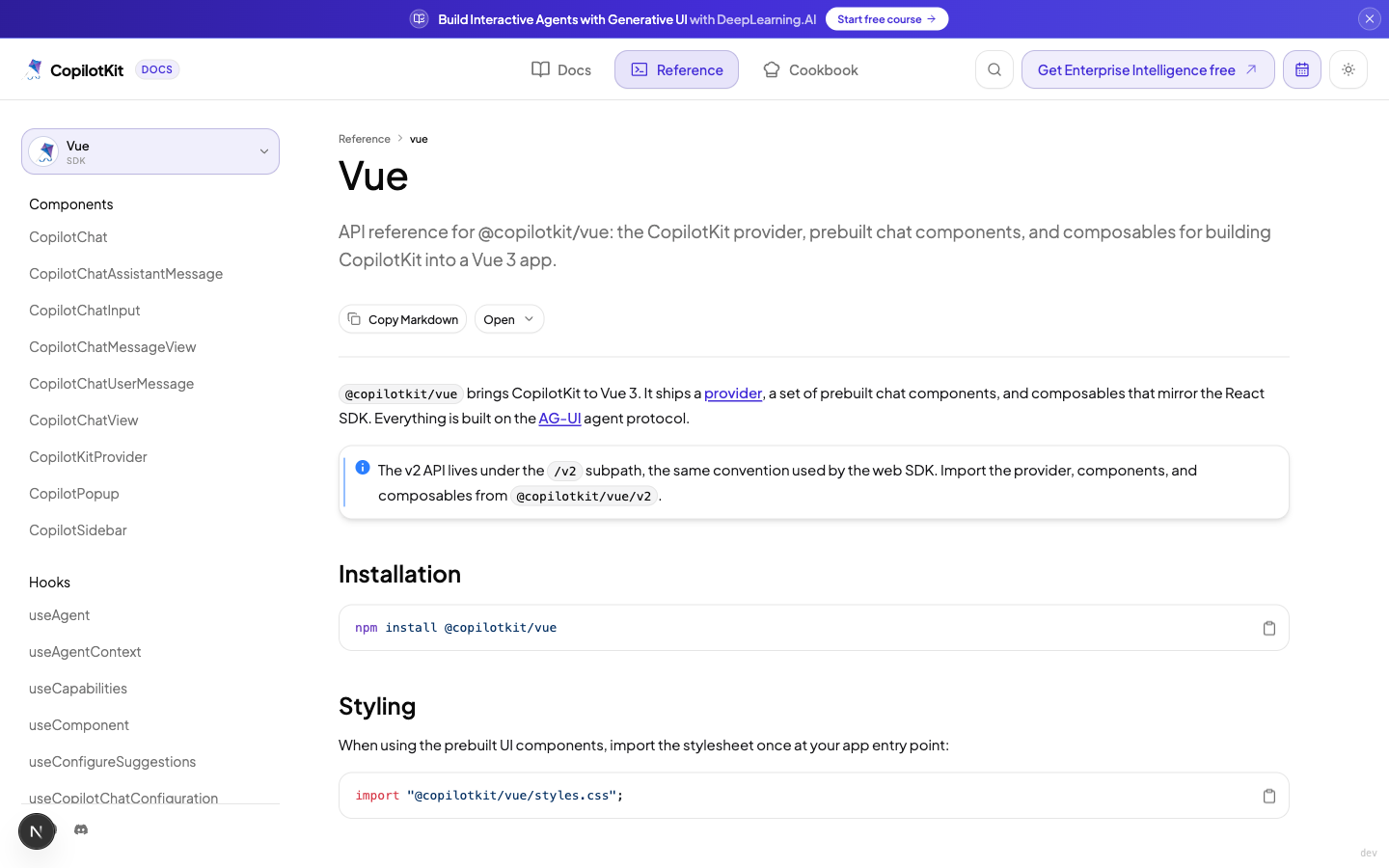
Adds a **Vue** section to the reference docs at `/reference/vue`,
alongside the existing React, React Native, and Core references. Until
now there was no Vue reference, so users and agents had no way to
discover the API.
It mirrors the React v2 reference but documents the real
`@copilotkit/vue/v2` API, with Vue idioms throughout (composables return
refs, slots instead of render props, kebab-case props, Vue SFC
examples).
### What's included
- The Vue index page (install, styling, provider setup)
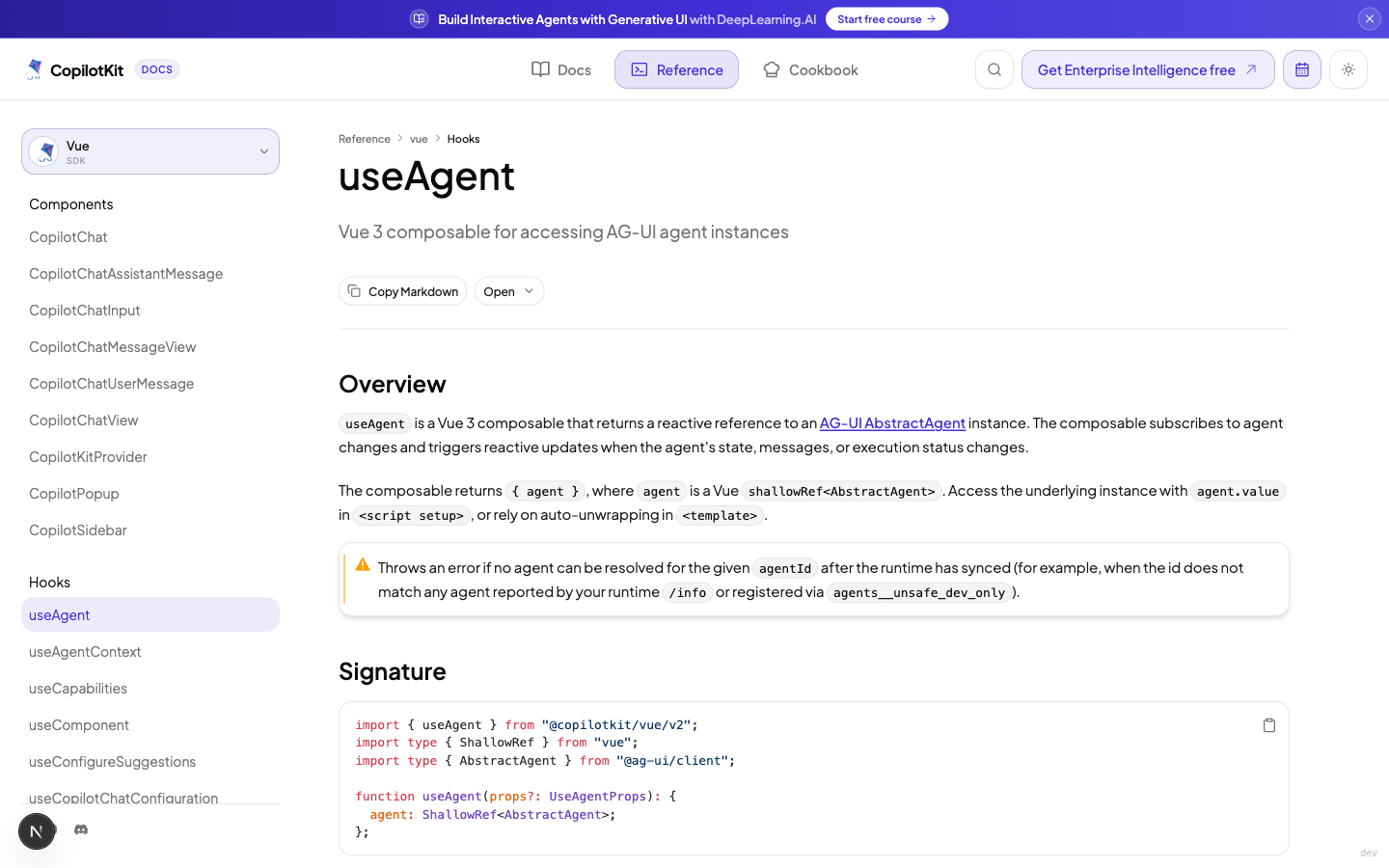
- 14 composables (useAgent, useFrontendTool, useHumanInTheLoop,
useThreads, and the rest)
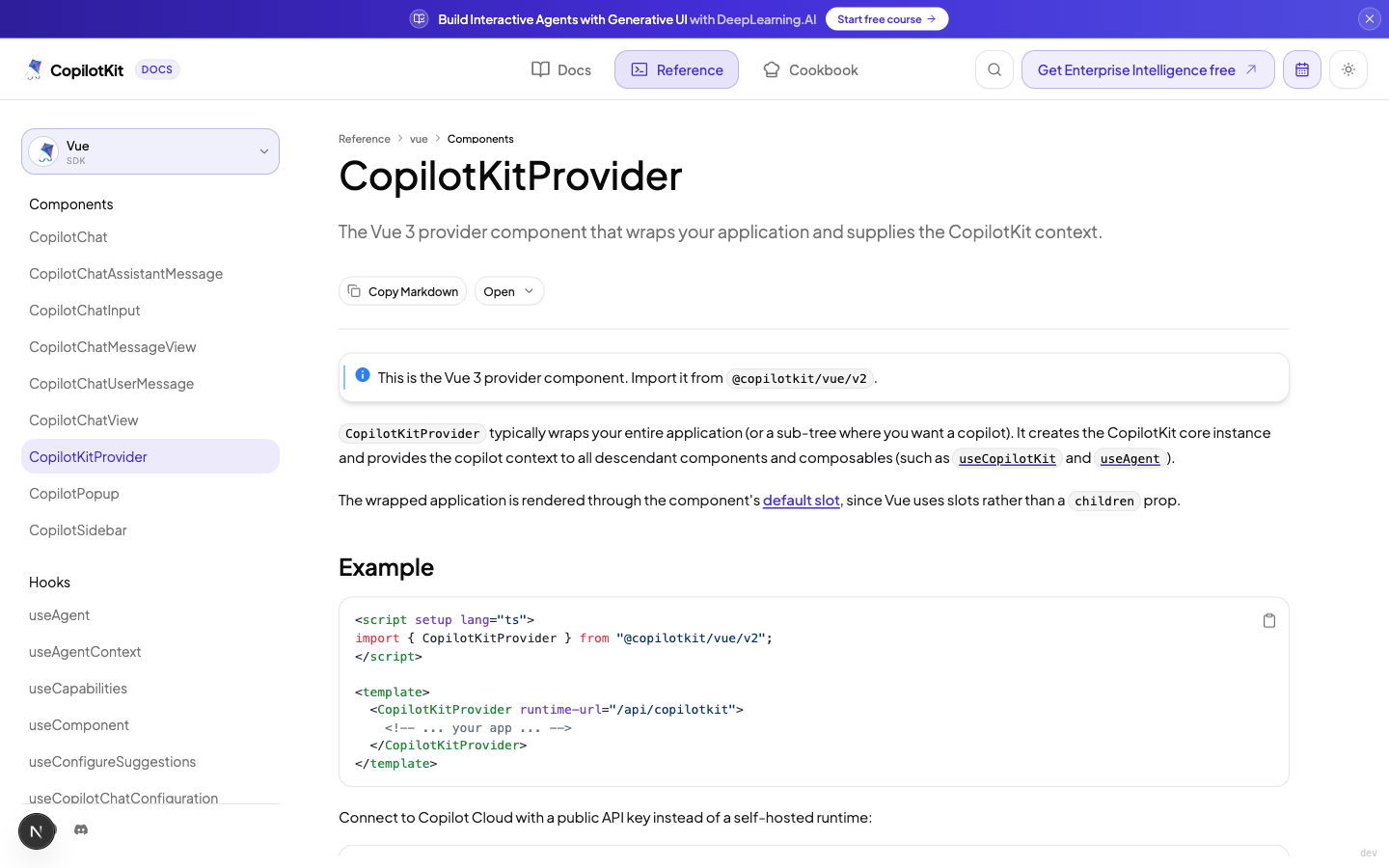
- 9 components (CopilotKitProvider, CopilotChat, CopilotPopup,
CopilotSidebar, and the chat sub-components)
- Vue registered in the SDK picker and the reference landing page
### Screenshots
Landing page (SDK picker set to Vue, full sidebar):
A composable page (useAgent):
A component page (CopilotKitProvider):
### How it was verified
- All 24 pages render (HTTP 200) on the local docs server
- Content shows up in `llms.txt` and `llms-full.txt`
- Each page was written from the Vue source, not copied from React, and
spot-checked for accuracy
Guide content and new demos are out of scope.
## Summary
- fix Showcase docs snippets that import `randomUUID` from non-existent
`@copilotkit/shared/v2`
- use the published `@copilotkit/shared` entrypoint instead
- move the fix to the publishing Showcase docs source under
`showcase/shell-docs`

## Linear
- FAC-65

## Verification
- `rg -n "@copilotkit/shared/v2" showcase/shell-docs/src/content`
returns no matches
- `pnpm validate:model-names`
- `npm ci --ignore-scripts` in `showcase/shell-docs`
- `npm run build` in `showcase/shell-docs`
- `git diff --check`
- pre-commit passed after refreshing root dependencies with `pnpm
install`
Fumadocs' default callout palette (generic blue/amber/green) renders the
docs <Callout> accent and left bar off-brand against the purple-anchored
theme — and on the main docs route the info/success tokens weren't emitted
at all, falling back to the near-white muted color.

Define --color-fd-info/warning/success as plain :root custom properties
(not @theme tokens, which Tailwind v4 tree-shakes when no utility class
references them — the Callout reads them only via inline var()). Map info
-> brand accent (purple), warning -> the existing docs --warning orange,
success -> brand mint (new --success token, mint/800 light, mint/400 dark).
All theme-aware; error stays mapped to --destructive via shadcn.css.
## Summary
Fixes#5417. The v1 `<CopilotKit>` wrapper's `validateProps` threw
`ConfigurationError: Missing required prop: 'runtimeUrl' or
'publicApiKey' or 'publicLicenseKey'` whenever neither `runtimeUrl` nor
a public key was supplied — without considering self-managed agents.
This rejected the documented self-managed-agent setup, even though the
underlying v2 `CopilotKitProvider` accepts it via its `hasLocalAgents`
gate.
- **Fix:** `validateProps` now mirrors the provider's `hasLocalAgents`
check, so `selfManagedAgents` and `agents__unsafe_dev_only` satisfy the
requirement without a `runtimeUrl` or Cloud key.
- **Test:** new rendering test pins the behavior — still throws when
nothing is configured, no longer throws when local agents are supplied.
- **Docs:** the showcase error-reference "v1 behaves differently"
callout claimed the wrapper throws unconditionally and rejects
`selfManagedAgents` (both now false); corrected, and dropped the "(v2
only)" label on the self-managed example.
## Test plan
- [x] `nx test react-core` — 1284 passing, 0 failing
- [x] New test fails before the fix (red) and passes after (green)
- [x] No new type errors introduced (pre-existing `tsc` noise unchanged
vs `main`)
The callout claimed the v1 <CopilotKit> wrapper has no dev-only
console.warn branch, but it composes CopilotKitV2Provider, which does
warn in development before the v1 validateProps throw. Drop the
misleading clause and contrast the throw-in-dev behavior instead.

Refs #5417
Adds the @copilotkit/vue v2 API reference to shell-docs: 9 component pages
(CopilotKitProvider, CopilotChat, CopilotChatView, CopilotChatInput,
CopilotChatMessageView, CopilotChatAssistantMessage, CopilotChatUserMessage,
CopilotPopup, CopilotSidebar) and 14 composable pages (useAgent, useAgentContext,
useCapabilities, useComponent, useConfigureSuggestions, useCopilotChatConfiguration,
useCopilotKit, useDefaultRenderTool, useFrontendTool, useHumanInTheLoop,
useInterrupt, useRenderTool, useSuggestions, useThreads), an index page, and
wiring into the reference version selector. Every documented API was verified
against packages/vue/src/v2.
The self-managed example sits under the "Fix (v2)" heading and uses
<CopilotKitProvider>, so the prior "works on both ... wrapper and v2"
comment read as if the v2 component itself were v1. Attribute the
portability to the selfManagedAgents prop instead of the component.

Refs #5417
Note on the self-managed agents page that selfManagedAgents is part of
the Enterprise Intelligence offering, with a pointer to discuss
licensing for production use.

Refs #5417
The error-reference callout claimed the v1 <CopilotKit> wrapper throws
unconditionally and does not accept selfManagedAgents. Both are no
longer true now that the wrapper honors local agents; update the note
and drop the "(v2 only)" label on the self-managed example.

Refs #5417
 Jordan Ritter





